

Imagine a place where the very fabric of reality is stretched to the breaking point. A place so dark, so dense, and so hungry that even light, the fastest messenger in the cosmos, is trapped in its inescapable grip. For decades, we’ve called them “holes,” but that is a cosmic misnomer.
Black holes are not empty voids. They are the crushed, ghostly remains of the most magnificent titans to ever roam the heavens. To understand black hole formation, we must look back at the life of the stars that preceded them.
The Tug-of-War that Builds a Star
Every star you see in the night sky is a masterpiece of celestial architecture, held together by a delicate, invisible balance. Think of a star as a lifelong Tug-of-War between two monumental titans:
- Gravity: The relentless inward pull, trying to crush the star into a single point.
- Nuclear Fusion: The explosive outward pressure generated by atoms smashing together in the core.
As long as a star has fuel to burn, the outward pressure of fusion keeps gravity at bay. It is a stable, glowing equilibrium that can last for millions or billions of years. But for the true giants of our universe, stars many times the mass of our Sun, this balance is destined to fail.
The Iron Dead End: Running Out of Fuel
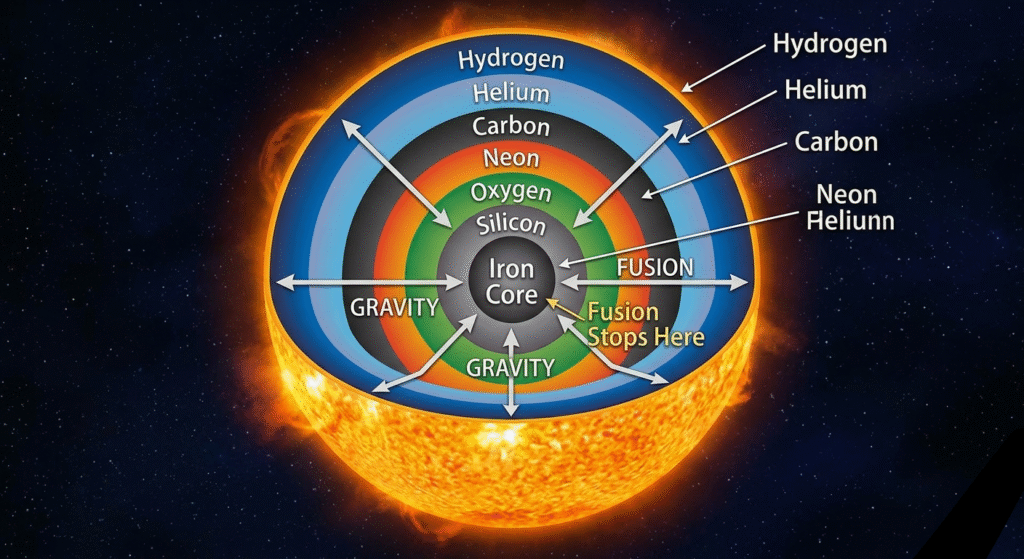
In the final chapters of stellar evolution, a massive star becomes a desperate alchemist. When it runs out of hydrogen, it begins to fuse heavier and heavier elements to stay alive. It burns through helium, then carbon, neon, and oxygen, creating layers like a cosmic onion.
However, the clock stops at Iron.
Unlike lighter elements, fusing iron doesn’t release energy; it consumes it. The moment iron appears in the core, the star’s engine stalls. The outward pressure that held gravity back for eons vanishes in an instant. The tug-of-war is over. Gravity has won.
The Great Collapse and the Supernova Birth
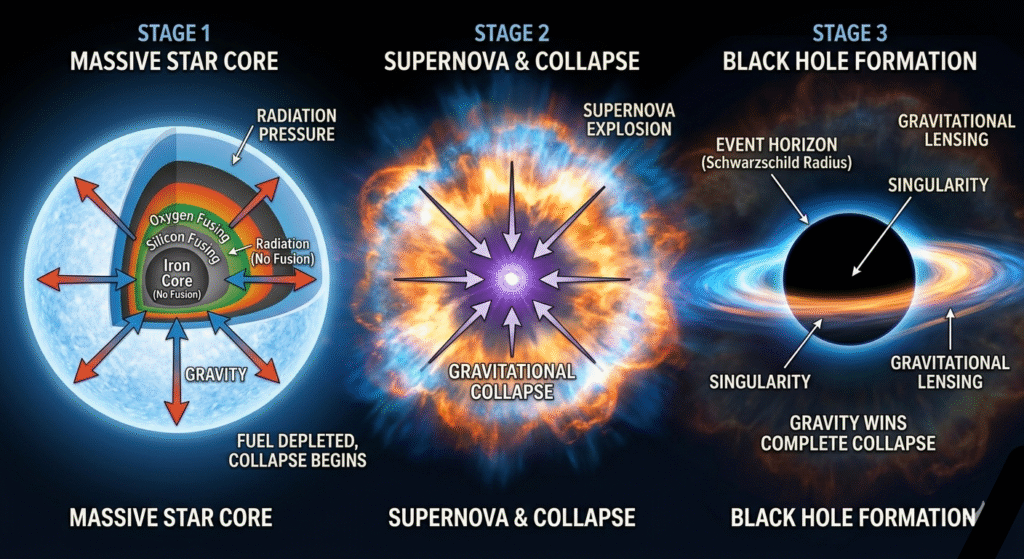
What happens next is the most violent event in the known universe. With no outward pressure to support it, the star’s core, an object the size of Earth, collapses to the size of a city in a fraction of a second.
This gravitational collapse sends a shockwave rippling outward, tearing the rest of the star apart in a supernova. For a few brief weeks, a single supernova can outshine an entire galaxy of hundreds of billions of stars. It is the death cry of a giant and the birth announcement of a monster.
The Core’s Destiny: Crossing the Event Horizon
Not every supernova creates a black hole. The outcome depends entirely on how much “stuff” is left behind in the core:
- The Middleweight: If the core is between 1.4 and about 3 times the mass of our Sun, it becomes a neutron star, a city-sized ball so dense a teaspoon of it would weigh a billion tons.
- The Heavyweight: If the core exceeds the Tolman-Oppenheimer-Volkoff limit (roughly 3 solar masses), nothing in the known laws of physics can stop the collapse.
Gravity crushes the core smaller and smaller until it passes its Schwarzschild Radius, the mathematical “point of no return.” At this moment, the event horizon forms. This is the spherical boundary around the black hole; once anything crosses it, the escape velocity required to leave exceeds the speed of light.
At the very center lies the singularity, a point of infinite density where our current understanding of space and time simply ceases to exist.
Conclusion: From Light to Mystery
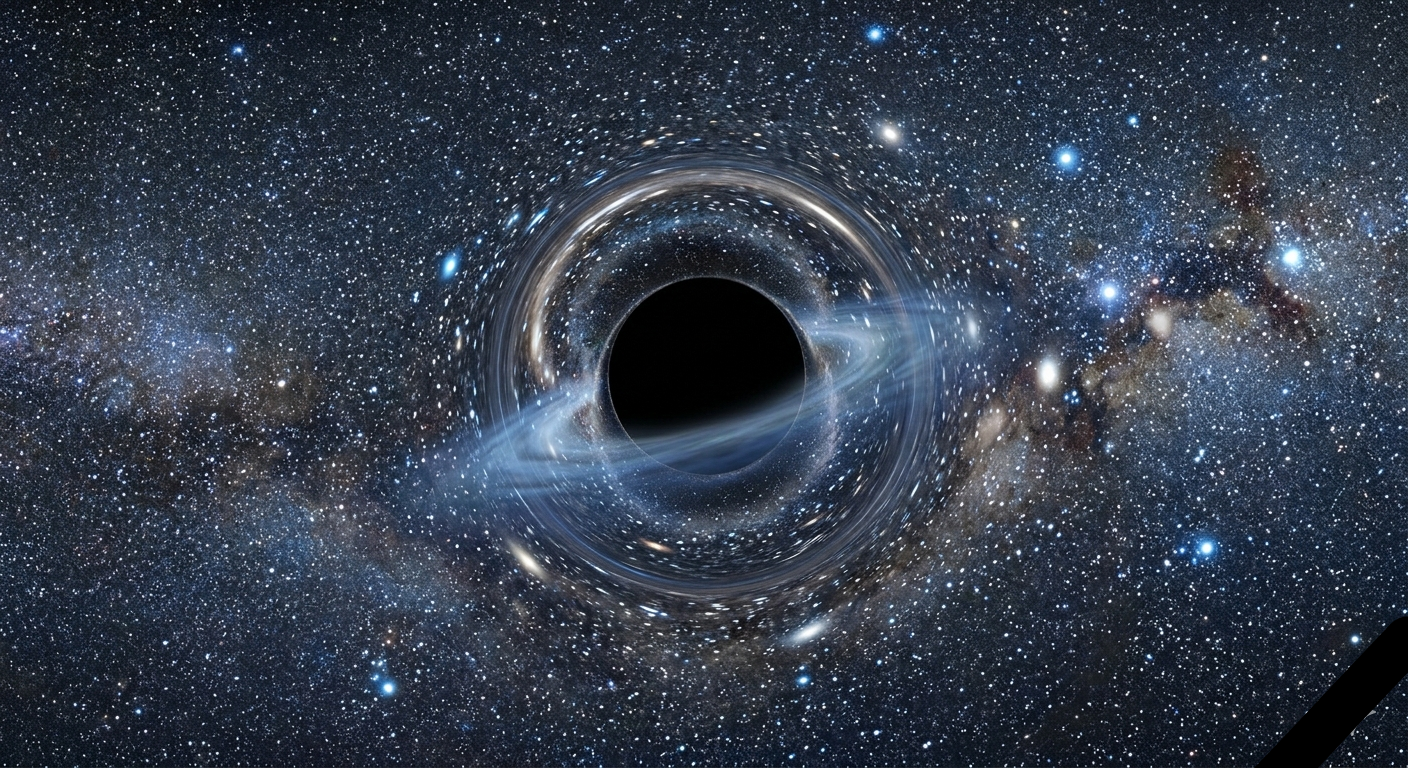
The journey of a black hole is a poetic cycle of transformation. It begins as a beacon of light and ends as a shadow that challenges everything we know about the universe. These cosmic monsters are not just graveyards of stars; they are the ultimate laboratories for the future of physics.
Read about what happens when black holes collide.
FAQ: Common Questions About Black Hole Formation
Can our Sun become a black hole?
No. Our Sun is too small. When it dies, it will shed its outer layers and leave behind a white dwarf. It lacks the mass required to trigger a supernova or a total gravitational collapse.
How long does it take for a black hole to form?
While the star lives for millions of years, the actual collapse of the core during a supernova happens in mere milliseconds, faster than the blink of an eye.
What is the “Event Horizon”?
It is the “surface” of the black hole. It isn’t a physical shell, but a mathematical boundary. Once you cross it, all paths lead inward toward the singularity.

One thought on “How Black Holes Are Actually Formed”