

When we think of a “thing,” we think of matter, atoms, molecules, a surface you can touch. We think of planets made of rock or stars made of plasma. But as a physicist, I have to let you in on a secret: a black hole is not a “thing” in any traditional sense.
The most common myth is that a black hole is a solid, ultra-dense ball floating in space. In reality, a black hole is a region of spacetime so severely warped that the very geometry of the universe has folded in on itself. It isn’t made of “stuff”; it is a localized collapse of reality.
Read about How Black Holes Are Actually Formed here.
The Anatomy of a Shadow: Breaking Down the Layers
To understand what black holes are made of, we have to look at their structure. Because they don’t have a physical surface, we define them by their boundaries.
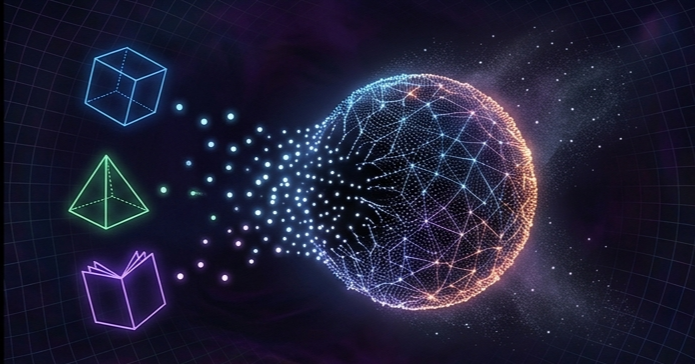
The Event Horizon: The Mathematical Brink
The “edge” of a black hole isn’t a crust or a shell. It is the Event Horizon, a mathematical boundary where the escape velocity exceeds the speed of light. If you crossed it, you wouldn’t feel a “bump.” You would simply find that every possible path through space-time now leads toward the center.
The Accretion Disk: The Only Visible Light
When you see the famous “donut” images from the Event Horizon Telescope, you aren’t seeing the black hole itself. You are seeing the Accretion Disk. This is a swirling maelstrom of gas and dust heated to billions of degrees by friction and gravity. It is the glowing “silhouette” that reveals the invisible giant.
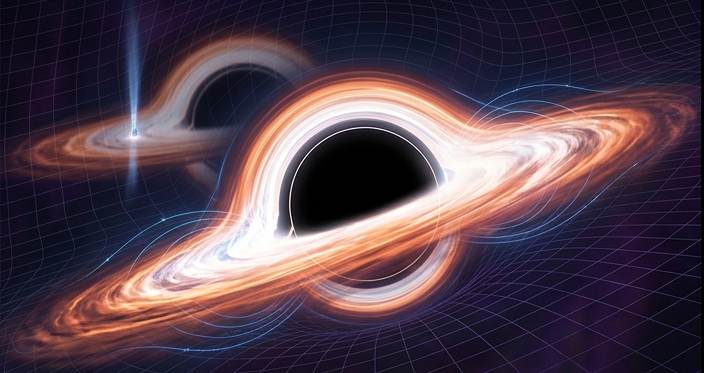
Read about the First Image of the Black Hole at the Heart of Our Galaxy here.
The Singularity: Where Physics Ends
At the very heart lies the Singularity. According to General Relativity, all the mass of the original star is crushed into a point of zero volume and infinite density. This is where our math fails. It is the ultimate “No Man’s Land” where General Relativity and Quantum Mechanics have a standoff that we have yet to resolve.
What Happens to the Matter?
If a massive star collapses, where does its “star-stuff” go? The short answer is: it vanishes from the reachable universe.
Imagine trying to cram an entire skyscraper into a single grain of sand, then cramming that grain of sand into nothing at all. To our human brains, infinite density in zero volume sounds like a mistake. In a sense, the matter doesn’t “go” anywhere, it becomes the source of the gravitational curvature itself. The star is gone; only its gravity remains, imprinted on the fabric of the cosmos.
Fast Facts
Do black holes have a color? No. They are the absence of light.
Can you touch a black hole? No. You would be “spaghettified” (stretched by tidal forces) long before you reached the center.
Are they vacuum cleaners? No. If our Sun were replaced by a black hole of the same mass, Earth would stay in the same orbit (it would just be very cold).
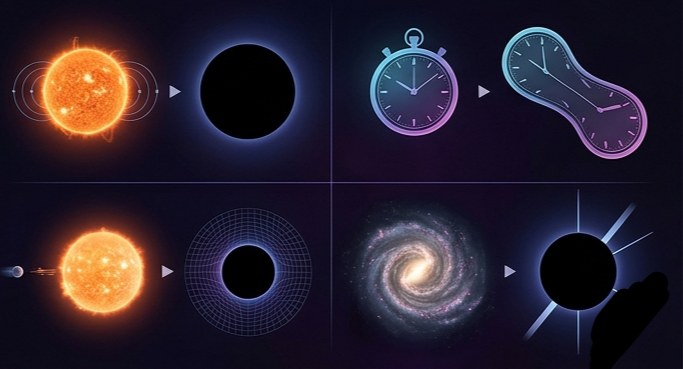
The “No-Hair Theorem”: Simplicity in Chaos
In the 1960s, physicists developed the No-Hair Theorem. It suggests that black holes are surprisingly simple. While a star is complex, made of specific elements, magnetic fields, and sunspots, once it becomes a black hole, it loses all those “hairs.”
An outside observer can only measure three things:
- Mass
- Electric Charge
- Angular Momentum (Spin)
Everything else, the fact that the star was made of hydrogen, or its original color, is erased from the observable universe.
The Mystery of the Interior: The Information Paradox
This leads us to a profound crisis in physics: the Information Paradox. If black holes erase the history of what fell into them, they violate a core rule of Quantum Mechanics, that information can never be destroyed.
The late Stephen Hawking proposed Hawking Radiation, suggesting black holes slowly “leak” energy and eventually evaporate. But if they evaporate, does the information they swallowed vanish too? Some theorists propose the Holographic Principle, suggesting that everything that falls in is actually encoded as 2D data on the surface of the Event Horizon, much like a hologram on a credit card.
Conclusion: A Captured Curvature
So, what are black holes made of? They are made of gravitationally curved space and captured energy. They are the places where the universe’s geometry becomes more “real” than the matter that created it. They are the ultimate laboratories of the extreme, challenging every definition of “existence” we possess.
