

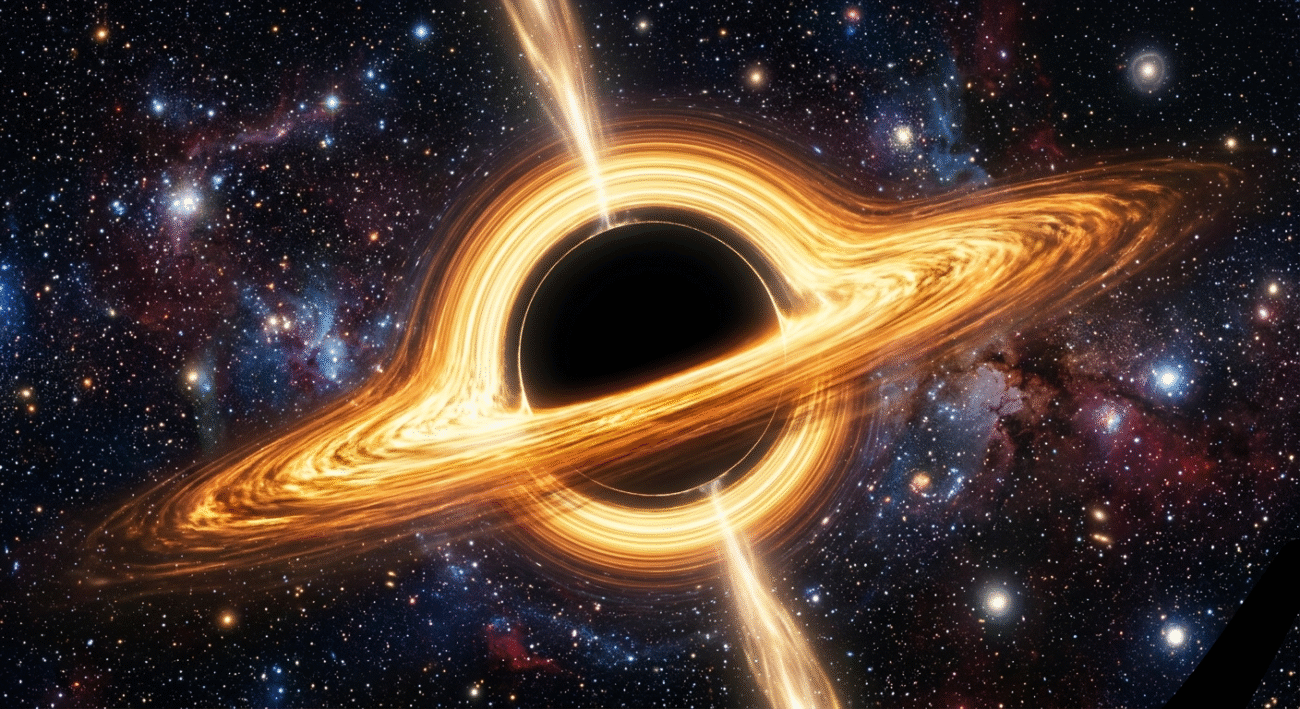
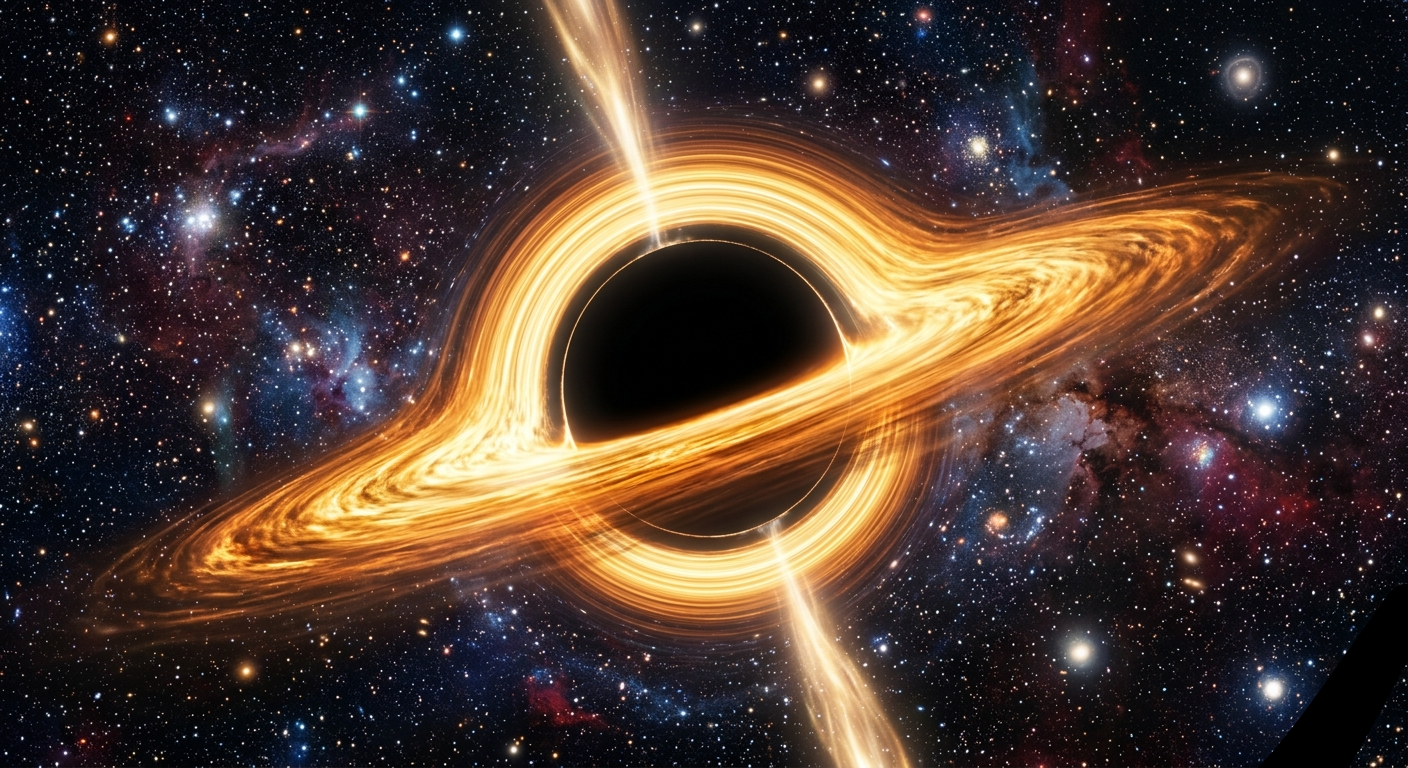
Imagine you are floating in the velvet void of space, drifting toward a sphere of absolute darkness. This is the event horizon, the cosmic “point of no return.” For decades, the consensus was simple: once you cross that line, you are deleted from the universe.
But as our understanding of General Relativity and Quantum Mechanics evolves, a more provocative question has emerged: Where do black holes lead? Is the center of a black hole a crushing finale, or is it a cosmic lobby waiting to transport you to the other side of reality?
Check our previous articles to know more about General Relativity and Quantum Mechanics.
The Harsh Reality: A Lesson in Spaghettification
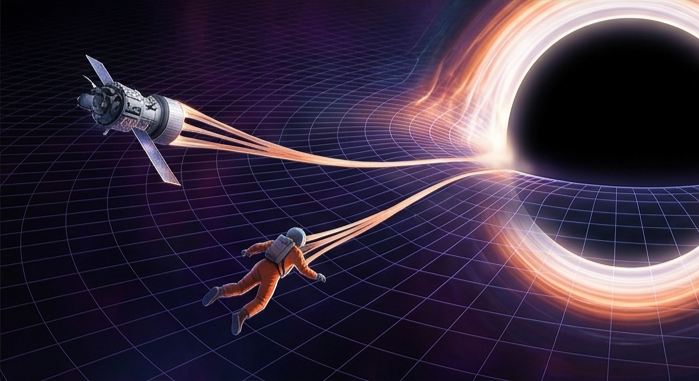
Before we get to the sci-fi portals, we have to address the “meat” of the problem, literally. If you fell into a stellar-mass black hole, you would experience a phenomenon known as spaghettification.
Gravity follows the inverse-square law. If you fall feet-first, the pull on your toes is significantly stronger than the pull on your head. In the extreme curvature of spacetime near a singularity, this difference (tidal force) becomes so violent that it stretches your body into a thin, miles-long ribbon of atoms. In this scenario, you don’t “go” anywhere; you simply become part of the black hole’s mass.
The Einstein-Rosen Bridge: The Cosmic Shortcut
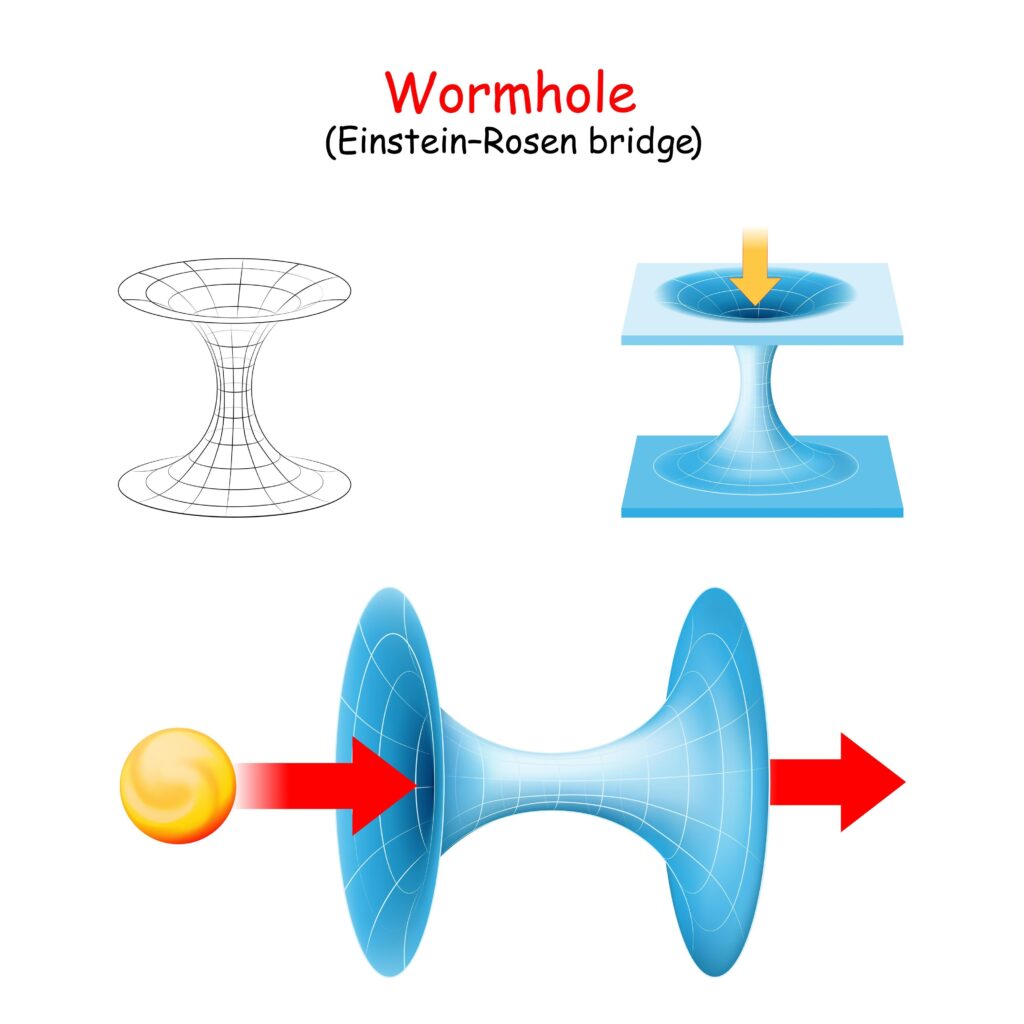
If we look at the math provided by Albert Einstein and Nathan Rosen, a different picture emerges. They proposed that a black hole might not be a bottomless pit, but a bridge.
The Wormhole Connection
An Einstein-Rosen Bridge, or a wormhole, is a theoretical “throat” that connects two distant points in spacetime. Instead of traveling 100,000 light-years across the Milky Way, you could theoretically pass through a black hole and emerge on the other side of the galaxy, or even in a different universe entirely.
White Holes: The Great Cosmic Exit?
If black holes are the ultimate vacuum cleaners of the universe, physics suggests there might be a “blower” to balance the scales. Enter the White Hole.
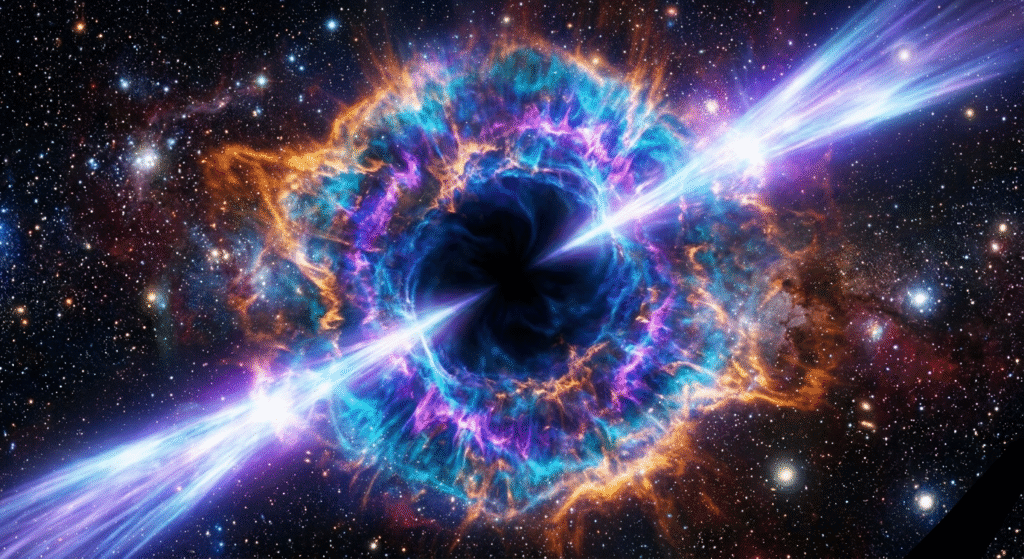
A white hole is the mathematical time-reversal of a black hole. While a black hole has an event horizon that nothing can escape, a white hole has a boundary that nothing can enter. Some physicists hypothesize that every black hole is connected to a white hole. In this “rebound” theory, the matter swallowed by a black hole is instantly ejected by a white hole in a different region of space or time.
The Holographic Principle: Stretched Across the Surface
What if you don’t go “through” or “in” at all? Some modern theorists, including the late Stephen Hawking, suggested that your physical body might be destroyed, but your information, the quantum blueprint of who you are, is never lost.
According to the Holographic Principle, everything that falls into a black hole is encoded as a 2D “image” on the surface of the event horizon. In this view, the black hole isn’t a room; it’s a hard drive. You wouldn’t be in another universe; you’d be a permanent, flattened ghost haunting the edge of this one.
The Final Frontier: Seeking Quantum Gravity
The truth is, our current laws of physics break down at the center of a black hole. We are missing the “Theory of Everything”, a bridge between the massive (General Relativity) and the microscopic (Quantum Mechanics). Until we can reconcile these two, the center of a black hole remains the universe’s best-kept secret.
We may never know for sure until we send an explorer in, but they wouldn’t be able to send a postcard back to tell us the results.
