
Welcome to the weirdest place in the universe. If you look at your hand, it feels solid; if you drop a ball, it falls down. We call this Classical Physics, and it works perfectly for everything from baking a cake to landing a rover on Mars.
However, if you were to shrink down until you were smaller than a speck of dust, the rules would break. At the level of the atom, the universe stops acting like a machine and starts acting like a fever dream. Forget everything you think you know about how the world works, because, in the quantum realm, the impossible happens every second.
The word “Quantum” actually comes from the Latin word for “how much”. In our everyday world, energy seems to flow like a smooth stream of water. In the subatomic world, energy comes in discrete “packets” or bundles, like individual drops.
Chapter 1: The Building Blocks
To understand the quantum world, we must first look at the Atom. You’ve likely seen the “solar system” model, where electrons orbit a nucleus like planets around a sun.
If that model were true, the electrons would lose energy and crash into the centre within a fraction of a second. Classical physics says the atom shouldn’t exist.
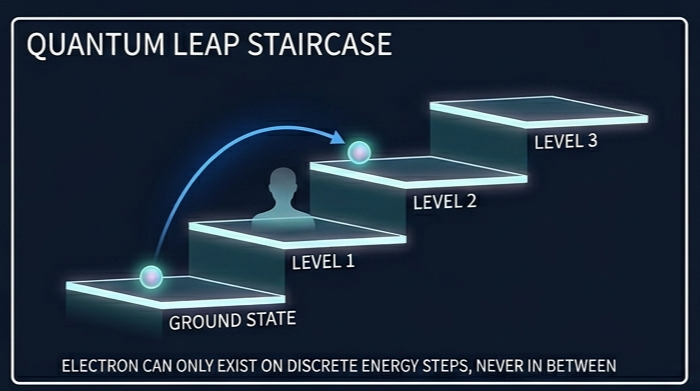
Quantum Mechanics saved the day by proving that electrons don’t just “sit” in space. They occupy specific, allowed energy levels. They can jump between these levels, but they can never exist in the “gap” between them, a phenomenon known as a Quantum Leap.
Chapter 2: The Four Pillars of Weirdness
Wave-Particle Duality: Everything is Both
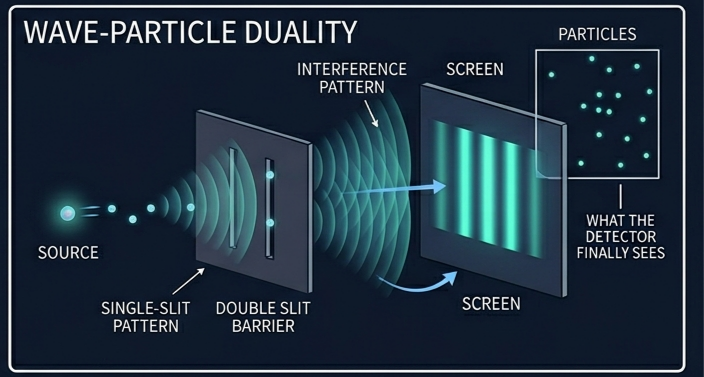
In the “big” world, things are either waves (like ripples in a pond) or particles (like marbles). In the quantum world, every object is both at the same time.
The Analogy: Think of a person who is both a doctor and a musician. Depending on where you meet them, at the hospital or at a concert, they appear to be one or the other, but they are always both.
This was proven by the Double-Slit Experiment. When we fire electrons at two slits, they interfere with each other like waves. However, if we try to “watch” which slit they go through, they instantly start acting like solid marbles again.
Superposition: Multiple States at Once
A quantum object doesn’t have a definite “setting” until it is measured. Until that moment, it exists in all possible states simultaneously.
The Analogy: Imagine a spinning coin on a table. While it’s spinning, it isn’t “Heads” and it isn’t “Tails”, it is a blur of both states at once. It only “becomes” one or the other when you slap your hand down to stop it.
This is the heart of the famous Schrödinger’s Cat thought experiment. Until we open the box to look, the cat is mathematically both dead and alive.
Quantum Entanglement: Spooky Connections
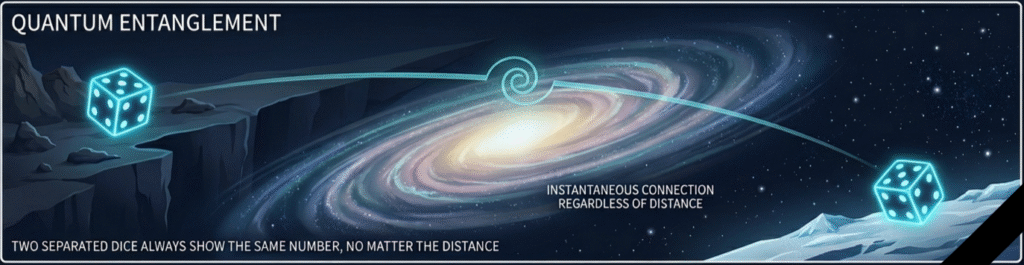
This was so strange that Albert Einstein called it “spooky action at a distance.” It suggests that two particles can become linked so that what happens to one instantly affects the other.
The Analogy: Imagine a pair of magic dice. You keep one in London and send the other to Mars. When you roll your die and get a six, the die on Mars instantly turns into a six as well, despite there being no wires or signals connecting them.
This connection happens faster than the speed of light. It suggests that at a fundamental level, the universe is deeply interconnected in ways we are still trying to map.
The Uncertainty Principle: You Can’t Know Everything
Werner Heisenberg discovered that there is a limit to what we can know about a subatomic particle. You can never know both its exact position and its exact speed at the same time.
The Analogy: If you take a fast-shutter photo of a racing car, you can see exactly where it is, but the wheels look frozen, so you don’t know its speed. If you take a long-exposure photo, the car is a blur; you know it’s going fast, but you can’t say exactly where it is.
The universe isn’t just “blurry” because our microscopes are bad. It is blurry because the universe itself is built on probability, not certainty.
You can read more about the uncertainty principle here.
Chapter 3: Why This Matters to You
You might think this is all just philosophy, but you are currently using quantum physics to read this. Without our understanding of the subatomic world, modern life would vanish.
- The Transistor: This is the “brain” of every computer chip; it relies on quantum hopping to switch electricity on and off.
- The Laser: Lasers work by forcing atoms to release “packets” of light all at the same time.
- MRI Scans: Hospitals use the “spin” of atoms in your body, a quantum property, to see inside you without surgery.
Conclusion & Forward Look
Quantum physics is built on four mind-bending pillars:
- Duality: Being both a wave and a particle.
- Superposition: Existing in many states at once.
- Entanglement: Instant connections across space.
- Uncertainty: A fundamental blurriness to nature.
The next frontier is Quantum Computing. While a normal computer uses bits (0 or 1), a quantum computer uses qubits that can be both 0 and 1 at the same time. This will allow us to solve problems in seconds that would take today’s supercomputers millions of years.

One thought on “How Quantum Physics Works: A Beginner’s Guide to the Subatomic World”