
Have you ever wondered why your car stays in the driveway when you aren’t looking, but an electron refuses to play by the same rules? For millions of years, human “common sense” evolved to help us survive a world of falling apples, charging predators, and moving stones. This is the realm of Classical Physics, where things have a definite place and follow predictable paths.
But when we zoom down to the subatomic world, our hard-wired intuition hits a brick wall. The logic of the “big” world simply doesn’t apply to the very small. To master Quantum Physics for beginners, we first have to admit that our brains weren’t naturally built to understand it, and that’s perfectly okay.
The “Ontological Shock”: Why Your Brain Rebels
The real difficulty of quantum mechanics isn’t just the complex Greek symbols or the heavy calculus. The true hurdle is what philosophers call “Ontological Shock.” It’s the realization that the very nature of reality is fundamentally different from what we perceive.
Wave-Particle Duality
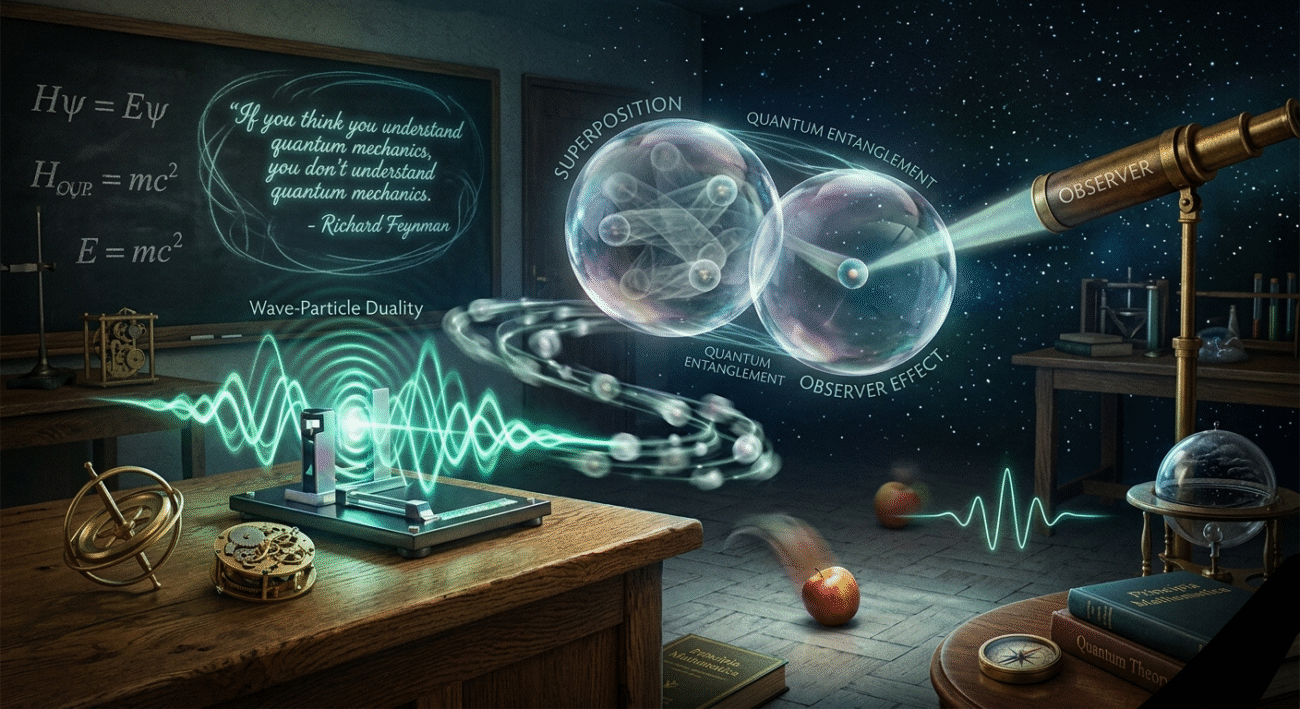
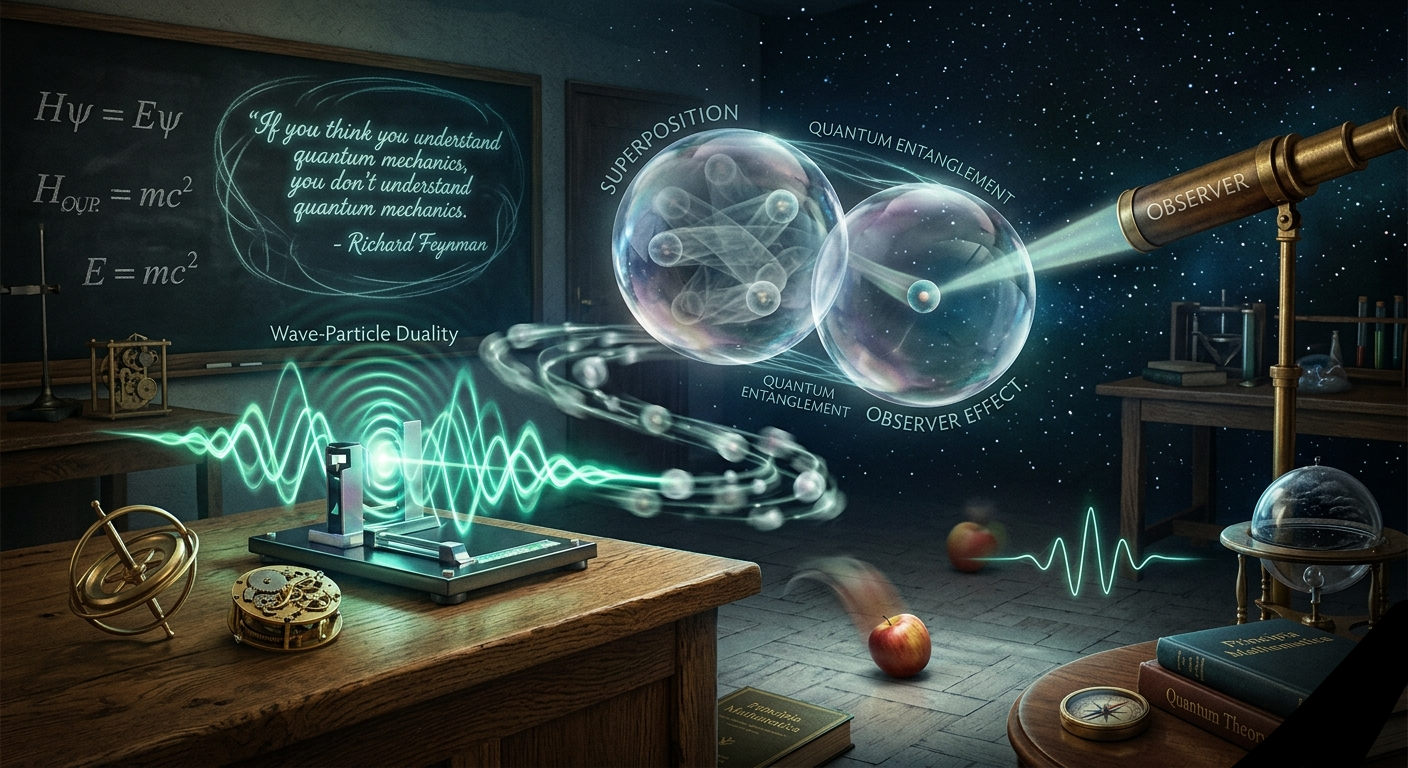
In our daily lives, a thing is either a solid object (like a baseball) or a ripple (like a wave in a pool). In the quantum realm, entities like electrons act as both. This “identity crisis” means subatomic objects don’t exist in one specific spot until they are forced to.
The Observer Effect
In classical physics, you can watch a race without affecting the runners. In quantum physics, the act of measurement actually changes the outcome. Simply “looking” at a particle collapses its many possibilities into a single, boring reality.
Non-locality: Einstein’s “Spooky Action”
Perhaps the most “illegal” concept in physics is entanglement. Two particles can become linked so deeply that changing one instantly affects the other, even if they are on opposite sides of the galaxy. Einstein famously called this “spooky action at a distance” because it seemed to defy the cosmic speed limit of light.
How to Finally “Get” It: A Mindset Shift
If you want to understand quantum physics for beginners, you have to stop trying to visualize little billiard balls spinning in circles. Instead, you need to start visualizing probability.
The Spinning Coin Analogy: Imagine a coin lying on a table. It is either Heads or Tails, this is classical physics. Now, imagine that same coin spinning rapidly on its edge. While it’s spinning, is it Heads? Is it Tails?
In a way, it is both and neither at the same time. This is superposition. The “blur” of the spinning coin represents the probability of where the coin might land once it finally stops.
Key Takeaways for the Quantum Mindset:
- Nature is Probabilistic: Nothing is certain until it is measured.
- Reality is Contextual: Things don’t have “properties” in isolation; they depend on how we interact with them.
- Math is the Map: While our visual imagination fails, the mathematics of quantum mechanics is the most accurate tool ever created by humanity.
The Wisdom of Richard Feynman
Even the greatest minds struggled with the intuition vs. reality gap. The legendary Nobel laureate Richard Feynman once famously remarked:
“If you think you understand quantum mechanics, you don’t understand quantum mechanics.”
Feynman wasn’t being discouraging. He was reminding us that the subatomic world doesn’t have to “make sense” to be true. To “understand” quantum physics is to accept that the universe is far stranger than our primate ancestors ever needed to imagine.
The Path Forward
Quantum physics isn’t hard because you aren’t smart enough. It’s hard because it requires us to unlearn the “obvious” truths of our everyday lives. Once you embrace the mystery and stop demanding that electrons act like tiny marbles, the beauty of the subatomic world begins to reveal itself.
