
Explore the mysterious weak nuclear force, the silent engine behind the sun’s glow and the secrets of radioactive decay, explained in plain English.
If you ask a random person on the street what holds the universe together, they’ll probably mention gravity. If they’re a bit of a science buff, they might bring up electromagnetism, the force that keeps your magnets on the fridge and your phone charging. But there is a third player in this cosmic game, one with a name that honestly does it a massive disservice: The Weak Nuclear Force.
Calling it “weak” feels like a bit of an insult. It’s like calling a master chef a “food reheater.” While gravity holds planets in orbit and the strong force acts like a super-glue inside atoms, the weak force does something much more magical. It changes the fundamental nature of reality. It is the only force capable of turning one kind of subatomic particle into another. Without it, the sun wouldn’t shine, and the complex chemistry required for life simply wouldn’t exist.
The Great Transformer
To understand what the weak force actually does, we have to look past the “solid” world we see and dive into the chaotic heart of an atom. You probably remember from school that atoms have protons and neutrons. For a long time, we thought these were the “uncuttable” building blocks of matter. We were wrong.
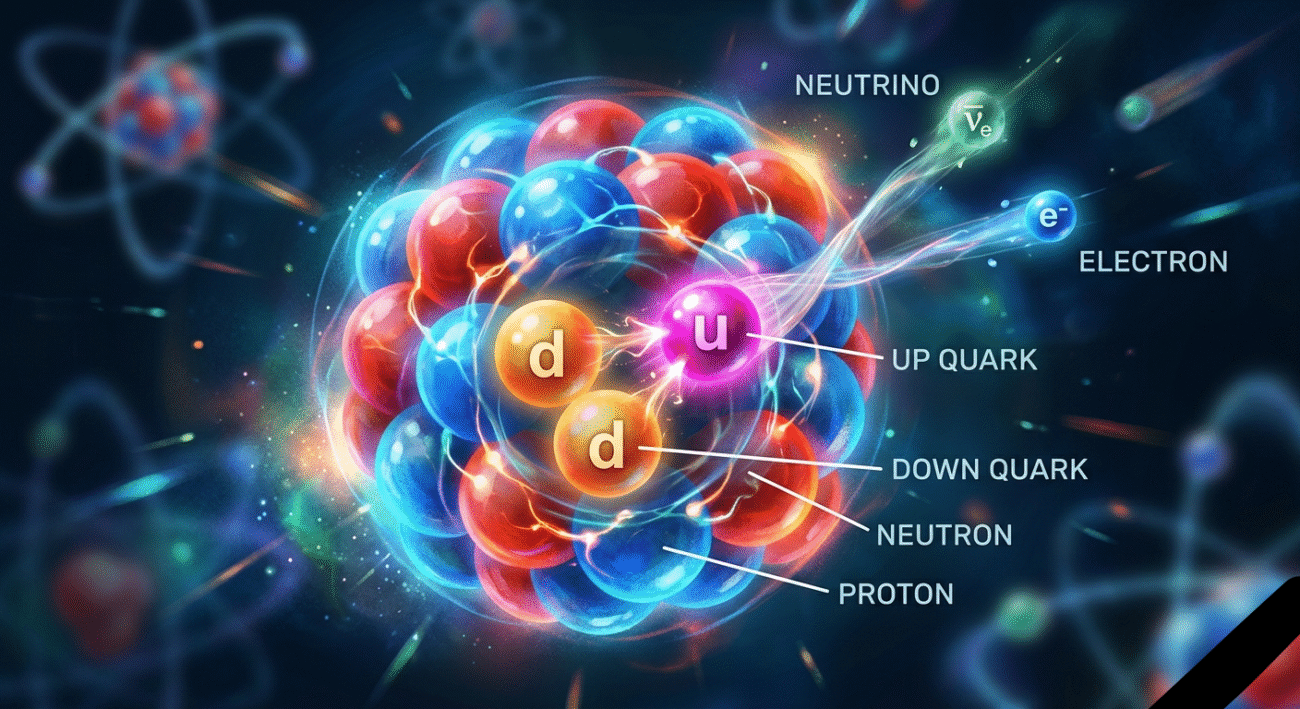
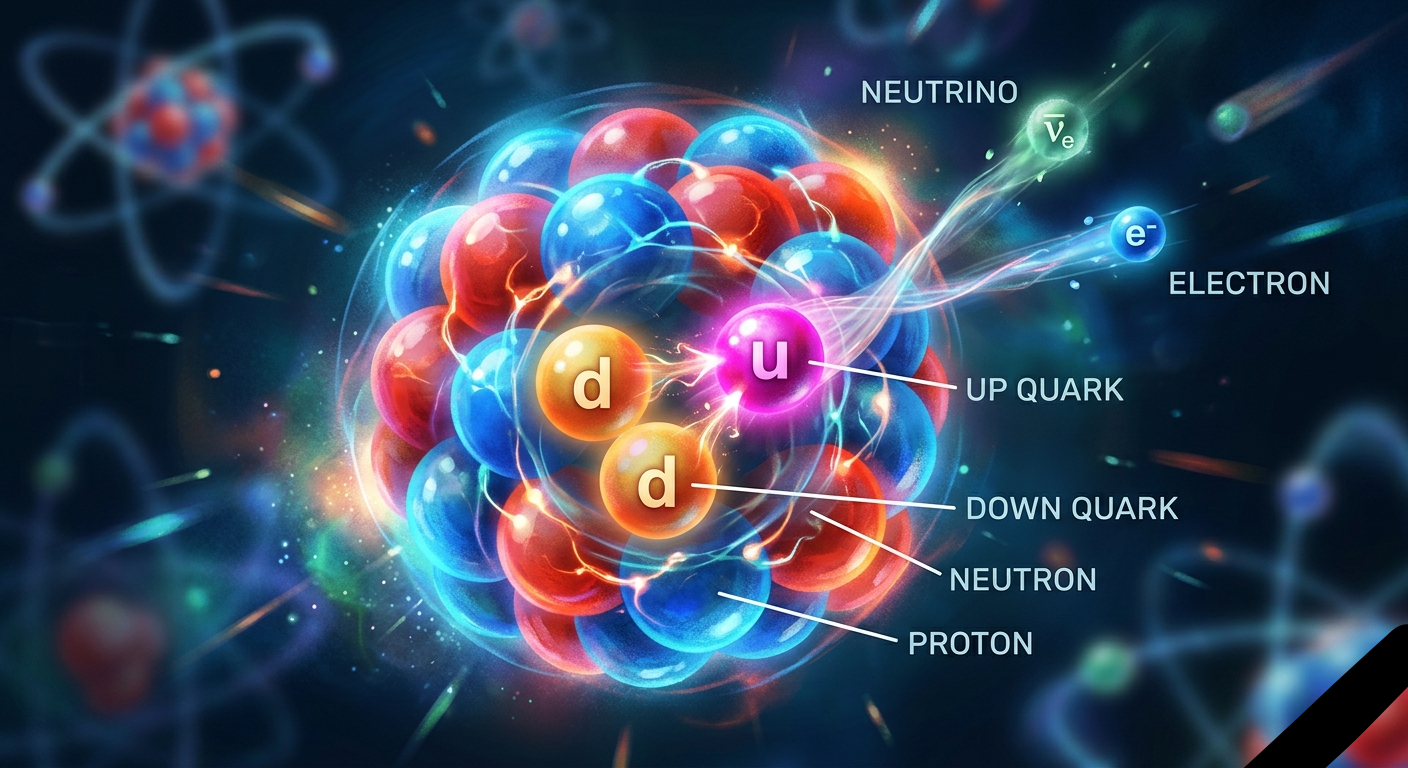
Protons and neutrons are made of even smaller bits called quarks. There are “up” quarks and “down” quarks. A proton is two ups and a down; a neutron is two downs and an up.
Here is where the weak force earns its paycheck. Occasionally, a down quark decides it’s tired of being a neutron and wants to become a proton. To do that, it has to flip its “flavor” and become an up quark. No other force in the universe can do this. The weak force steps in, facilitates this identity crisis, and in the process, the neutron spits out an electron and a tiny, ghostly particle called a neutrino.
We call this beta decay. It’s the engine of natural radioactivity, and while “radioactivity” sounds like something out of a superhero origin story (or a disaster movie), it is a fundamental rhythm of our universe.
The Sun’s Slow Burn
You might be wondering why you should care about quarks flipping identities in a vacuum. Well, look up at the sky.
The Sun is essentially a massive, ongoing nuclear explosion. But it’s a very controlled one. If the Sun burned through its fuel all at once, we’d be toast in seconds. If it didn’t burn at all, we’d freeze. The reason the Sun has been providing a steady, gentle warmth for billions of years is due to the “weakness” of the weak force.
In the core of the Sun, protons are constantly slamming into each other. Usually, they just bounce off because they both have a positive charge. But occasionally, thanks to the weak force, a proton transforms into a neutron right at the moment of impact. This allows them to stick together and begin the process of fusion.
Because the weak force is so, well, weak, this transformation happens very rarely. It acts as a cosmic bottleneck. It slows down the solar furnace just enough so that the Sun simmers rather than explodes. We are alive because the weak force is remarkably inefficient.
Chasing Ghosts: The Wu Experiment
For a long time, physicists assumed the laws of nature were perfectly symmetrical, that the universe didn’t have a “left-handed” or “right-handed” preference. They called this parity.
In 1956, a brilliant physicist named Chien-Shiung Wu (often called the First Lady of Physics) conducted a landmark experiment involving Cobalt-60. She cooled the atoms down to near absolute zero and aligned them in a magnetic field. According to the “perfect” logic of the time, the electrons from the decaying cobalt should have been emitted in all directions equally.
Instead, they mostly shot out in one specific direction.
The scientific community was stunned. The weak force, it turned out, is a “left-handed” force. It broke the symmetry that everyone thought was baked into the fabric of creation. This discovery shattered our neat visions of a mirrored universe and proved that at the most fundamental level, nature has a preference. It was a messy, human-like quirk found in the very laws of physics.
The Heavy Messengers: W and Z Bosons
Most forces are carried by particles that have no mass. Light (electromagnetism) is carried by photons, which are weightless. This allows light to travel forever across the vacuum of space.
The weak force is different. Its messenger particles, the W and Z bosons, are incredibly heavy, about 80 to 90 times the mass of a proton. Imagine trying to play catch, but instead of a baseball, you’re throwing a heavy bowling ball. You can’t throw it very far, right?
This is why the weak force only works over unimaginably short distances, smaller than the diameter of a single proton. It is a local force, a short-range interaction that governs the intimate details of the atomic nucleus while leaving the rest of the solar system to gravity and light.
A Universe of Intention
When we look at the weak force, we see a universe that isn’t just a collection of static rocks and gas. We see a universe that is constantly “becoming.”
If the weak force were just a little bit stronger, the Sun would have burned out long before life had a chance to crawl out of the oceans. If it were a little bit weaker, the stars might never have ignited at all. There is a profound, delicate balance in these constants.
It reminds us that the world is more than what we can touch. There are invisible hands at work, turning neutrons into protons, keeping the stars alight, and ensuring that the matter making up your body remains stable yet capable of change.
The next time you feel the heat of the sun on your skin, take a second to think about the W bosons and the shifting quarks. It’s a complex, beautiful system, a hidden alchemy that makes our very existence possible. We live in a world that is being quietly transformed every single microsecond, governed by a force that is anything but “weak.”
