
Imagine you are trapped in a labyrinth. To find the exit, a classical computer, the one in your pocket or on your desk, would act like a lone hiker. It explores one path, hits a dead end, retraces its steps, and tries another. It is methodical, but painfully slow.
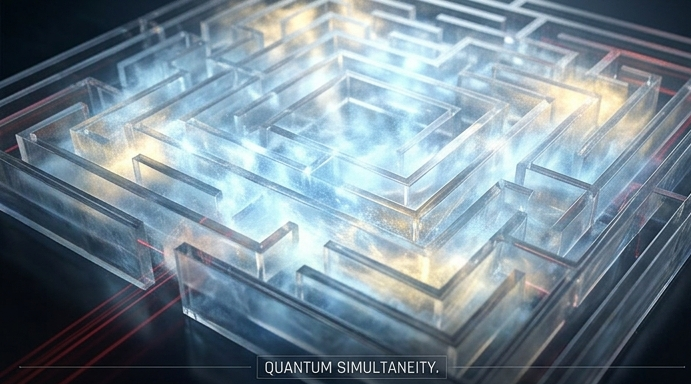
Now, imagine a quantum computer. Instead of walking one path at a time, it exists as a mist that fills the entire maze simultaneously. It “feels” every corridor, every turn, and every dead end at once. Almost instantly, the mist concentrates at the exit.
This is Quantum Advantage: the moment a quantum system performs a calculation that would take a classical supercomputer thousands of years to complete. We aren’t just building faster computers; we are reinventing the physics of information itself.
To understand the physics behind qubits, read our Beginner’s Guide to the Subatomic World.
Bits vs. Qubits: The Power of Being “Everywhere”
At the heart of every digital device is the bit. It is the ultimate minimalist: a light switch that is either On (1) or Off (0). Every email you’ve sent and every video you’ve streamed is just a massive sequence of these binary flips.
The Bloch Sphere Analogy
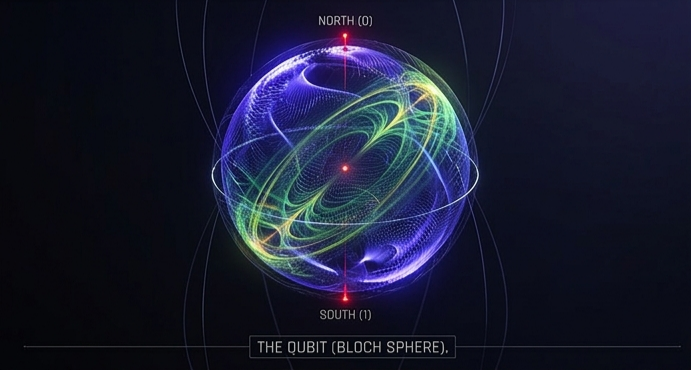
In the quantum realm, we use qubits. To understand the difference, imagine a globe (physicists call this the Bloch Sphere):
- Classical Bit: You can only stand at the North Pole (0) or the South Pole (1).
- Qubit: You can be anywhere on the surface of the globe, at the equator, in the tropics, or hovering between longitudes, all at once.
This state is called Superposition. A qubit doesn’t choose to be a 0 or a 1 until the very moment we measure it. Until then, it represents a complex probability of both, allowing a quantum machine to hold vast amounts of data in a single state.
The Quantum Engine: Spooky Networking and Smart Noise
If superposition is the “state” of the engine, then Entanglement and Interference are the gears that make it move.
Entanglement: The Ultimate Connection
Einstein famously called this “spooky action at a distance.” When two qubits become entangled, they become mathematically linked. Change the state of one, and its partner changes instantly, even if they are on opposite sides of the universe. This allows qubits to work in a massive, synchronized harmony that classical bits can never achieve.
Interference: The Noise-Canceling Strategy
How does a quantum computer pick the right answer out of a billion possibilities? Through Quantum Interference. Think of it like high-end noise-canceling headphones. The computer uses wave mechanics to:
- Cancel out (destructive interference) the “noise” of the wrong answers.
- Amplify (constructive interference) the “signal” of the correct solution.
The Cold Hard Reality: Machines More Fragile Than Glass
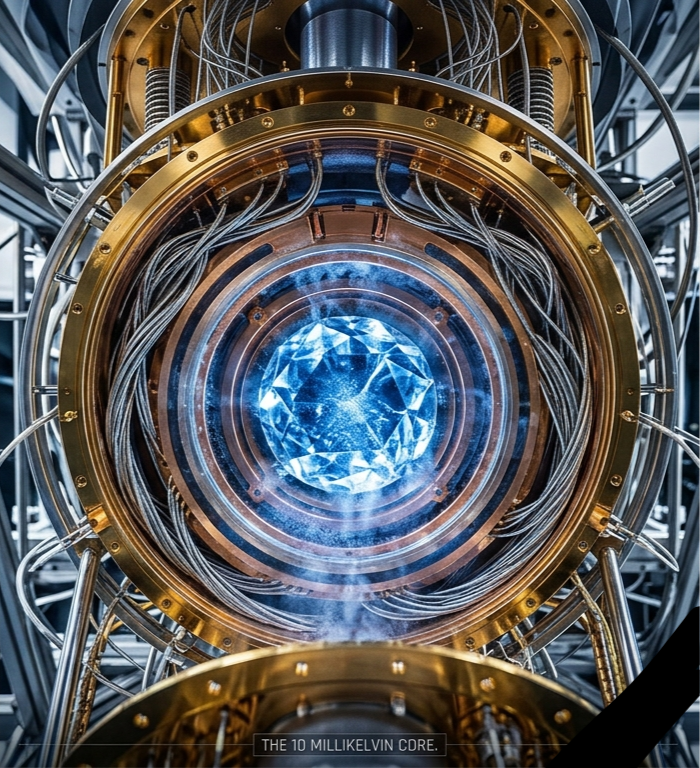
Building these machines is a feat of extreme engineering. Most quantum processors, like those developed by Google or IBM, require temperatures near Absolute Zero, roughly -273°C. This is colder than the vacuum of deep space.
The Challenge of Decoherence
Why the deep freeze? Because qubits are incredibly sensitive. A single stray photon or a tiny vibration can cause Decoherence, the quantum equivalent of a computer crash. The “mist” evaporates, the superposition collapses, and the calculation is lost. Maintaining “coherence” is the primary bridge we must cross to make quantum computing practical for everyday use.
Real-World Applications: Rewriting the Future
Quantum computing isn’t just for theoretical physics; it’s the key to solving “unsolvable” problems in the physical world.
1. Medicine and Protein Folding
Classical computers struggle to simulate the complex ways proteins fold. Quantum computers can model molecular interactions at the atomic level, potentially curing diseases and designing life-saving drugs in days rather than decades.
2. The Great Encryption Crisis
Most modern security relies on the fact that factoring giant numbers is hard for classical bits. A powerful quantum computer could breeze through these codes. To stay ahead, scientists are already developing Post-Quantum Cryptography (PQC), new math that even a quantum ghost can’t crack.
3. Climate and Material Science
We could design high-efficiency batteries that don’t degrade or discover new catalysts for carbon capture to scrub CO2 from our atmosphere. Quantum simulation allows us to “test” these materials in a virtual lab before we ever build them.
Conclusion: Our “Vacuum Tube” Moment
We are currently living through the “Vacuum Tube” era of quantum computing. Just as the massive, room-sized ENIAC of the 1940s eventually gave way to the pocket-sized silicon revolution, today’s cryogenic quantum vats are the precursors to a new age of humanity.
When we reach our “Transistor Moment“, the point where quantum hardware becomes stable, scalable, and error-corrected, the boundary between what is “impossible” and what is “computable” will vanish forever.

One thought on “How Quantum Computing Works: Beyond the Binary Revolution”