
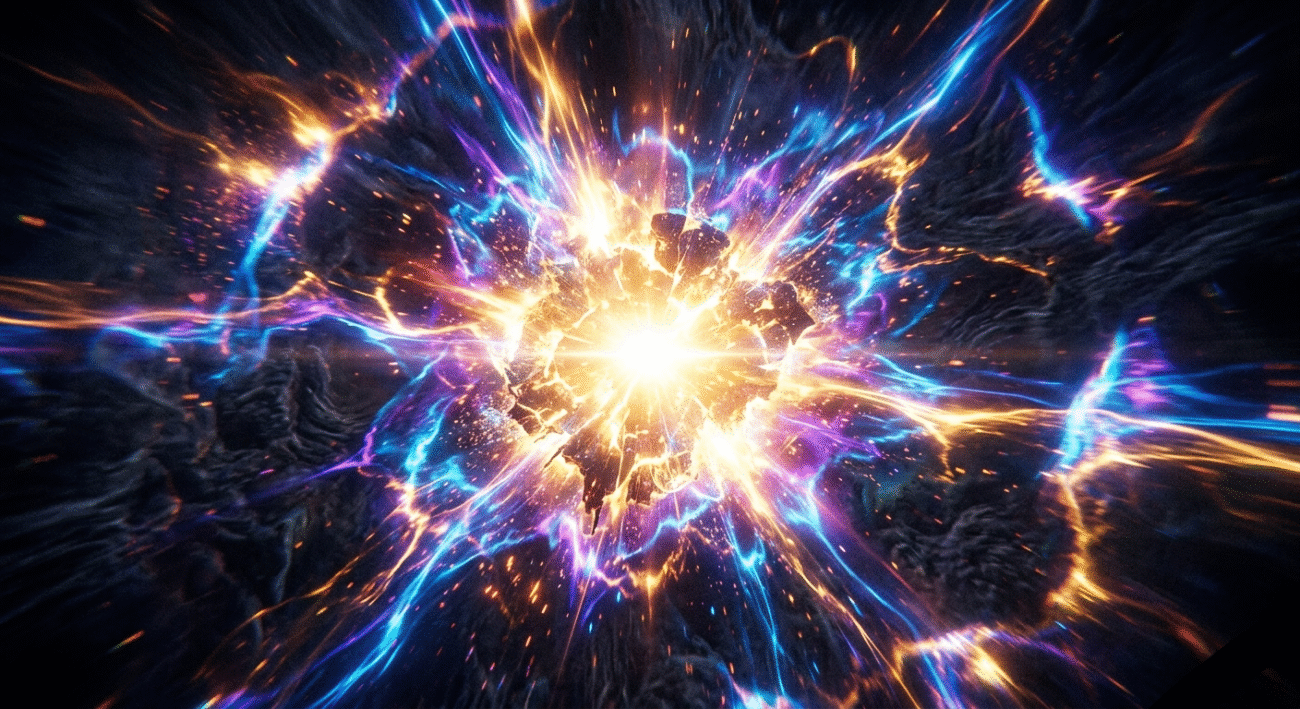
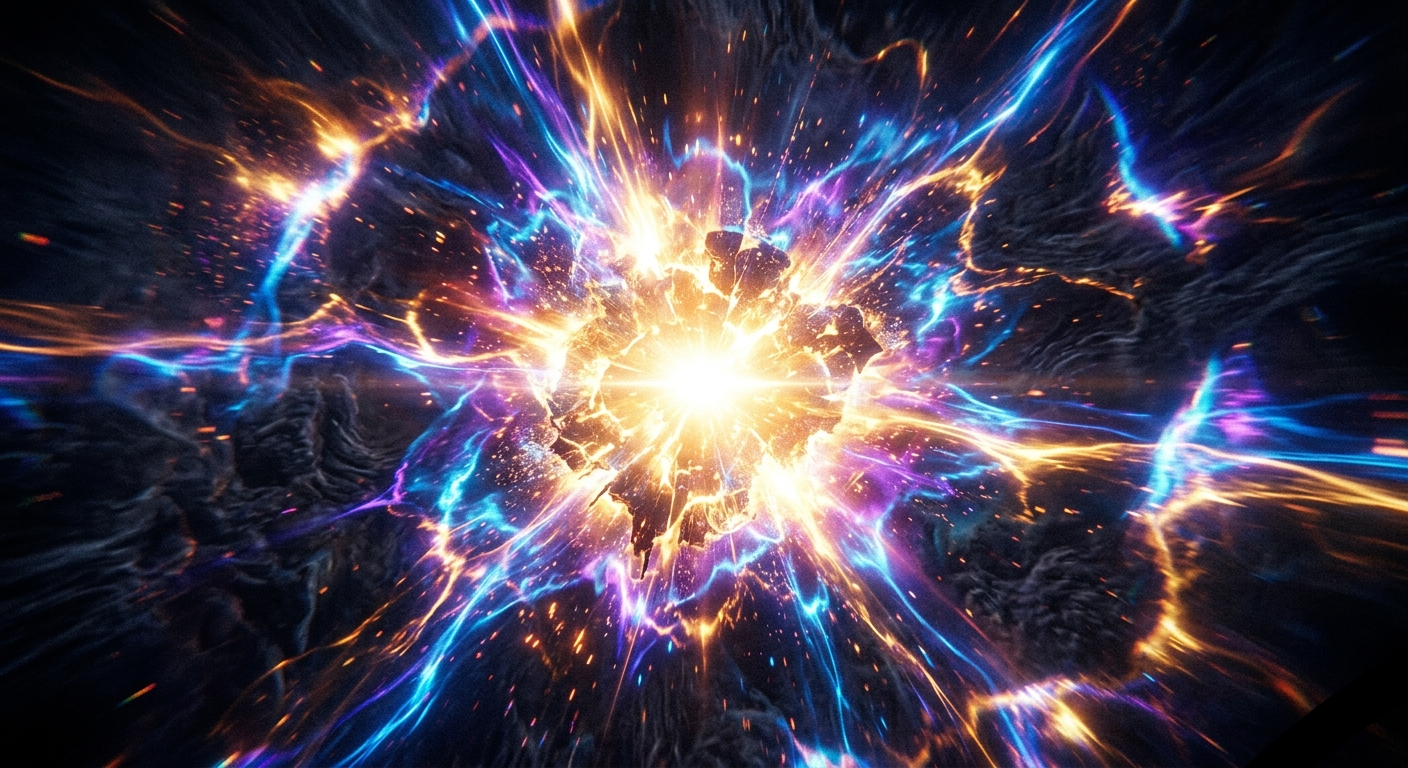
If you travel back in time 14 billion years, the entire universe, every star, planet, and galaxy that will ever exist, is squeezed into a space smaller than a single subatomic particle. It is infinitely hot, infinitely dense, and poised on the brink of an explosion that will create time and space itself. This is the Big Bang. To the human mind, it sounds like absolute science fiction. How could anyone possibly know what happened at the dawn of time? But in physics, we don’t rely on guesswork; we rely on fingerprints. The cosmos is covered in them. Here is the undeniable scientific evidence that proves why the Big Bang theory is right.
The Cosmic Crime Scene – Galaxies on the Run
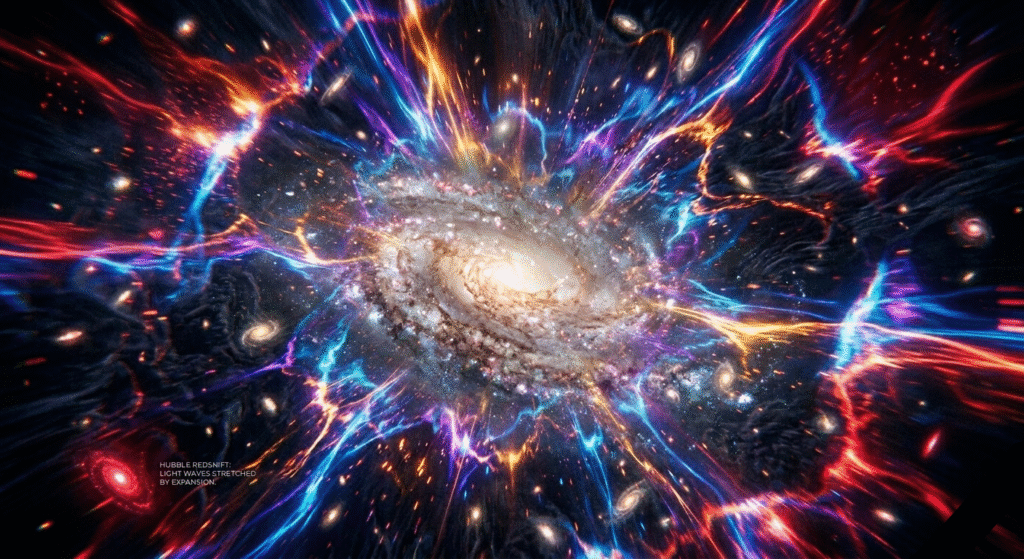
The first major clue that the Big Bang happened came from a man named Edwin Hubble in 1929. Before Hubble, scientists believed the universe was static, eternal, and unchanging. Hubble shattered that assumption using a simple trick of light called redshifting.
Think of the sound of a police siren. As the ambulance speeds toward you, the sound waves compress, making the pitch higher. As it drives away, the sound waves stretch out, lowering the pitch. Light does the exact same thing.
When Hubble looked at distant galaxies, he noticed their light was shifted toward the red end of the spectrum. In physics, “red light” means the light waves have been stretched out.
- This proved that galaxies aren’t sitting still; they are flying away from us at mind-boggling speeds.
- More importantly, the farther away a galaxy is, the faster it is moving.
The Logical Conclusion: If you rewound the cosmic movie reel of an expanding universe backward, all those galaxies flying apart would come closer and closer together, eventually colliding and merging at a single, infinitely dense starting point.
The Cosmic Microwave Background – The Echo of Creation
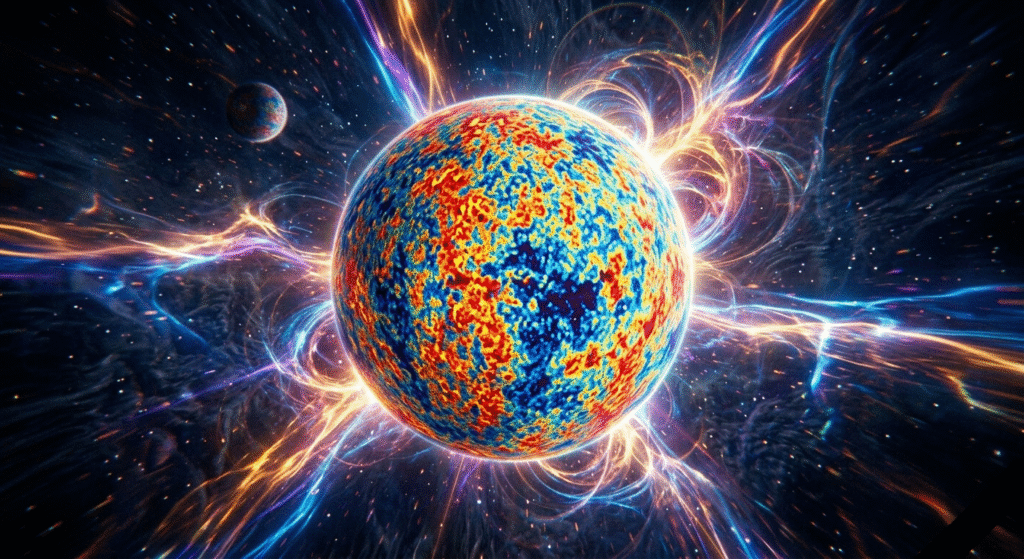
If you set off a massive firework, the smoke stays in the air long after the flash disappears. The Big Bang left behind its own version of “smoke”, a literal echo of the universe’s birth cry. This is known as the Cosmic Microwave Background (CMB), and it is the strongest evidence we have.
In the 1940s, physicists predicted that if the universe started as an unimaginably hot, dense point, a flash of brilliant radiation must have filled space roughly 380,000 years after the expansion began. Because the universe has been stretching ever since, that ancient light should have stretched out too, transforming into invisible microwaves chilling the universe just above absolute zero.
In 1964, two radio astronomers accidentally stumbled upon this exact signal. No matter where they pointed their antenna into the sky, day or night, they picked up a faint, persistent hum.
Fast Facts (The Static on Your TV):
- The Cosmic Microwave Background is so pervasive that about 1% of the “static” or snow on old, analog television sets between channels was actually interference caught from the birth echo of our universe.
- The CMB provides a perfect thermal “snapshot” of the universe when it was an infant, matching the mathematical predictions of the Big Bang down to the decimal point.
Cosmic Chemistry – The Perfect Recipe of Elements
Imagine baking a cake without a recipe, guessing the amounts of flour, sugar, and eggs, and somehow getting a perfect cake every single time. That’s what the chemistry of our universe looks like.
During the first few minutes of the Big Bang, the universe acted as a giant thermonuclear reactor. It was so hot that subatomic particles fused together to create the very first elements in a process called Big Bang Nucleosynthesis.
Nuclear physicists calculated exactly how much Hydrogen, Helium, and Lithium should have been cooked up in that primordial oven based on the laws of thermodynamics:
- The math predicted the pristine, early universe should be roughly 75% Hydrogen and 25% Helium.
- When astronomers look at the oldest, most untouched stars and gas clouds in deep space today, they find exactly that ratio.
If the universe had always existed without a hot, dense beginning, the abundance of these light elements would be completely random or heavily skewed by stellar cycles. The fact that the universe matches the cosmic recipe perfectly is proof that it went through a superheated, collective infancy.
The Evolution of Galaxies
If the universe had no beginning and was infinitely old, we should see an equal mix of old and young galaxies scattered uniformly through space. But we don’t.
Because light takes time to travel across space, looking deeper into the universe is literally looking back in time. When telescopes like James Webb and Hubble look at galaxies billions of light-years away, they see them as they looked billions of years ago.
- The most distant galaxies look completely different from modern galaxies like our Milky Way; they are smaller, clumpier, and filled with massive, short-lived stars.
- This structural change over immense timelines confirms that the universe is actively evolving, growing, and changing from a definitive starting point.
Conclusion: A Theory Formed by Inescapable Facts
Saying the Big Bang is “just a theory” misinterprets how science works. In physics, a theory is an explanation backed by a mountain of verified evidence. We know why the Big Bang is right because three entirely separate lines of evidence, the expansion of space, the microwave echo of creation, and the precise chemistry of the cosmos, all point to the exact same conclusion.
This comprehensive guide is part of our mission to map out the grandest architecture of reality. If you want to dive deeper into the bizarre mechanics that govern the universe on its smallest scale, explore our [Beginner’s Guide to the Subatomic World] to see how the building blocks of the Big Bang actually behave.
Does knowing that the universe had a definitive beginning change how you view our place in the cosmos? Or do you still find the idea of an expanding space hard to conceptualize? Let’s talk about it in the comments below!
