

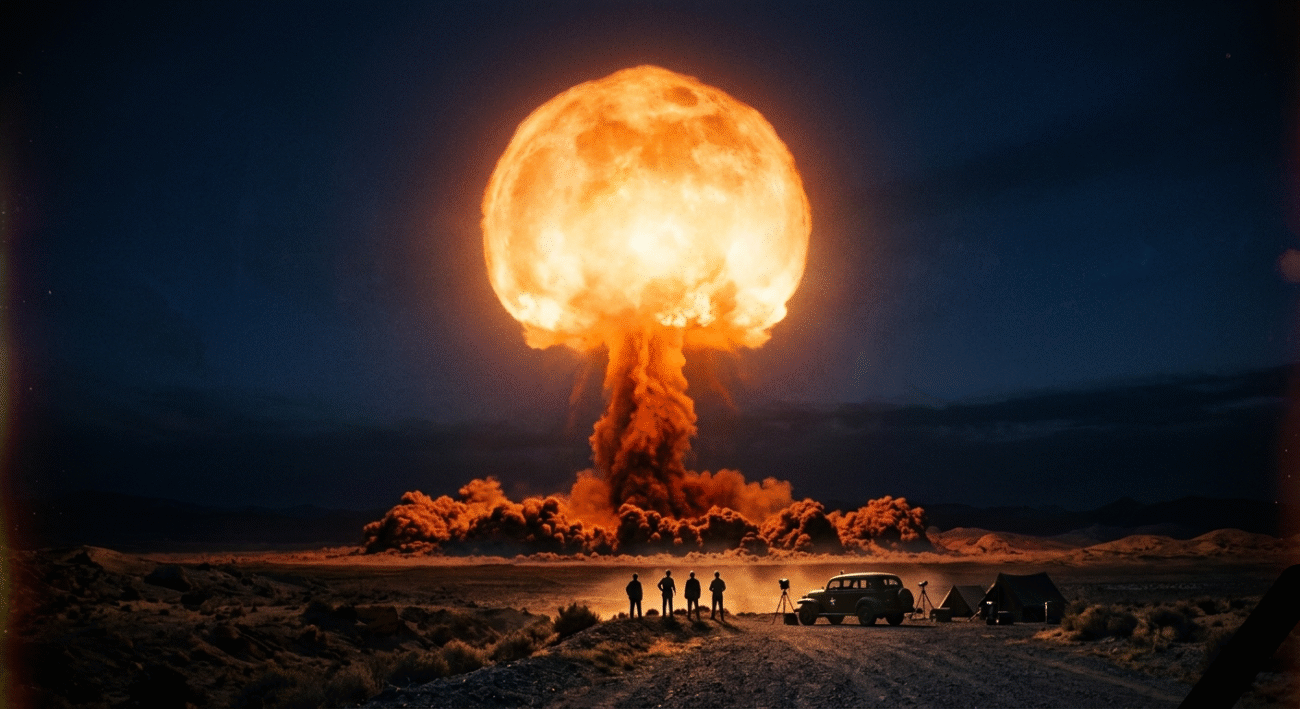
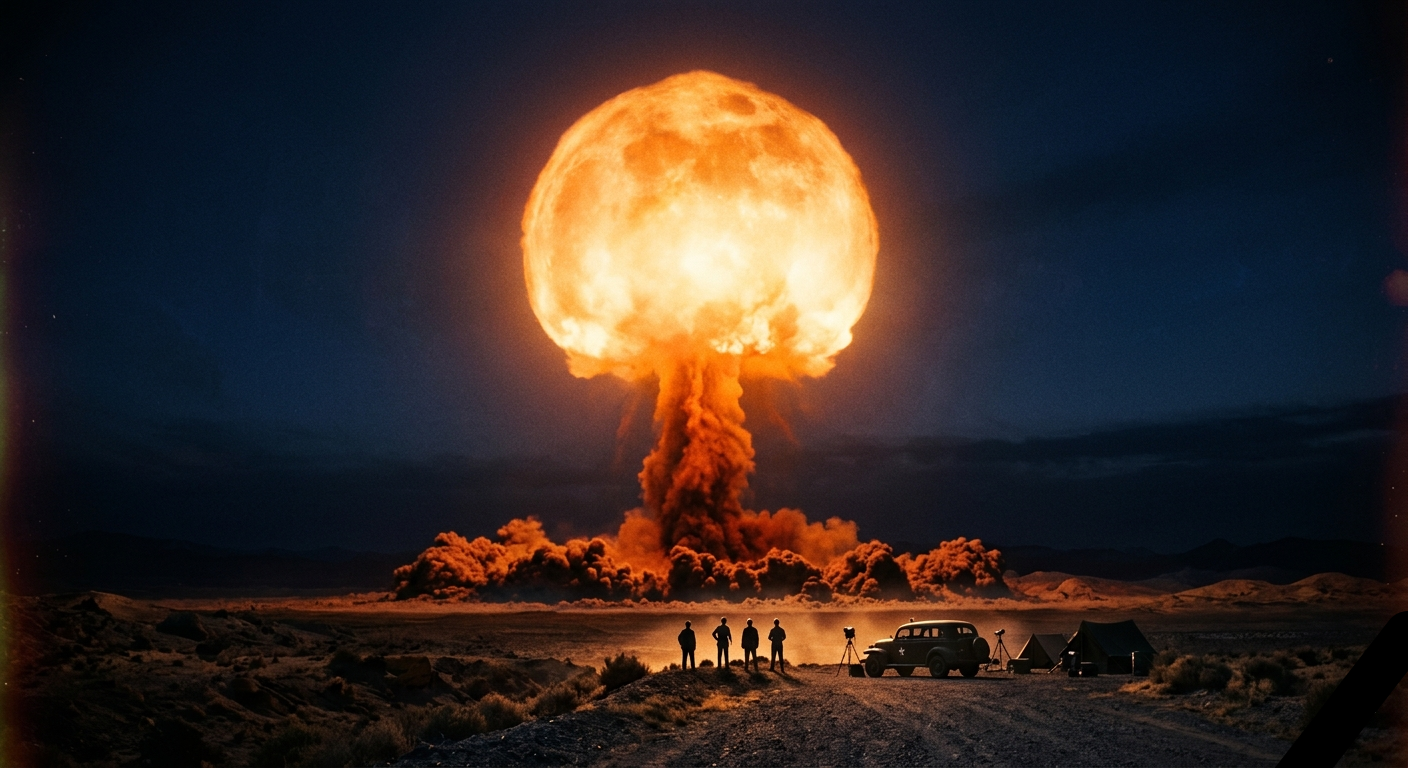
On July 16, 1945, in the quiet desolation of the New Mexico desert, humanity did the unthinkable: we bottled the power of a star. When the first atomic device detonated at the Trinity site, it released a flash brighter than a dozen suns, turning the desert sand into glass and forever altering the trajectory of our species. We had moved beyond the chemistry of fire and into the fundamental physics of the universe.
How did a group of scientists, hidden away in secret cities, manage to unlock such a devastating force? To understand the atomic bomb, we must look into the heart of the atom and the desperate race against time that defined the 20th century.
The Science of the Atom (How it Works)
At its simplest level, an atomic bomb is a device that releases the energy holding the center of an atom together. This process is called nuclear fission.
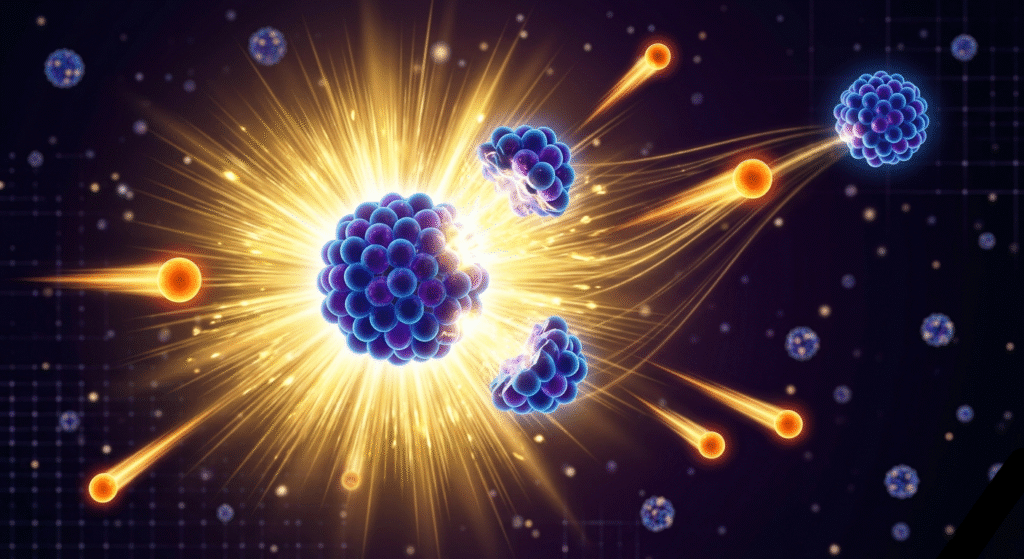
Think of the nucleus (the center) of a heavy atom as a tightly packed collection of billiard balls. If you fire a single neutron, a tiny subatomic particle, into that group at the right speed, it doesn’t just bounce off. Instead, the nucleus becomes unstable and splits into two smaller pieces.
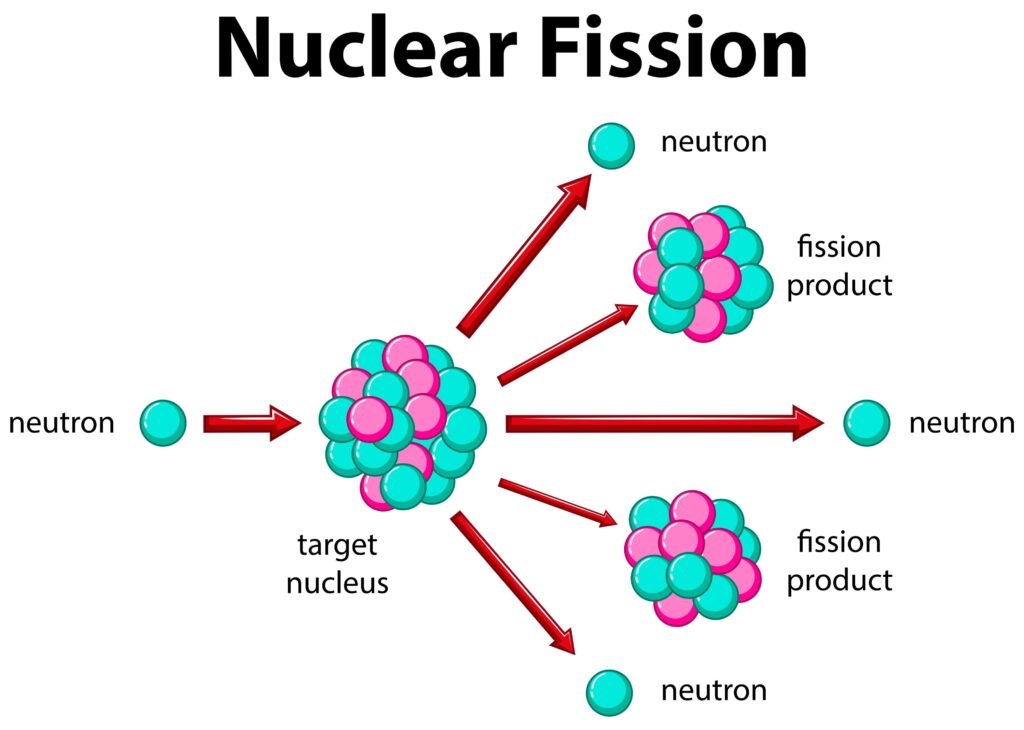
When that split happens, it releases a staggering amount of energy and, crucially, a few more “stray” neutrons. If those new neutrons hit other nearby nuclei, they cause them to split, too. This is a chain reaction.
Read our previous article : What Happens When Particles Collide at Near Light Speed?
Critical Mass and the Explosion
To get an explosion, you need a supercritical mass. This means you have enough fuel (Uranium-235 or Plutonium-239) packed closely enough together that the chain reaction grows exponentially in a fraction of a second.
During the Manhattan Project, scientists developed two ways to achieve this:
- The Gun-Type Design: Used in the “Little Boy” bomb, this fired one piece of Uranium-235 into another at high speed, like a bullet in a barrel, to reach critical mass.
- The Implosion-Type Design: Used in the “Fat Man” bomb, this used a ring of high explosives to squeeze a core of Plutonium-239 inward, crushing it until it became dense enough to detonate.
The Inventors and the Manhattan Project
The atomic bomb was not the “aha!” moment of a single lone genius. It was the result of a massive, $2 billion secret industrial complex known as the Manhattan Project.
The Spark of Discovery
The race began in late 1938. German chemists Otto Hahn and Fritz Strassmann accidentally discovered fission in a Berlin lab. However, it was Lise Meitner and Otto Frisch who provided the theoretical explanation, realizing that the atom had actually been split.
Fearful that Nazi Germany would harness this power, Albert Einstein signed a famous letter to President Franklin D. Roosevelt in 1939. Einstein’s formula, E=mc^2, provided the mathematical proof that a tiny amount of matter could be converted into a massive amount of energy.
The Architect of Los Alamos
By 1942, the United States launched the Manhattan Project. The scientific heart of the operation was the Los Alamos Laboratory in New Mexico, led by J. Robert Oppenheimer.
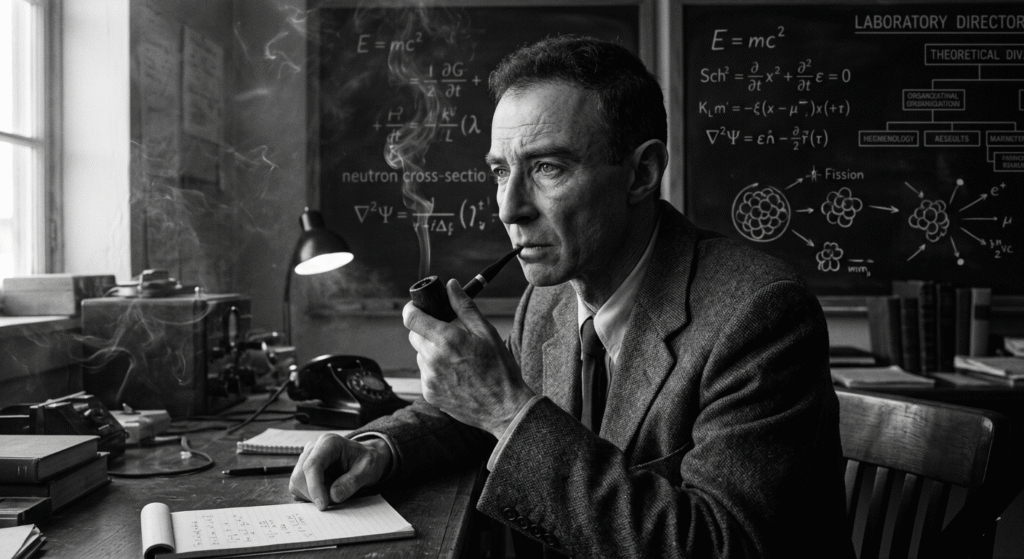
Oppenheimer, often called the “Father of the Atomic Bomb,” was a brilliant theoretical physicist who managed thousands of scientists under intense pressure. After witnessing the first successful test, he famously reflected on the gravity of their creation by quoting the Bhagavad Gita: “Now I am become Death, the destroyer of worlds.”
Key Figures in the Race
- Enrico Fermi: He led the team that created the first controlled, self-sustaining nuclear chain reaction in a squash court at the University of Chicago in 1942.
- Leslie Groves: The Army General who oversaw the entire project, ensuring that secret cities like Oak Ridge, Tennessee, and Hanford, Washington, could produce the necessary fuel.
The Legacy
The invention of the atomic bomb ended World War II, but it birthed a new and terrifying era: the Nuclear Age. The world was suddenly divided by the “Iron Curtain,” and the Cold War began as nations scrambled to build even more powerful hydrogen bombs.
For the scientists involved, the legacy was a heavy one. Many, including Oppenheimer, later advocated for international control of nuclear weapons, haunted by the ethical implications of their “gadget.” They had provided humanity with the means of its own destruction, hoping that the sheer terror of the weapon would make global war unthinkable.
Does knowing the history and science behind the atomic bomb change how you view its legacy? What role should scientists play in ethics? Let’s discuss in the comments below.
Glossary of Key Terms
- Nuclear Fission: The process of splitting a heavy atomic nucleus into smaller parts, releasing energy.
- Neutron: A subatomic particle with no charge that acts as the “bullet” to split atoms.
- Isotope: A version of an element with a different number of neutrons; Uranium-235 is the rare, “fissionable” isotope needed for bombs.
- Critical Mass: The minimum amount of nuclear fuel needed to maintain a self-sustaining chain reaction.
- Manhattan Project: The secret U.S.-led research project (1942–1946) that produced the first nuclear weapons.

One thought on “How the Atomic Bomb Works, Who Built It, and When”