

Explore the mystery of magnetic monopoles, the “North-only” magnets that could rewrite the laws of physics and unlock the secrets of the Big Bang.
The Magnet You Can’t Break
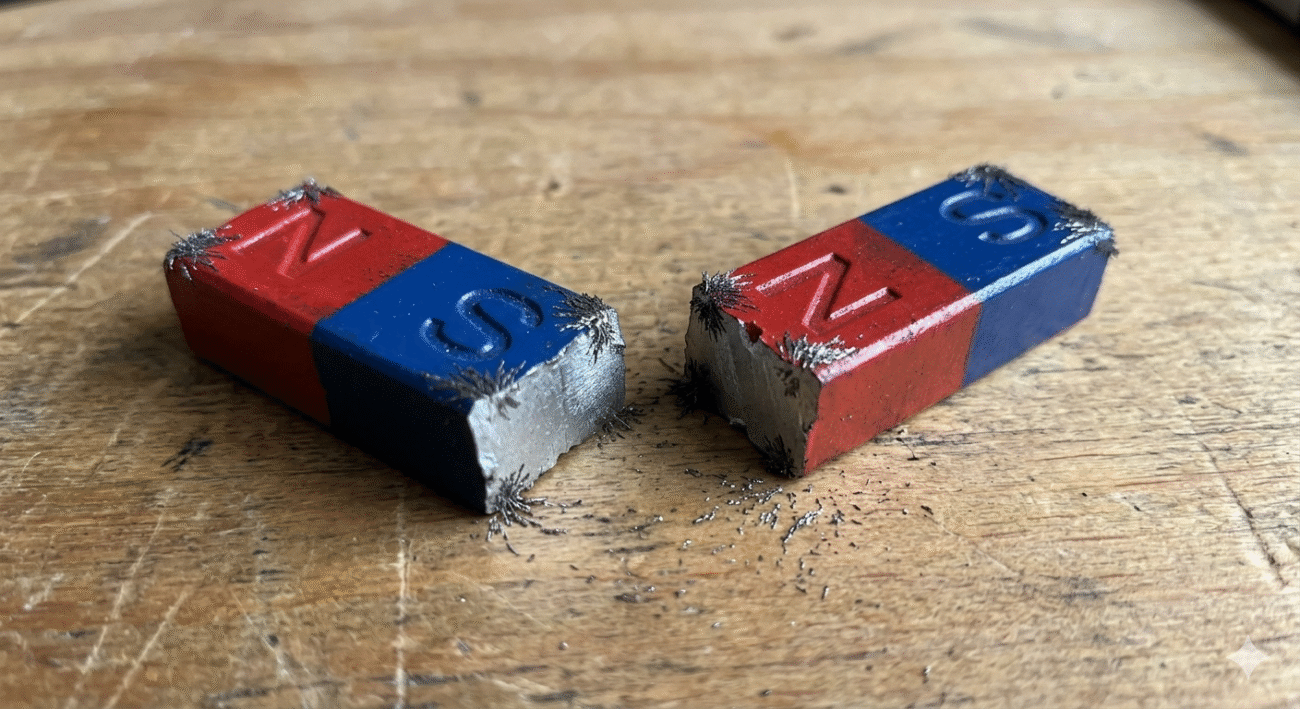
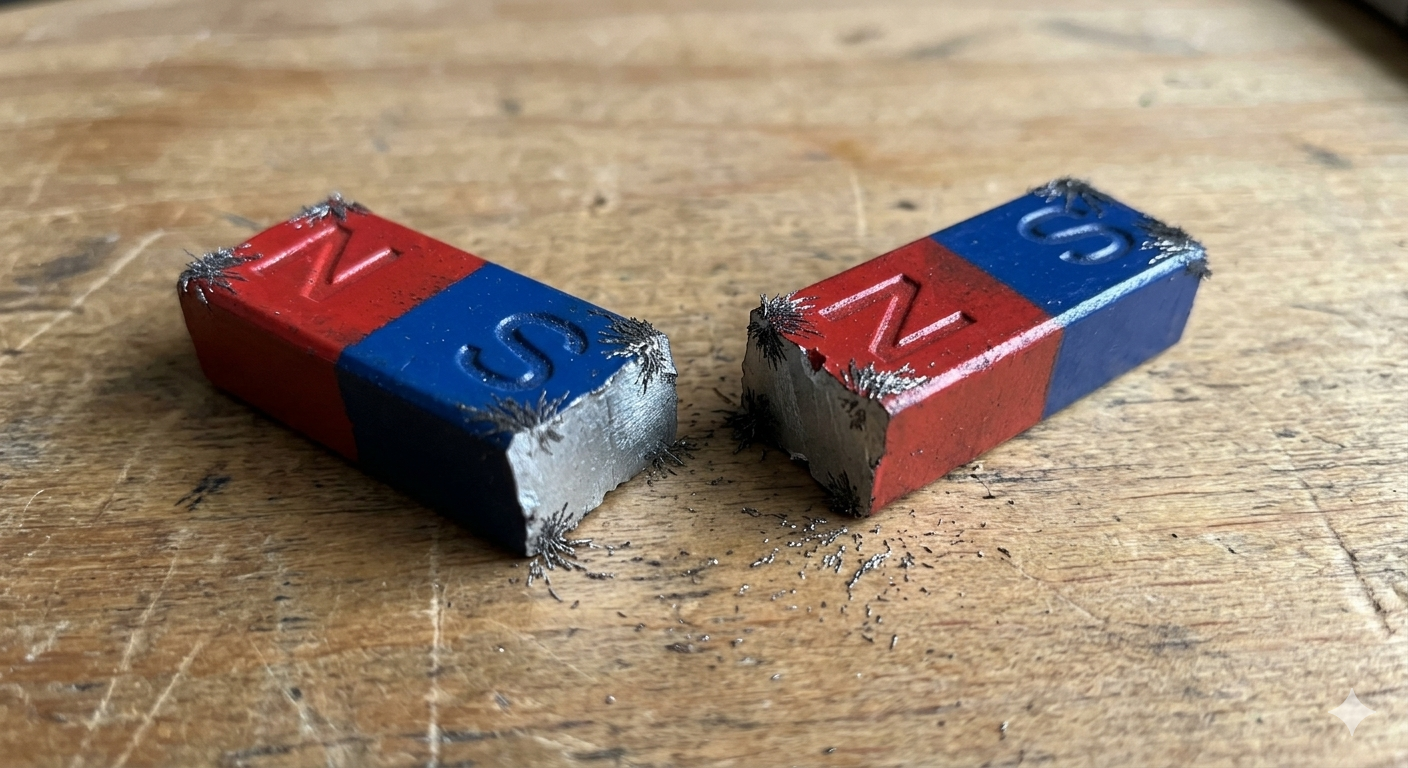
If you’ve ever played with a kitchen magnet, you know the drill. It has a North pole and a South pole. If you’re feeling particularly destructive and decide to snap that magnet in half, you might expect to end up with a “North” piece and a “South” piece.
But nature doesn’t play along. Instead, you just end up with two smaller magnets, each still sporting its own North and South poles. You can keep slicing and dicing down to the level of individual atoms, and you’ll still find those two poles linked together like inseparable twins. In the world of physics, we call this a dipole.
But for over a century, some of the most brilliant minds in science have been asking a nagging question: Where are the orphans? Where are the “monopoles”, particles that carry just a single magnetic charge, either North or South, all by themselves?
The Symmetry Problem
To understand why physicists are so obsessed with finding something that might not exist, we have to look at the inherent beauty of the universe. Generally speaking, nature loves symmetry.
In the 1860s, James Clerk Maxwell unified electricity and magnetism into a single set of equations. They are, for the most part, gorgeous. But there’s a glaring “hiccup” in the math. Electricity has solo players: you can have a lone positive charge (like a proton) or a lone negative charge (like an electron). They don’t need a partner to exist.
Magnetism, however, always shows up in pairs. This creates a lopsidedness in Maxwell’s equations. If magnetic monopoles existed, the math would become perfectly symmetrical. It’s a bit like looking at a beautiful architectural drawing and noticing one window is missing on the left side. You just know it should be there.
Dirac and the “Ghost” of a Particle
In 1931, the legendary physicist Paul Dirac took this curiosity to the next level. He wasn’t just looking for symmetry; he was looking for an explanation for why electricity behaves the way it does.
Dirac discovered that if even a single magnetic monopole existed somewhere in the universe, it would explain why electric charge is “quantized”, meaning it only comes in specific, discrete packets rather than a continuous flow.
Since we know for a fact that electric charge is quantized, Dirac’s math suggested that monopoles must be out there. It was a bold claim: the existence of a particle we’ve never seen is the reason for the behavior of the particles we see every day.
The Big Bang Connection
So, if they are so fundamental, why haven’t we found one? The answer might lie in the sheer violence of the beginning of time.
Modern “Grand Unified Theories” (GUTs), which try to link the three main forces of nature, suggest that monopoles were created in the staggering heat of the very early universe, just fractions of a second after the Big Bang. These aren’t your average subatomic particles. A single magnetic monopole could be incredibly heavy, perhaps 10 quadrillion times the mass of a proton.
If they are that heavy, you aren’t going to find them floating around in a high school lab. You’d need the energy of the early universe to forge them. Some theories suggest that as the universe expanded rapidly (a process called inflation), these monopoles were spread so thin that there might only be a handful of them in our entire observable neighborhood of space.
The Close Calls: Experiments and “Emergent” Monopoles
We haven’t stopped looking, though. Scientists have checked everything from moon rocks to ancient minerals, hoping to find a “trapped” monopole.
One of the most famous stories in this hunt happened on Valentine’s Day in 1982. A physicist named Blas Cabrera at Stanford University had a detector running that consisted of a superconducting loop. If a monopole passed through it, it would leave a very specific “signature” in the electric current. At 1:53 PM, the machine recorded a perfect signal. It was exactly what a monopole should look like.
The physics world held its breath. But despite years of further searching and much more sensitive equipment, the event was never repeated. Was it a real particle from the stars, or just a one-in-a-billion glitch? To this day, it’s known as the “Valentine’s Day Monopole,” a tantalizing mystery that remains unsolved.
Today, experiments like MoEDAL at the Large Hadron Collider are still on the watch. They use specialized plastic foils to catch the “tracks” of highly ionizing particles, hoping to see the tell-tale path of a monopole.
A Different Kind of Monopole
While we haven’t found a “fundamental” monopole (the kind that’s a single particle), we have found something called “emergent” monopoles.
In 2009, researchers working with “spin ice”, a specific type of crystalline material, noticed that the atoms inside behaved in a way that mimicked monopoles. At very low temperatures, the magnetic fields inside the crystal “fracture,” and the North and South poles move independently of one another.
Now, to be clear, these aren’t the cosmic particles Dirac was looking for. They can’t exist outside the crystal. But they prove that the concept of a monopole isn’t just a mathematical fever dream; nature knows how to make them, even if she’s hiding the universal version from us.
Why Does It Matter?
You might wonder why we spend millions of dollars and decades of time looking for a “one-sided magnet.” Is it just about making the equations look pretty?
In part, yes. But it’s also about understanding the structure of reality. Finding a monopole would be like finding a missing piece of the Rosetta Stone. It would confirm our theories about how the forces of nature were once united. It would give us a direct window into the first moments of creation.
There is a certain humility in this search. It reminds us that for all our technological prowess, we are still like children beachcombing, looking for a specific type of shell that we’re pretty sure exists because of the way the waves hit the shore.
Conclusion: The Quiet Universe
As of today, the silence is deafening. Our detectors remain quiet, and our magnets remain stubbornly two-sided.
Perhaps the monopoles are out there, drifting through the vast, dark voids between galaxies, too rare to ever be caught. Or perhaps the universe has a deeper secret that we haven’t yet grasped, a reason why that symmetry remains broken.
Regardless of the outcome, the hunt for the magnetic monopole tells us something profound about ourselves. We aren’t content with just seeing how things work; we want to know why they are the way they are. We look at the stars and the subatomic world and expect to find order, beauty, and logic. Whether we find the “orphan” magnet or not, the search itself is a testament to the human drive to find harmony in the grand design of the cosmos.
