

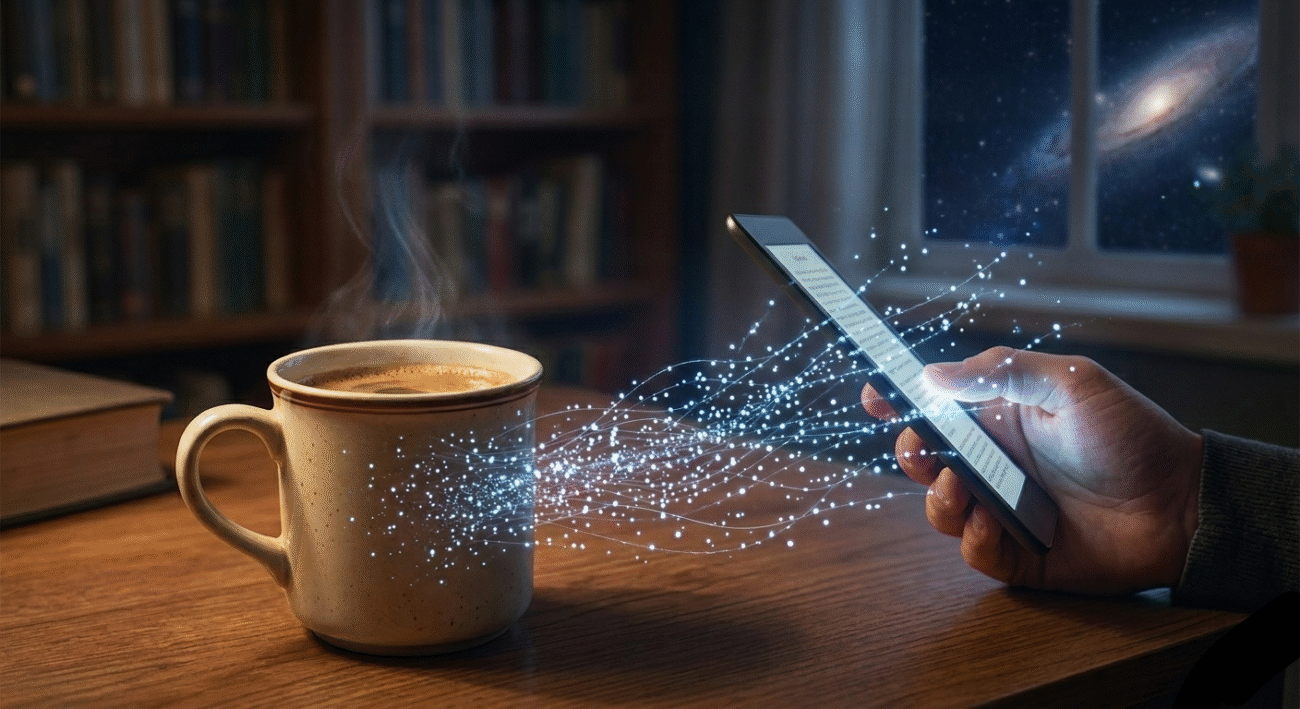
Discover the fascinating world of neutrinos, the nearly invisible “ghost particles” streaming through you right now. A deep dive into the tiny mysteries of the cosmos.
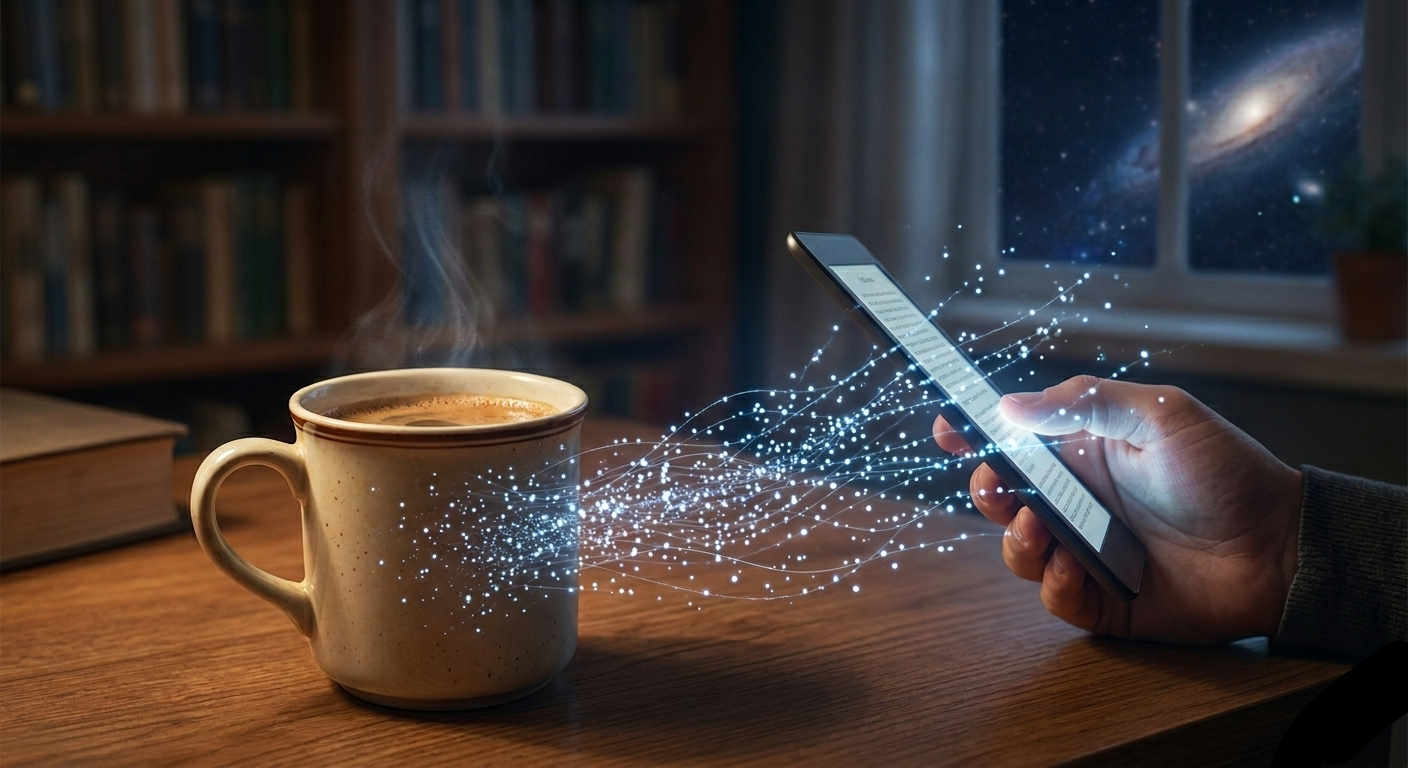
The Ghost Particles in Your Coffee
Right now, as you read this sentence, about 100 trillion tiny travelers are streaming through your body every single second. They are passing through your eyes, your brain, and the device you’re holding. They don’t stop there, either; they zip straight through the floor, through the molten core of the Earth, and out the other side into the vacuum of space at nearly the speed of light.
They haven’t left a single scratch. You didn’t feel a thing.
These are neutrinos, and they are perhaps the most bashful residents of our universe. Often called “ghost particles,” neutrinos are so light and so antisocial that they can pass through a lead wall a light-year thick without ever hitting an atom. For decades, they were the stuff of theoretical whispers, but today, they are the key to understanding why the stars shine and, ultimately, why we exist at all.
A Desperate Idea
The story of the neutrino didn’t start with a high-tech telescope; it started with a “desperate remedy.” In 1930, a physicist named Wolfgang Pauli was looking at radioactive decay and noticed something alarming: energy seemed to be disappearing. In physics, energy is supposed to be conserved, it doesn’t just vanish into thin air.
Pauli sat down and wrote a letter to his colleagues, proposing a “ghost” particle that carried away the missing energy. He hated the idea. He actually apologized for it, saying he had “done a terrible thing” by proposing a particle that could never be detected.
It took another 26 years before technology caught up with his imagination. In 1956, researchers finally “caught” a few neutrinos coming out of a nuclear reactor. Since then, the more we learn about them, the weirder they get.
The Three Flavors of Nothing
Imagine if you bought a scoop of chocolate ice cream, but by the time you walked to your table, it had turned into vanilla. Then, as you took the first bite, it became strawberry.
In the world of the very small, this is exactly what neutrinos do. They come in three “flavors”: electron, muon, and tau. But they don’t pick a lane. As they travel through space, they constantly oscillate, shifting from one flavor to another.
This discovery was a massive deal for the scientific community because it proved something we didn’t expect: neutrinos have mass. It’s an incredibly tiny amount, so small we still haven’t been able to weigh it precisely, but it isn’t zero. If they were massless, like light, they couldn’t change flavors. This tiny bit of weight flipped our understanding of the Standard Model of physics on its head.
Why Do We Care?
It’s easy to ask why we spend billions of dollars building massive detectors to find particles that don’t want to be found. The answer lies in the heart of the sun.
The sun is a giant fusion reactor. At its core, it’s crushing hydrogen into helium, releasing a gargantuan amount of energy. Light is part of that energy, but light is “sticky.” A photon (a particle of light) created in the sun’s core takes about 100,000 years to bounce its way to the surface so it can finally zoom toward Earth.
Neutrinos, however, find the sun transparent. They fly out of the core at the speed of light and reach us in about eight minutes. When we detect solar neutrinos, we aren’t seeing the sun as it was in the Ice Age; we are seeing what is happening in its heart right now. They are our only direct “telescope” into the engines of the stars.
The Giant Underground “Eyes”
Since neutrinos don’t like to interact with anything, catching them requires some of the most surreal architecture on Earth. To find them, you have to go where it’s quiet.
- KM3NeT: the project (Cubic Kilometre Neutrino Telescope) is currently under construction at the bottom of the Mediterranean Sea. Once completed, it will use the crystal-clear, abyssal water off the coasts of France and Italy as its detection medium. By sinking thousands of optical sensors thousands of feet into the darkness, KM3NeT will open a new window on the cosmos, particularly looking toward the center of our galaxy, to find the sources of the most energetic neutrinos in the universe.
- IceCube: Deep under the South Pole, scientists have turned a cubic kilometer of ancient, crystal-clear ice into a detector by lowering strings of sensors into holes miles deep.
- Super-Kamiokande: In Japan, there is a stainless steel tank holding 50,000 tons of ultra-pure water buried deep inside a mountain.
When a neutrino, on the rarest of occasions, actually hits a water molecule, it creates a tiny flash of blue light called Cherenkov radiation. It’s the subatomic equivalent of a sonic boom. By recording these tiny blue sparks, we can trace where the neutrino came from, whether it was a nearby nuclear power plant or a collapsing star halfway across the galaxy.
The Architecture of the Invisible
There is a profound humility in studying the neutrino. We live in a world of “stuff”, mountains, oceans, buildings, that feels solid and permanent. But the vast majority of the universe’s matter is actually these invisible threads, weaving through everything without a sound.
If neutrinos didn’t exist, or if their properties were even slightly different, the nuclear reactions that power the sun wouldn’t work. The heavy elements that make up our bodies, the carbon in our DNA, the calcium in our bones, might never have been forged in the deaths of ancient stars.
We are, in a very real sense, living in a house built by ghosts.
Also read: Why the Universe is Made of Matter not Antimatter?
A Final Thought
As you go about your day, take a moment to consider the invisible rain falling all around you. We often think of “nothingness” as empty space, but the neutrino tells us that “nothing” is actually teeming with information and energy.
The mystery of these particles reminds us that the universe isn’t just what we can see or touch. Most of the “real world” is happening in the silent gaps between atoms, in the particles that refuse to play by our rules. We are just beginning to learn how to listen to what they have to say.

One thought on “Neutrinos: the Ghost Particles and One of the Biggest Mysteries”