

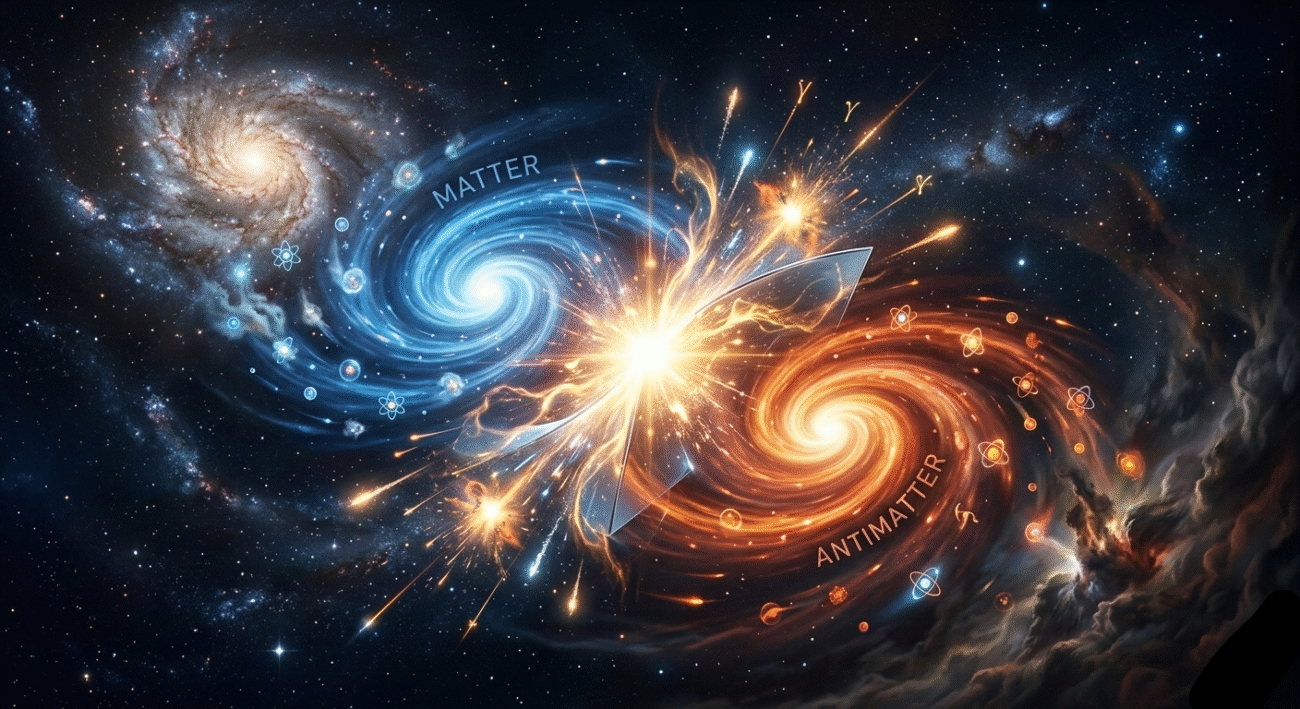
Discover the mind-bending world of antimatter. Learn what it is, why it’s the most expensive substance on Earth, and the giant mystery of why our universe even exists.
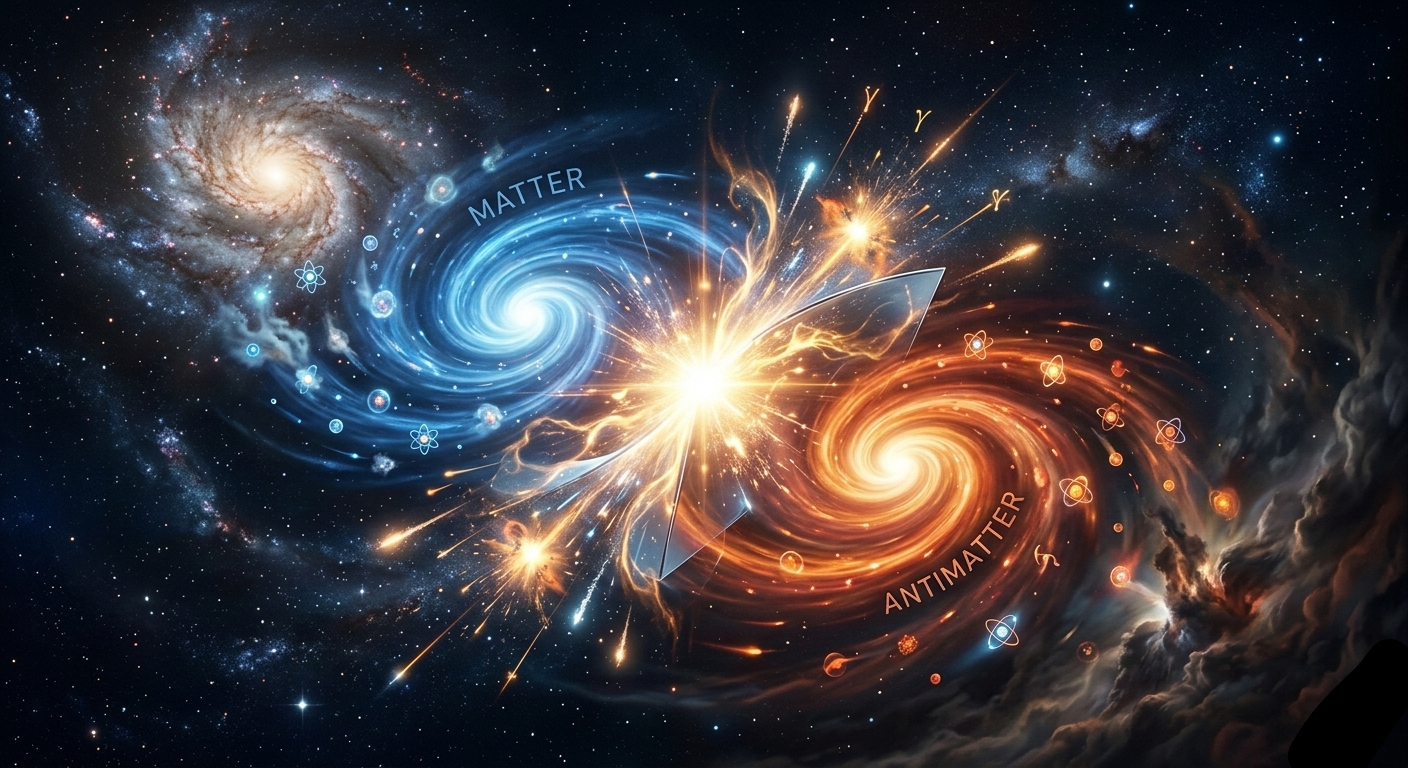
Imagine for a second that you have a twin. This twin looks exactly like you, acts like you, and wears the same clothes. But there’s a catch: they are made of a kind of “reverse” matter. If the two of you ever shook hands, you wouldn’t just have a greeting, you would both vanish in a flash of light brighter than a thousand suns, leaving behind nothing but pure energy.
That isn’t the plot of a low-budget sci-fi flick; it’s a fundamental reality of our universe. This “reverse” material is called antimatter. It is arguably the most exotic, expensive, and elusive substance in existence. And while it sounds like something dreamed up in a writer’s room, it’s currently being studied in labs like CERN, right beneath the Swiss countryside.
The real mystery, however, isn’t just that antimatter exists. It’s that we exist.
The Mirror Image of Reality
To understand antimatter, we first have to look at the “normal” matter that makes up your coffee cup, your phone, and your own skin. Everything we see is built from atoms, which are made of subatomic particles: protons, neutrons, and electrons.
Back in 1928, a physicist named Paul Dirac was staring at some particularly nasty equations. He realized his math suggested something strange: for every particle of matter, there should be an “antiparticle” that is its exact mirror image.
Take the electron, for instance. It has a tiny negative charge. Dirac’s work predicted there should be a particle with the exact same mass but a positive charge. We now call that a positron. A few years later, someone actually found one in a cosmic ray experiment, and the world of physics was never the same.
When Worlds Collide (Literally)
The defining characteristic of antimatter is its relationship with matter. They are the ultimate “star-crossed lovers.” They are drawn to each other, but the moment they touch, they undergo a process called annihilation.
When a particle and its antiparticle meet, they don’t just break into smaller pieces. They transform 100% of their mass into energy. To give you some perspective, the nuclear fission used in power plants only converts about 0.1% of the fuel’s mass into energy. Antimatter is the most efficient fuel source theoretically possible.
If you had just one gram of antimatter and let it touch a gram of regular matter, the resulting explosion would be roughly equivalent to the blast that leveled Hiroshima.
The Great Cosmic Vanishing Act
This brings us to the biggest “Whoops” in the history of science.
According to our best understanding of the Big Bang, the universe should have started with equal amounts of matter and antimatter. It was a massive burst of energy, and energy usually creates particles in pairs.
But here’s the problem: if there were equal amounts of both, they should have all found each other, annihilated, and left the universe as a vast, empty sea of light. There wouldn’t be any stars, no planets, and certainly no people reading articles on the internet.
Yet, here we are.
For some reason, there was a tiny “imperfection” in the early universe. For every billion particles of antimatter, there were roughly a billion and one particles of matter. That tiny surplus, that one-in-a-billion leftover, is what survived the great annihilation to form every galaxy we see today. Why that lopsidedness exists is one of the most profound questions in modern science. It’s as if the universe “preferred” that we exist.
Why Can’t We Just Make More?
If antimatter is such an incredible energy source, why aren’t we using it to power our cities or travel to Mars?
The short answer: it’s incredibly difficult to make and even harder to keep.
At facilities like CERN, they use massive particle accelerators to smash protons into metal targets. Occasionally, the energy from those collisions “condenses” into antimatter. But we’re talking about tiny, microscopic amounts. If we gathered all the antimatter humans have ever produced since the dawn of time and annihilated it all at once, it wouldn’t even have enough energy to boil a pot of tea.
Then there’s the storage problem. You can’t put antimatter in a glass jar or a steel tank because it would touch the walls and, poof, it’s gone. Scientists have to use “Penning traps,” which are complex magnetic and electric fields that suspend the antimatter in a vacuum, keeping it hovering in mid-air so it never touches a single atom of regular matter.
Antimatter in Your Daily Life
Despite its rarity, antimatter isn’t just a laboratory curiosity. You might have already encountered it without realizing it.
If you or a loved one has ever had a PET scan at a hospital, you’ve used antimatter. “PET” stands for Positron Emission Tomography. Doctors inject a radioactive tracer into the body that emits positrons (those “anti-electrons” we mentioned). When those positrons meet the electrons in your cells, they annihilate and give off tiny bursts of gamma rays, which the scanner picks up to create a detailed 3D map of your organs.
It’s a beautiful thought: the most mysterious substance in the cosmos is used every day to save lives right here on Earth.
Also read: The Great Unseen: Are We Living in a Multidimensional Masterpiece?
A Universe Built on a Needle’s Point
When we look up at the night sky, we are looking at the survivors of a cosmic lottery. We live in a world made of matter, but we are surrounded by the “ghosts” of the antimatter that didn’t make it.
The fact that the universe didn’t just cancel itself out, that there was a slight tilt in the scales that allowed for complexity, life, and consciousness, is enough to make anyone pause. It suggests that the laws of physics aren’t just cold, mechanical rules; they are tuned in a way that allows a story to unfold.
We are still searching for the “Why.” We’re looking for why the symmetry broke and where all that missing antimatter went. Perhaps it’s hidden in distant corners of the universe, or perhaps the answer lies in a property of physics we haven’t even named yet.
Until then, we can appreciate the strange reality that we are, quite literally, the “leftovers” of a cosmic miracle.

2 thoughts on “The Universe’s Missing Half: Where Did All the Antimatter Go?”