
Ever wonder what you’re actually made of? Dive into the world of elementary particles, the smallest building blocks of the universe.
Have you ever looked at a mountain, or maybe just the coffee mug on your desk, and wondered how far down the “rabbit hole” goes? If you take that mug and smash it, you get shards. Smash those shards, and you get dust. If you had a powerful enough microscope, you’d eventually see atoms.
But the story doesn’t end there. For a long time, we thought atoms were the end of the line, the “indivisible” bits of the universe. Then we found out they were more like tiny solar systems, with a nucleus of protons and neutrons orbited by electrons.
Today, we know even that isn’t the whole truth. We’ve gone deeper, peeling back the layers of reality to find the true protagonists of the universe: elementary particles. These are the things that cannot be split, have no internal parts, and are the smallest “somethings” that make up everything.
The Standard Model: The Universe’s “Instruction Manual”
Physicists keep track of these particles using something called the Standard Model. Think of it as the ultimate periodic table, but instead of listing elements like gold or oxygen, it lists the fundamental ingredients required to bake a universe from scratch.
The Standard Model is arguably the most successful scientific theory in human history. It’s a bit like a map; it doesn’t just tell us what’s there, but how these tiny pieces talk to each other.
1. The Quarks: The Heavy Lifters
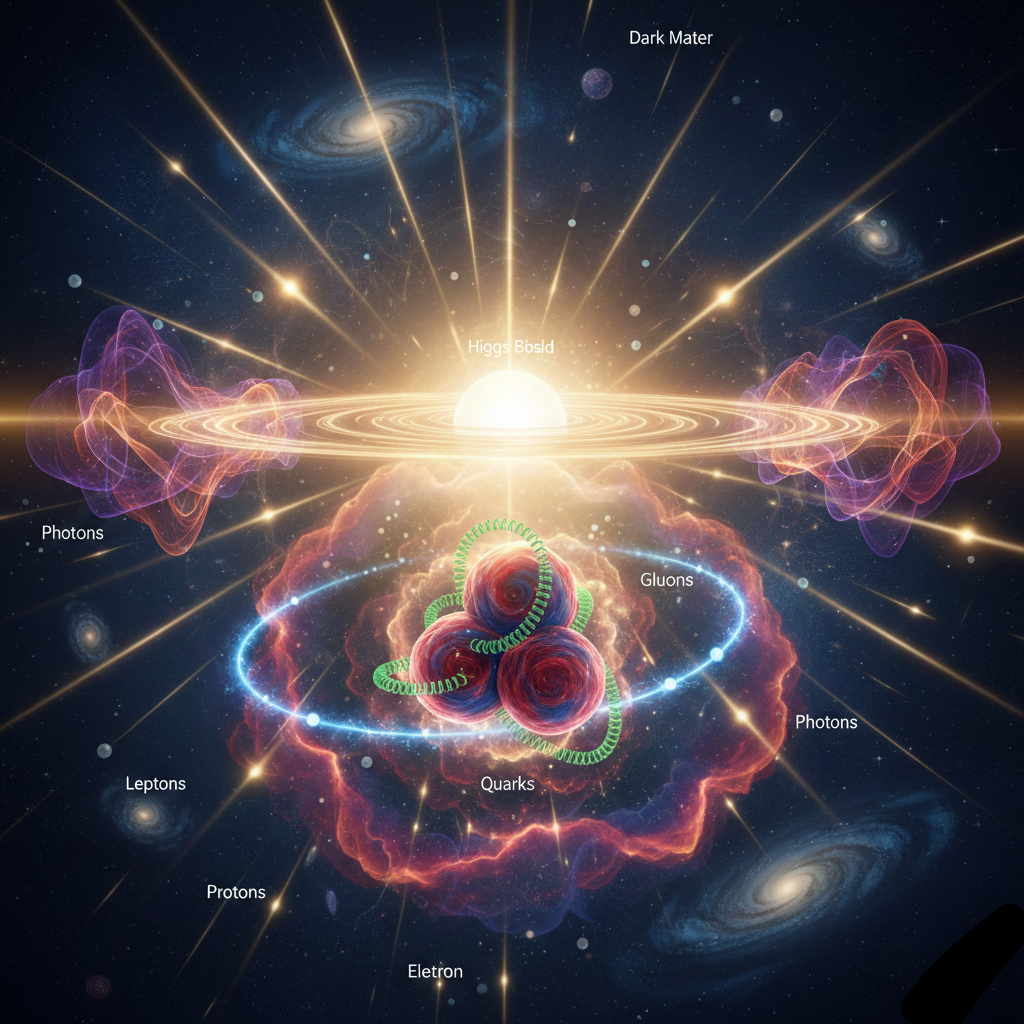
First up are the Quarks. These are the social butterflies of the subatomic world, you never find them alone. They are always bound together in groups.
There are six types (or “flavors,” as physicists whimsically call them), but you only really need to know about two to understand the world around you: the Up quark and the Down quark.
- Two Ups and a Down make a Proton.
- Two Downs and an Up make a Neutron.
Everything you see, the trees, the stars, your own DNA, is essentially just different arrangements of these two little particles. The other four quarks (Charm, Strange, Top, and Bottom) are much heavier and usually only show up in high-energy environments, like the Big Bang or inside giant particle accelerators like the Large Hadron Collider.
2. The Leptons: The Loners
Next, we have the Leptons. Unlike quarks, leptons are perfectly happy being on their own. The most famous lepton is the Electron.
You know the electron as the thing that powers your phone and zips around the outside of atoms. It’s incredibly light and carries a negative charge. But the electron has a mysterious cousin called the Neutrino.
Neutrinos are like ghosts. They have almost no mass and no charge, which means they don’t really interact with anything. Right now, trillions of neutrinos from the sun are streaming through your body every second. They pass through you, the floor, and the entire Earth as if we weren’t even here. It’s a bit humbling to realize the “solid” world is basically transparent to these little guys.
The Messengers: Why Does Anything Happen?
If the universe were just quarks and leptons sitting around, nothing would ever happen. To have a functioning universe, you need forces. You need things to push, pull, and hold together.
In particle physics, forces aren’t just invisible magic; they are carried by “messenger” particles called Bosons.
- Photons: These are particles of light. They carry the electromagnetic force. When you see a sunset or get a static shock from a carpet, that’s photons doing their job.
- Gluons: These are the “glue” of the universe. They carry the Strong Nuclear Force, which holds quarks together to form protons and neutrons. Without gluons, atoms would literally fly apart.
- W and Z Bosons: These carry the Weak Nuclear Force, which is responsible for certain types of radioactive decay. It’s also what allows the sun to shine.
The Guest of Honor: The Higgs Boson
You might remember hearing about the this particle back in 2012. This is the Higgs Boson.
For decades, scientists wondered why some particles, like quarks, have mass, while others, like photons, have none. The theory was that there is an invisible field, the Higgs Field, permeating the entire universe.
Imagine walking through a room full of people. If you’re a famous celebrity, people crowd around you, slowing you down. That “resistance” to movement is effectively mass. If you’re a nobody, you zip through the room unnoticed. The Higgs Boson is the physical proof that this field exists. It gives particles their “heft,” allowing matter to clump together into stars and planets.
Why Should We Care?
At this point, you might be thinking, “This is fascinating, but does it change how I live my life?”
On a practical level, understanding these particles has given us MRI machines, PET scans, and the very transistors that make your computer work. But on a deeper, human level, studying elementary particles is about curiosity. It’s about our innate desire to understand the grand design of the world we find ourselves in.
There is a profound beauty in the idea that the staggering complexity of a human being, the ability to love, to think, to create art, can be traced back to a handful of tiny, invisible points of energy interacting in a perfectly balanced dance.
Also read: The Universe’s Secret Soundtrack: How We Finally Learned to Listen to Gravity.
Final Thoughts: The Mystery Remains
We’ve come a long way since the ancient Greeks guessed that everything was made of earth, air, fire, and water. We’ve mapped the subatomic world with incredible precision. Yet, the more we learn, the more we realize how much is still hidden.
We still don’t know what “Dark Matter” is made of, even though it seems to outweigh all the particles we do know about by five to one. We don’t know how gravity fits into this tiny world.
The story of the elementary particles isn’t finished. It’s an ongoing invitation to look at the world with a sense of wonder. We are, quite literally, made of stardust and organized by laws so elegant they almost feel like a masterpiece. The next time you look at your hands, remember: you are a walking, talking collection of quarks, leptons, and bosons, held together by forces that have been at work since the beginning of time.

3 thoughts on “Small Particles, Big Reality: A Simple Guide to the Building Blocks of Life”