

Explore the mysterious world of rogue planets, worlds that drift through the galaxy without a sun. Learn how they form and why they might be more common than stars.
The Orphans of the Milky Way
Imagine, for a moment, a world where the sun never rises. Not because of a long winter or a thick layer of clouds, but because there is no sun at all.
For a long time, we assumed that planets were strictly “homebodies.” We thought they were inseparable from their parent stars, bound forever by gravity in a neat, predictable cosmic dance. But as our telescopes have grown more sensitive and our understanding of orbital mechanics more nuanced, a different, and slightly haunting picture has emerged.
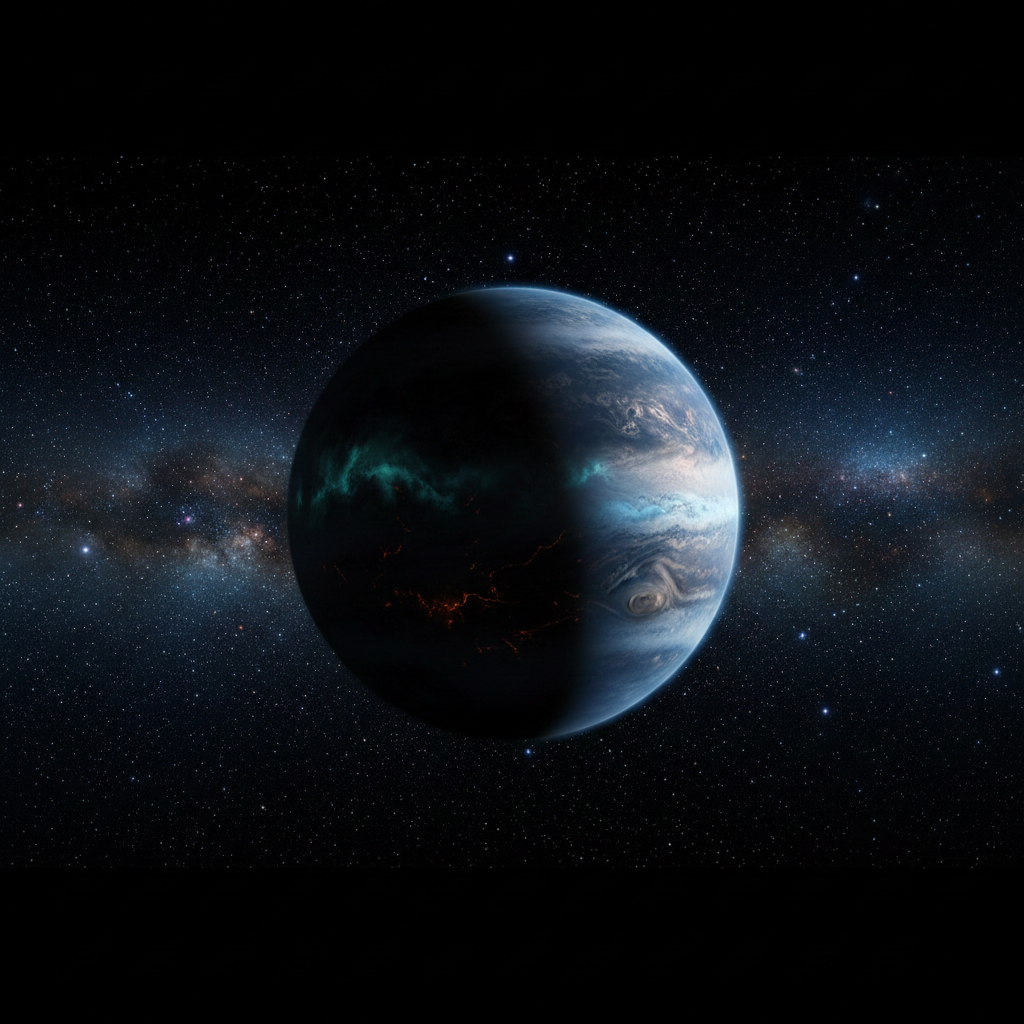
Space isn’t just a void punctuated by solar systems; it is populated by “rogue planets.” These are massive, lonely worlds drifting through the ink-black silence of interstellar space, untethered to any star. They are the cosmic nomads, and they might just outnumber the stars themselves.
How Does a Planet Lose Its Way?
You might wonder how a planet ends up “homeless” in the first place. It turns out that the early stages of a solar system are a lot more violent than the school posters of our Eight Planets suggest.
When a solar system is young, it’s a crowded, chaotic mess of gas, dust, and protoplanets. Gravity is pulling and pushing everything at once. Sometimes, two massive planets will get too close to each other. In this gravitational tug-of-war, one planet might get the “slingshot” treatment, gaining enough speed to be kicked out of the neighborhood entirely.
There is also a second possibility: some rogue planets may never have had a family to begin with. They might form the same way stars do, from the collapse of a small cloud of gas and dust, but they simply never got big enough to ignite and become a sun. They are born in the dark and stay there.
Seeing the Invisible
If these planets don’t have a star to illuminate them, how on earth do we find them? They don’t emit their own light, and they don’t reflect any nearby sunshine. Finding a rogue planet is essentially like trying to find a black cat in a coal cellar during a power outage.
Astronomers have to get creative. We use a technique called gravitational microlensing.
- The Concept: According to Einstein’s theories, gravity warps the fabric of space.
- The Effect: When a rogue planet passes directly in front of a distant, background star, its gravity acts like a magnifying glass.
- The Result: For a brief moment, that distant star appears to brighten.
It’s a fleeting, one-time event. We can’t go back and check it again, which makes the discovery of these worlds feel like catching a glimpse of a ghost.
Could Life Exist in the Dark?
This is the question that usually gets people leaning in closer. We are used to thinking of the Sun as the ultimate source of all life. Without photosynthesis, how could anything survive?
Surprisingly, some planetary scientists believe these dark worlds might not be as frozen as they look. If a rogue planet is large enough and has a thick enough atmosphere, specifically one rich in hydrogen, it might be able to trap its own internal heat.
Planets generate heat from their cores (think of Earth’s molten center). On a rogue planet with a dense “blanket” of an atmosphere, this geothermal energy might be enough to keep oceans liquid beneath a thick crust of ice. It’s a strange thought: a world of eternal night, warmed from below, perhaps harboring life in deep, lightless abysses.
A Galaxy More Crowded Than We Thought
Recent data from missions like the Euclid space telescope suggests that these wanderers aren’t rare exceptions. In fact, some estimates suggest there could be trillions of them in the Milky Way alone.
If that’s true, it changes how we view the “void” between stars. Instead of a vast, empty desert, interstellar space might be more like a crowded highway, filled with billions of dark, silent globes drifting through the shadows.
Also read: How Do Astronomers Measure Distance in Space?
The Beauty of the Wanderer
There is something deeply poetic about the existence of rogue planets. They remind us that the universe is far more dynamic and less “settled” than we like to think. We live in a very stable, privileged corner of the cosmos, but out there, the rules of the game are different.
As we continue to launch more advanced observatories, like the Nancy Grace Roman Space Telescope, we are likely to find thousands more of these nomads. Each one tells a story of a chaotic past, a story of a world that was pushed out into the cold and yet continues to endure, traveling its own path through the stars.
It makes you look at the night sky a little differently, doesn’t it? You realize that for every pinprick of light you see, there might be a dozen dark worlds passing through the gaps, invisible but very much there.

One thought on “The Cosmic Nomads: Are Rogue Planets Wandering the Dark Between Stars?”