

Ever wonder how we know how far away stars are without using a tape measure? Discover the “Cosmic Distance Ladder” and how astronomers measure the universe.
Have you ever stood outside on a truly dark night, looked up at the shimmering carpet of the Milky Way, and felt that sudden, dizzying sense of scale? It’s a universal human experience. But inevitably, once the awe settles, the logical brain kicks in with a stubborn question: How on earth do we actually know how far away all that is?
It’s not like we can fly a tape measure out to Alpha Centauri. Even our fastest spacecraft would take tens of thousands of years just to reach the nearest star system. To the naked eye, the sky looks like a flat canopy, a black cloth poked with silver pins. There is no depth perception in the deep cosmos. Yet, we can confidently say that one star is four light-years away while a galaxy is two million.
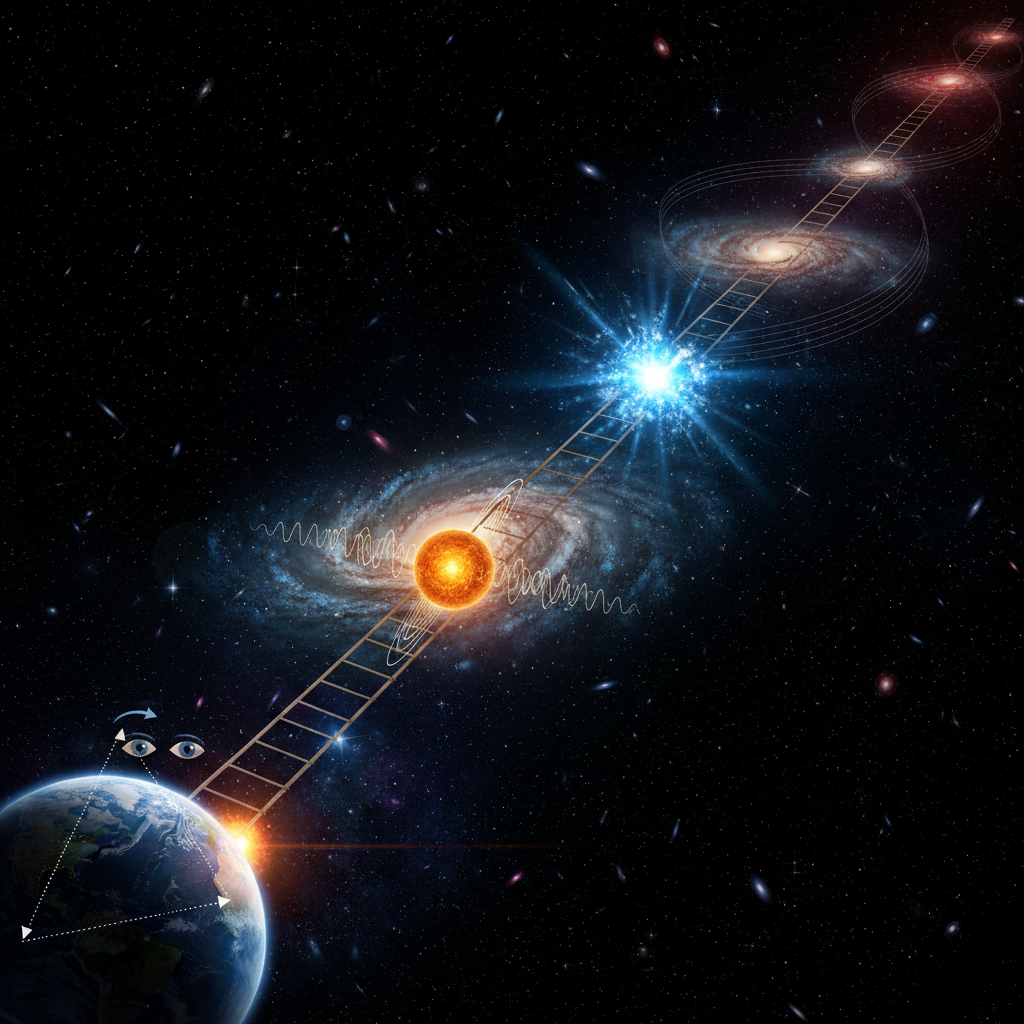
The way we figured this out is one of the most brilliant “MacGyver” moves in scientific history. Astronomers call it the Cosmic Distance Ladder.
The First Rung: Good Old-Fashioned Geometry
The bottom of the ladder starts right here at home using a trick called parallax. You’ve actually used this yourself today without realizing it.
Hold your thumb out at arm’s length and close your left eye. Now switch, closing your right and opening your left. Your thumb appears to “jump” against the background of the wall. That shift happens because your eyes are a few inches apart, giving you two different points of view.
Astronomers do the exact same thing, but they use the entire orbit of the Earth as their “eyes.” They take a picture of a nearby star in January, then wait until July when the Earth is on the opposite side of the sun, about 186 million miles away from where it started. By measuring that tiny shift in the star’s position against the much more distant background, they can use basic high school trigonometry to calculate the distance.
It’s elegant and incredibly accurate, but it has a limit. If the star is too far away, the “jump” is so small it’s impossible to measure. For the deeper reaches of space, we need a different kind of tool.
Standard Candles: The Light Bulbs of the Universe
Once we move beyond our immediate stellar neighborhood, geometry fails us. This is where we stop measuring angles and start measuring brightness.
Imagine you’re standing on a long, dark highway at night. You see a car’s headlights in the distance. If you know exactly how bright those light bulbs are supposed to be (their “intrinsic luminosity”), you can calculate how far away the car is based on how dim the lights look to you. In astronomy, we call these objects Standard Candles.
1. The Pulsing Stars
The most famous standard candles are Cepheid Variables. These are massive, aging stars that “breathe”, they physically expand and contract, getting brighter and dimmer in a steady rhythm.
In the early 1900s, Henrietta Swan Leavitt discovered that the speed of this pulsing is directly tied to the star’s true brightness. If you find a Cepheid that pulses once every ten days, you know exactly how much light it’s putting out. By comparing that to how faint it looks through a telescope, you get a precise distance. It was this discovery that allowed Edwin Hubble to prove that the Andromeda “nebula” was actually a whole separate galaxy.
2. The Supernova Yardstick
But what if a galaxy is so far away we can’t see individual pulsing stars? Then we wait for a Type Ia Supernova. These occur when a white dwarf star steals too much matter from a neighbor and explodes. Because these stars always explode at the exact same mass limit, they always go off with the same “wattage.” They are the most powerful light bulbs in the universe, visible from billions of light-years away.
The Final Stretch: The Redshift
At the furthest edges of the observable universe, even supernovae become rare or hard to spot. Here, we rely on the very fabric of space itself.
In the 1920s, we discovered that the universe is expanding. As light travels through this expanding space, it gets stretched out. Just as a siren’s pitch drops as an ambulance drives away from you (the Doppler Effect), light from distant galaxies gets shifted toward the red end of the spectrum.
This is known as Redshift. The further away a galaxy is, the faster it’s receding from us, and the “redder” its light becomes. By measuring this shift, we can map the distance to the very edge of the cosmic horizon.
A Symphony of Checks and Balances
The reason we call it a “ladder” is that each rung relies on the one below it. We use parallax to calibrate the distance to Cepheid stars. We use those stars to calibrate the distance to supernovae. And we use supernovae to calibrate our understanding of redshift.
If one rung were wrong, the whole thing would wobble. This is why modern astronomy is currently in a bit of a localized “crisis” (which scientists actually find very exciting). Different ways of measuring the expansion of the universe are giving slightly different results. It suggests there’s something about the way space behaves that we don’t quite understand yet.
Also read: When Titans Meet: Can Two Black Holes Actually Collide?
Reflections on the Infinite
It is a profound thought that we, living on a small blue marble tucked away in a quiet corner of a garden-variety galaxy, have been able to “touch” the edge of the universe through nothing more than logic and light.
Measuring the universe isn’t just about numbers or cataloging coordinates. It’s a testament to the human spirit’s refusal to be limited by its physical surroundings. We are small, yes, infinitesimally so. But there is a certain dignity in our ability to look at a flickering point of light and, through patience and math, figure out exactly how much vastness lies between us and the rest of creation.
The universe is a grand, intricate clockwork, and every time we add a new rung to the ladder, we aren’t just measuring distance; we are uncovering the story of where we came from and how we fit into the design.

One thought on “How Do Astronomers Measure Distance in Space?”