

Discover the mystery of pulsars, nature’s most precise cosmic clocks. Learn how these spinning dead stars challenge our understanding of physics and time.
Imagine you’re standing in the middle of a vast, pitch-black ocean. Far off in the distance, a lighthouse beam sweeps across the water. Every few seconds, without fail, that flash of light hits your eyes. It’s rhythmic, dependable, and a little bit lonely.
Now, imagine that lighthouse isn’t on a rocky coast. Instead, it’s a ball of matter the size of a city, spinning faster than a kitchen blender, floating in the deepest reaches of interstellar space.
When astronomers first picked up a signal like this in 1967, they didn’t call it a “pulsar” right away. In fact, for a brief, flickering moment, they wondered if they’d finally heard from someone else. The pulses were so precise, ticking every 1.33 seconds, that the team at Cambridge jokingly labeled the source LGM-1: “Little Green Men.”
As it turns out, the truth was far stranger than aliens. They had discovered a pulsar, and it remains one of the most extreme objects ever found in our universe.
What Exactly Is a Pulsar?
To understand a pulsar, you have to understand the dramatic way a massive star dies. When a star much larger than our Sun runs out of fuel, it doesn’t go quietly. It explodes in a supernova, shedding its outer layers in a violent display of cosmic fireworks.
But what’s left behind is the real “magic.” The core of the star collapses under its own gravity. It gets crushed so tightly that the atoms themselves break down. Electrons and protons are squeezed together until they become neutrons.
What you’re left with is a neutron star.
Think about this for a second: a neutron star takes the mass of about one and a half Suns and packs it into a sphere only about 12 to 15 miles across. It’s like taking the entire Earth and crushing it down until it fits inside a small city’s downtown core. A single teaspoon of pulsar material would weigh about a billion tons.
The Cosmic Lighthouse Effect
So, if every pulsar is a neutron star, why don’t we call them all the same thing? The difference lies in the “pulse.”
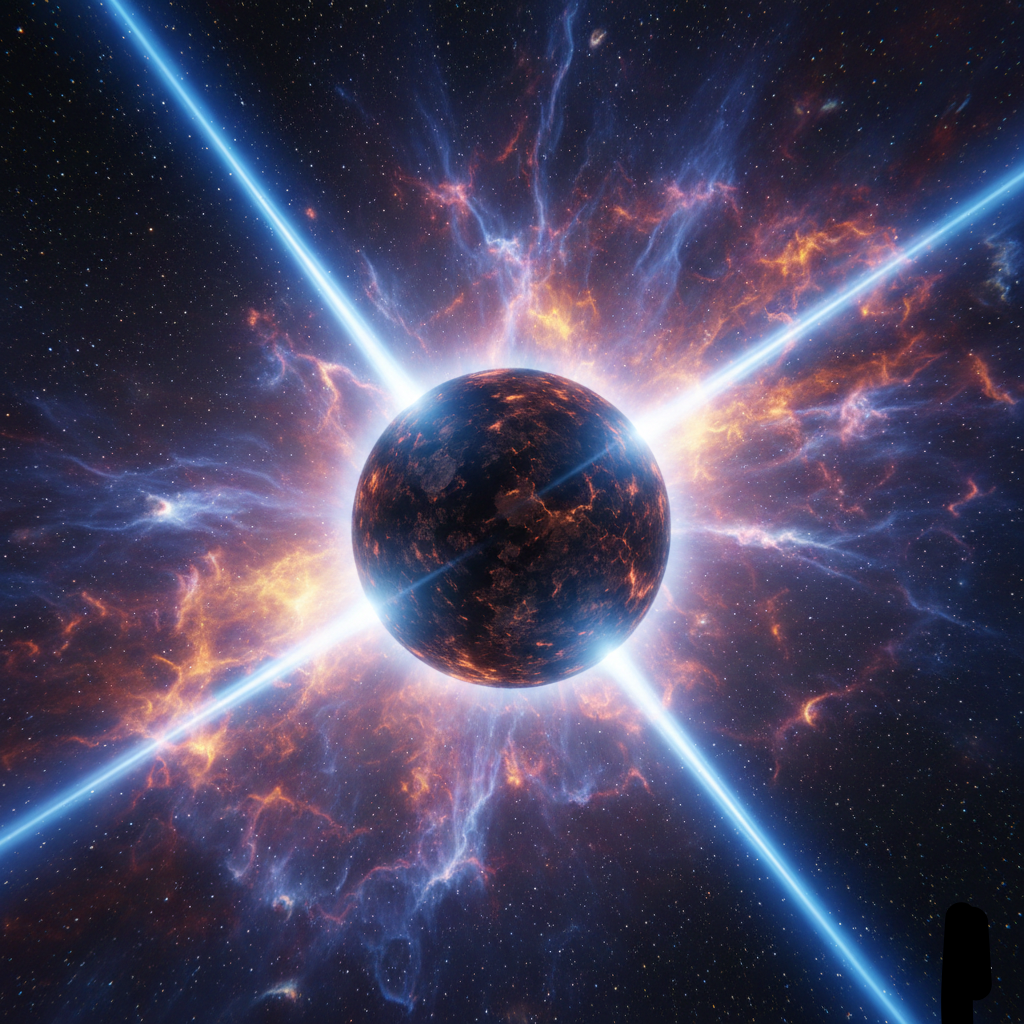
Pulsars are neutron stars that happen to be spinning incredibly fast and possess intense magnetic fields. These magnetic fields funnel jets of particles out of the star’s north and south poles, emitting powerful beams of radio waves.
As the star spins, these beams sweep through space. If the Earth happens to be in the path of that beam, we see a “pulse” of radio energy every time the star completes a rotation. It’s exactly like that lighthouse beam. The star isn’t actually blinking; it’s just spinning, and we’re catching the highlights.
Faster Than a F1 Engine
The speed at which these objects spin is enough to make your head hurt. Some pulsars rotate once every few seconds. Others, known as millisecond pulsars, can spin hundreds of times per second.
The record holder, a pulsar named PSR J1748−2446ad, rotates at about 716 times per second. That means its “surface” is moving at about 24% of the speed of light. If you were standing on its equator (which you couldn’t, because the gravity would instantly turn you into a subatomic pancake), you’d be whipping through space at over 40,000 miles per second.
It’s hard to wrap the human mind around something that massive moving that fast. It defies our everyday intuition of how objects should behave.
Why Do We Care About Beeping Stars?
You might wonder why scientists spend so much time listening to these cosmic “beeps.” It’s not just because they’re cool (though they definitely are). Pulsars are actually some of the most useful tools in the shed for physicists.
1. The Ultimate Clocks
Because pulsars are so massive and their rotation is so stable, they keep time better than almost anything else in the universe. Some pulsars rival the precision of atomic clocks. By monitoring the “ticks” of these stars, astronomers can detect tiny ripples in the fabric of space-time, known as gravitational waves.
2. Laboratories of the Extreme
We can’t build a laboratory on Earth that recreates the intense gravity or magnetism of a pulsar. By observing them, we get to see how matter behaves under conditions that are literally impossible to replicate here. They are the ultimate “crash test dummies” for the laws of physics.
3. GPS for the Galaxy
In the 1970s, when we sent the Voyager spacecraft out into the deep reaches of the solar system, we included a “map” on the Golden Record. That map used the positions and frequencies of 14 pulsars to show any potential finders exactly where Earth is located. Since pulsars are so unique and long-lasting, they serve as permanent cosmic landmarks.
A Sense of Wonder
There is something deeply humbling about the existence of pulsars. When you look up at a clear night sky, it looks peaceful. It looks static. But we know now that the darkness is filled with these invisible, screaming-fast lighthouses, ticking away with a rhythm that has lasted for millions of years.
They remind us that the universe is far more energetic and “alive” than it appears to the naked eye. We live on a quiet little blue marble, but just over the horizon of our vision, the remnants of dead stars are performing a high-speed dance that challenges everything we think we know about time and matter.
Reflection: The Rhythm of the Cosmos
As we’ve moved from the “Little Green Men” theory to a mathematical understanding of neutron stars, we haven’t lost the mystery. If anything, the reality is more poetic.
These stars are the ghosts of giants. They are the concentrated essence of a sun that lived fast and died hard, now spending its afterlife as a clock for the rest of the universe. In their steady, unwavering beat, we find a sense of order amidst the chaos of the cosmos, a reminder that even in the vast, silent reaches of space, there is a rhythm to be found.
The next time you look at the stars, think of the pulsars. Even if you can’t see them, they’re out there, keeping time for the galaxy, one spin at a time.

2 thoughts on “Nature’s Cosmic Metronomes: The Incredible Story of Pulsars”