

Discover the real story behind Schrodinger’s cat. We break down the paradox of quantum superposition and why a cat in a box changed how we see reality.
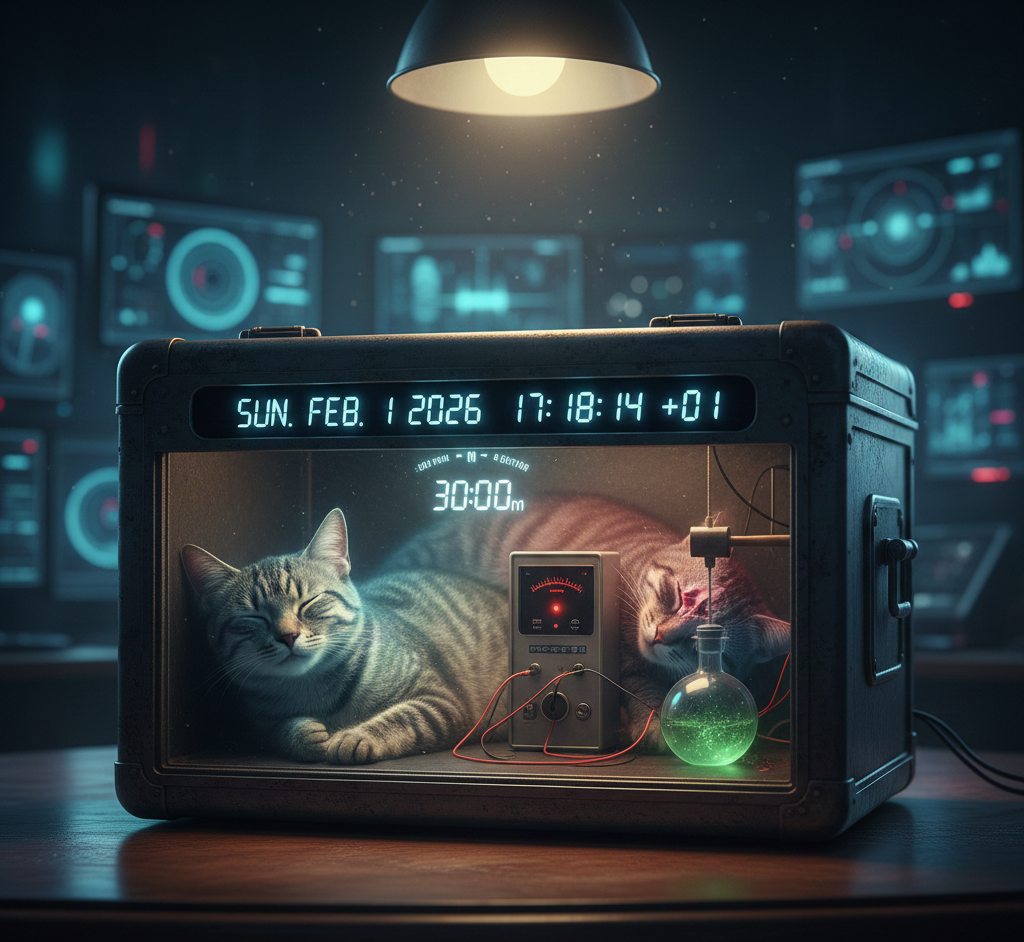
If you’ve spent any time on the internet, you’ve seen the memes. A cat in a cardboard box that is simultaneously grumpy and ghostly, or a “Wanted: Dead and Alive” poster featuring a fluffy tabby. Schrödinger’s cat has become the unofficial mascot of “weird science,” a shorthand for anything that feels confusing or contradictory.
But here’s the kicker: Erwin Schrödinger, the Nobel Prize-winning physicist who dreamed up the scenario in 1935, wasn’t trying to show off how cool quantum mechanics was. He was actually trying to point out how ridiculous it sounded. He wanted to show that if you follow the logic of the leading physics theories of his day to their natural conclusion, you end up with a situation that defies common sense.
So, how did a grumpy physicist’s attempt at sarcasm become the most famous analogy in science? To understand the cat, we first have to understand the microscopic world it was meant to mock.
The World of the Very Small
In our everyday lives, things are predictable. If you leave your keys on the kitchen table, they stay on the kitchen table. They don’t suddenly smear across the room or exist in three different places at once. This is “classical” physics, and it works great for cars, planets, and sandwiches. However, when physicists started looking at atoms and subatomic particles (like electrons), the rules changed. They found that particles don’t have a definite “place” until someone looks at them. Instead, they exist in a “superposition”, a mathematical haze of all possible locations and states at the same time.
Think of a spinning coin. While it’s spinning on the table, it’s not heads, and it’s not tails. It’s a blur of both. Only when you slap your hand down on it does it “collapse” into one state or the other. In the quantum world, everything is a spinning coin.
Enter the Box
Schrödinger found this idea, specifically the “Copenhagen Interpretation” championed by Niels Bohr, to be a bit much. He decided to scale the problem up to something we can all visualize: a cat. The setup is famous: You take a cat and place it in a sealed steel chamber. Along with the cat, you place a “diabolical device.” This device contains a tiny bit of radioactive substance, so small that perhaps in one hour, one of the atoms decays, but also, with equal probability, perhaps none of them do. If an atom decays, it triggers a Geiger counter, which releases a hammer that breaks a flask of poisonous gas, killing the cat. If no atom decays, the cat stays perfectly fine.
Dead and Alive?
According to the quantum rules of the time, because the decay of the atom is a quantum event, it exists in a superposition of “decayed” and “not decayed” until someone measures it. But because the life of the cat is tied to that atom, the logic dictates that the cat must also be in a superposition. Until you open the box to check, the cat is, mathematically and physically, both dead and alive. Schrödinger’s point was simple: That’s absurd. He wasn’t suggesting that “zombie cats” are a real biological phenomenon. He was using the cat to show that there was a missing link between the quantum world of atoms and the “macro” world we live in. He was essentially asking, “At what point does the weirdness stop?”
Why Does Looking Matter?
You might be thinking, “The cat knows if it’s alive! It doesn’t need me to open the box.” And you’re right. In modern physics, we talk about something called decoherence.
The reason we don’t see “dead-and-alive” cats in the real world is that the cat is constantly interacting with its environment, bumping into air molecules, radiating heat, even touching the floor of the box. Each of these interactions acts like a mini-observation, “collapsing” the quantum state almost instantly.
To keep something in a true superposition, you have to isolate it perfectly from the rest of the universe, which is nearly impossible for anything larger than a few molecules.
Why We Still Talk About It ?
If Schrödinger was trying to debunk the idea, why are we still obsessed with it? Because even though the cat is a joke, the underlying science is 100% real.
Today, we use the principles of superposition to build quantum computers. Unlike a regular computer bit that is either a 1 or a 0, a “qubit” can be both at the same time. This allows quantum computers to process massive amounts of data in parallel, solving problems that would take a normal supercomputer thousands of years. The cat also sparked the “Many Worlds” interpretation. Some physicists suggest that the cat doesn’t collapse into one state. Instead, at the moment the box is opened, the universe splits. In one timeline, you see a living cat; in another, you’re mourning a pet. It sounds like science fiction, but it’s a serious theory held by some of the brightest minds in the field.
Also read: Will the Universe eventually collapse ?
The Lesson of the Cat
Schrödinger’s cat teaches us that reality is a lot more fragile than it looks. We like to think of the world as a solid, objective place, but at its very foundation, it’s built on probabilities and shadows.
We may never see a cat that is both dead and alive, but we live in a universe where the building blocks of life are doing exactly that every single nanosecond. Schrödinger intended his cat to be a warning about the limits of our understanding, but it ended up becoming an invitation to look deeper into the mystery.
Next time you see a cat staring intently at a seemingly empty corner of the room, don’t just assume it’s chasing a ghost. Maybe it’s just more in tune with the quantum blur of the universe than we are.

The beauty of your writing lies not just in its words, but in its ability to evoke deeper emotions and thoughts.