
Ever wondered what life looks like at the speed of light? Explore the mind-bending reality of Einstein’s cosmic speed limit, time dilation, and why the universe won’t let you go any faster.
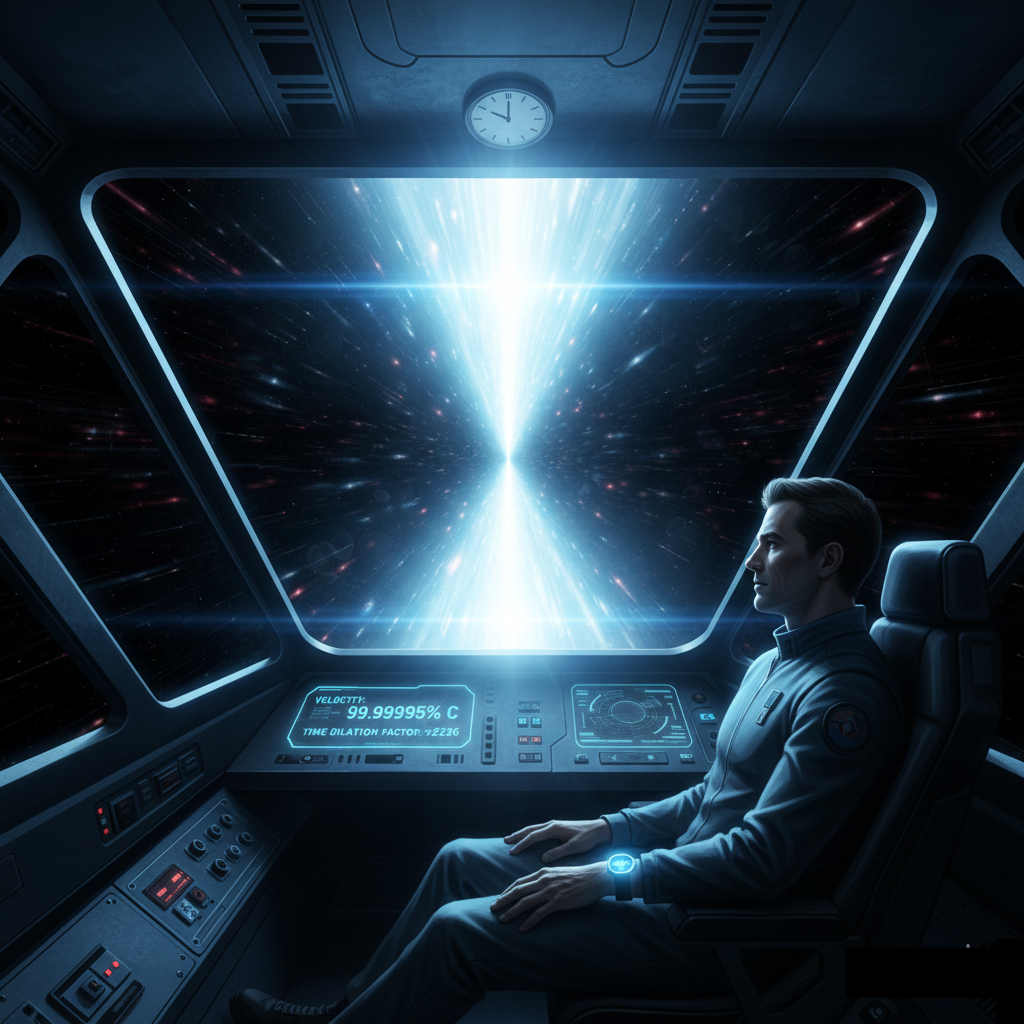
We’ve all seen it in the movies. A captain barks an order, a lever is pushed, and the stars outside the cockpit window stretch into long, glowing streaks of white light. In an instant, the ship is across the galaxy. It’s a convenient plot device, but it hides a reality that is far more haunting and beautiful than Hollywood usually lets on.
If you could actually hitch a ride on a beam of light, the universe wouldn’t just look different, it would break. Time would cease to mean anything, space would shrink to a point, and the very laws of physics would conspire to stop you from ever reaching that finish line.
The Ultimate Speed Limit
First, we have to talk about the number. Light travels at roughly 299,792,458 meters per second. In the time it took you to read that sentence, a photon (a particle of light) could have circled the Earth seven times.
In our daily lives, speed feels additive. If you’re on a train going 50 mph and you throw a ball forward at 10 mph, someone on the ground sees that ball moving at 60 mph. Common sense, right? But light doesn’t play by those rules. Whether you’re standing still or chasing a light beam in a rocket ship, that light is always moving away from you at the exact same speed.
This realization was Albert Einstein’s “aha!” moment. If the speed of light is a constant, then everything else we thought was fixed, like time and space, must be flexible.
Also read: Why your GPS needs Einstein to work.
Mass: The Heavy Price of Speed
Here is the first “gotcha” of interstellar travel: the faster you go, the “heavier” you get.
In physics, energy and mass are two sides of the same coin (E=mc^2). As you pump energy into a spaceship to make it go faster, that energy doesn’t just increase your velocity; it actually increases your relativistic mass.
Imagine trying to push a shopping cart. At a walking pace, it’s easy. But as you approach the speed of light, that shopping cart starts to feel like it weighs as much as a mountain, then a planet, then a galaxy. To get that last tiny bit of speed to actually hit the limit, you would need an infinite amount of energy. Since there isn’t an infinite amount of energy in the entire universe, you’re stuck. You can get to 99.9%, but that final 0.1% is a brick wall built by the laws of nature.
Time is a Rubber Band
Let’s pretend for a moment that we found a loophole, a “cheat code” for the universe. You’re now traveling at 99.5% the speed of light. What do you see?This is where things get trippy. You wouldn’t feel like you’re moving fast. To you, inside the ship, everything feels normal. Your heart beats at the same rate; your watch ticks at the same speed. But if you could look through a telescope at your friends back on Earth, you’d see them moving in extreme fast-forward.
This is time dilation. From Earth’s perspective, your time has slowed down to a crawl. If you took a five-year trip at near-light speed and then returned home, you might find that decades, or even centuries, have passed on Earth. You’ve essentially traveled into the future. It’s a one-way ticket; there’s no “reverse” gear for this kind of time travel.
The View from the Cockpit: The Doppler Effect
What about the view out the window? Forget the “star streaks” from Star Wars.
As you accelerate, a phenomenon called the Doppler Effect takes over. You know how a siren changes pitch as an ambulance drives past? Light does the same thing. The light from stars in front of you would be “blue-shifted”, bunched up into shorter, higher-energy wavelengths. Eventually, visible light would shift all the way into X-rays and gamma rays, becoming invisible to the human eye (and potentially lethal).
Meanwhile, the stars behind you would “red-shift,” stretching out into radio waves until they vanished into darkness.
Furthermore, because of Relativistic Aberration, your field of view would warp. Even stars that are technically behind you would appear to swing around into the front. It would feel like you’re looking through a massive, distorted “fish-eye” lens, with the entire universe being compressed into a single, blindingly bright tunnel of light directly ahead of you.
The Photon’s Perspective: Instant Everything
Now, let’s go all the way. What if you were a photon?
For a particle of light, time doesn’t exist. This is the most difficult concept to wrap our heads around. Because of how the math of relativity works, at the speed of light, time dilation becomes infinite.
If you were a photon emitted from a star 100 million light-years away, you would feel like you arrived at the human eye that perceives you the exact same instant you were born. To the photon, there is no journey. There is no distance. The universe is essentially flat, and every point in space and time is reachable instantaneously.
We see the light from ancient stars as “old,” but to the light itself, it is still the moment of the Big Bang.
Why Does This Matter?
It’s easy to dismiss this as “nerd talk” or stuff that only matters if you have a billion-dollar rocket. But understanding the speed of light is really about understanding the fabric of our reality. It tells us that we live in a universe that has a built-in “refresh rate.” It tells us that “now” is a subjective term.
The speed of light isn’t just a speed; it’s the speed of causality. It’s the maximum rate at which information can travel. If the Sun disappeared this second, we wouldn’t know for eight minutes, because the “news” of its disappearance literally cannot reach us any faster.
Final Thoughts
We may never reach the stars in a single human lifetime using conventional engines. The speed of light is a formidable gatekeeper, demanding infinite energy and warping our reality the closer we get to it.
But maybe that’s for the best. The fact that the universe has these “hard limits” gives it structure. It ensures that cause always precedes effect and that the past stays in the past. We are living in a giant, beautifully synchronized clock, and while we might be frustrated that we can’t break the gears, there’s something deeply humbling about knowing we’re part of the mechanism.
So, the next time you look up at a star, remember: you aren’t just looking at a point of light. You’re looking at a traveler that has experienced no time at all to reach you, carrying news from the past at the fastest speed the universe allows.

3 thoughts on “The Cosmic Speed Limit: What Happens if We Actually Hit 300,000 Kilometers per Second?”