
Ever wonder what happens when particles collide at near light speed? Explore the high-energy world of particle physics, the Large Hadron Collider, and the secrets of the universe.
We tend to think of the world as a solid, dependable place. You sit on a chair, and it holds you up. You throw a ball, and it bounces. But if you zoom in, past the cells, past the molecules, and deep into the heart of the atom, the rules of the “real world” start to feel a lot more like a fever dream.
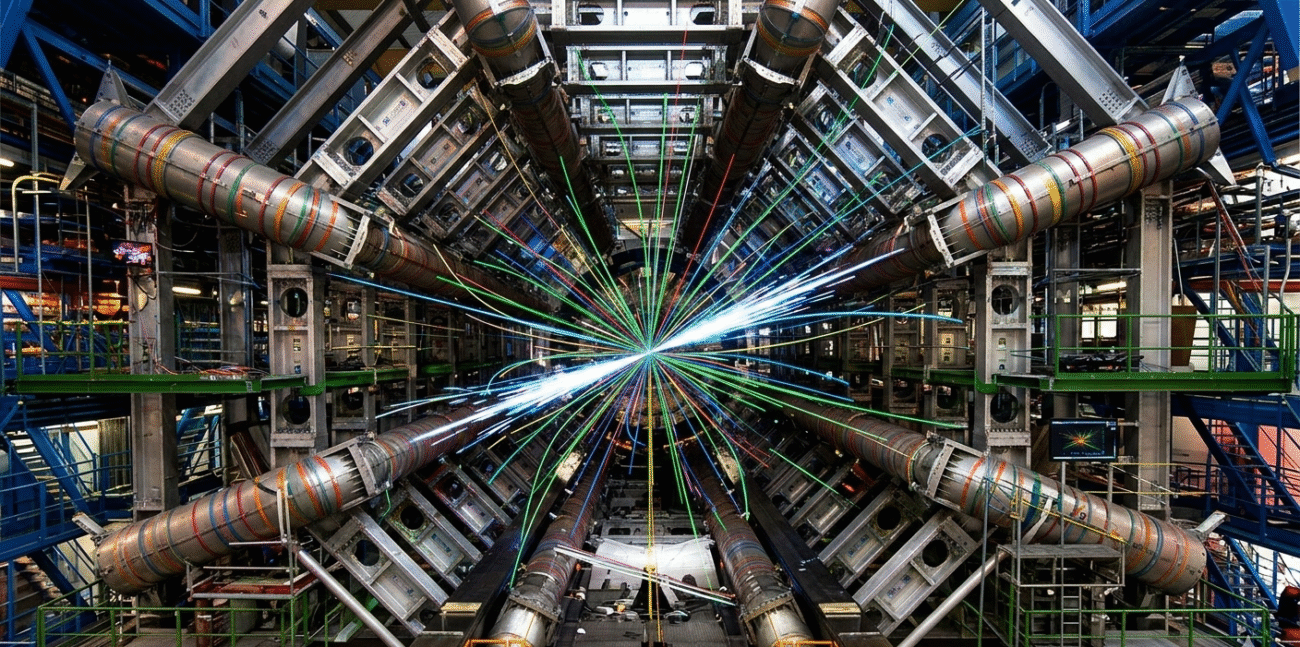
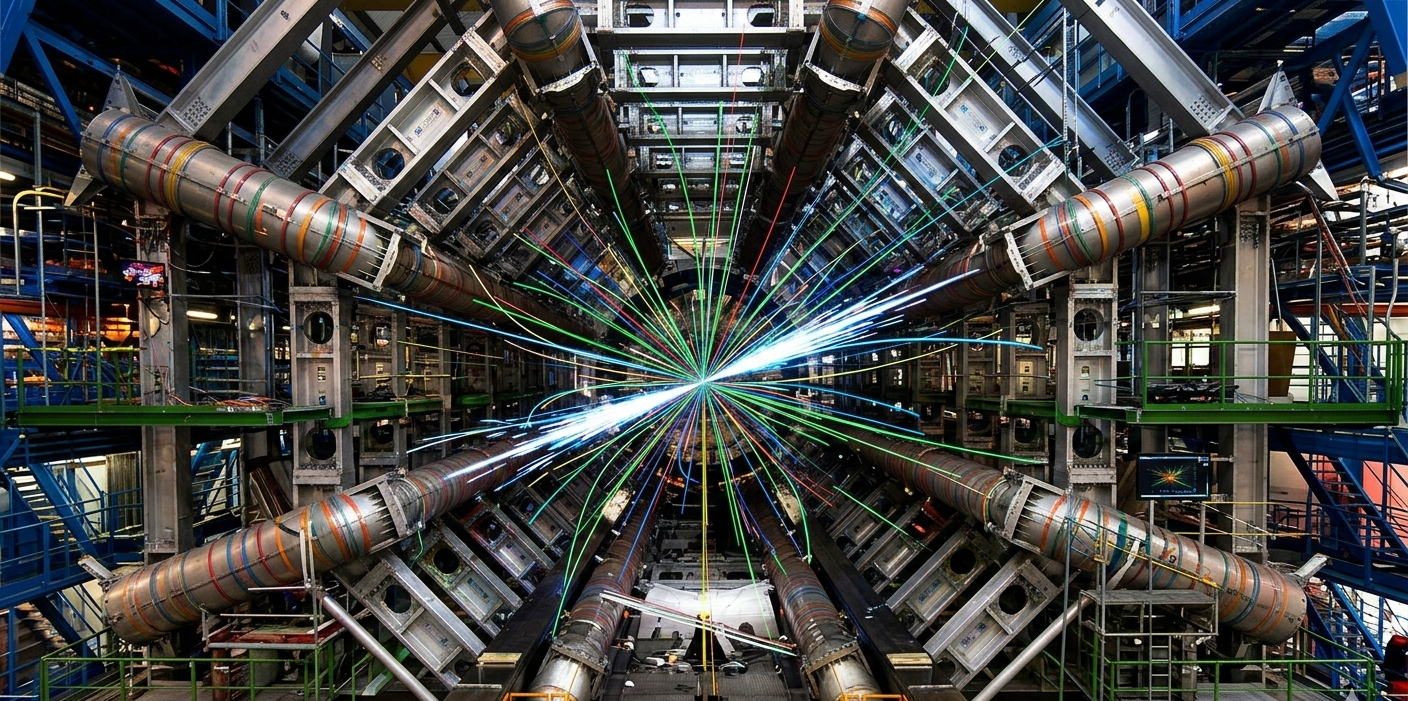
In massive tunnels buried deep underground, like the Large Hadron Collider (LHC) in Switzerland, scientists spend their days playing the world’s most expensive game of “bumper cars.” They take tiny bits of matter, accelerate them to 99.9999991% the speed of light, and smash them into each other.
But why? What actually happens in that fraction of a billionth of a second when two particles meet head-on at nearly 300,000 kilometers per second?
It’s Not Just a Crash; It’s a Transformation
In our everyday lives, if you crash two watches together, you get a pile of broken watches. You don’t expect the gears and springs to suddenly turn into a toaster or a flock of birds.
In the subatomic world, however, things are different. When two protons collide at near light speed, they don’t just “break.” Because they are traveling so fast, they carry a staggering amount of kinetic energy. According to the most famous principle in physics, Einstein’s E=mc^2, energy and mass are just two sides of the same coin.
When those protons hit, that massive burst of energy is instantly converted into matter. New particles, some much heavier than the original protons, pop into existence out of thin air. It’s less like a car crash and more like two strawberries colliding and producing a whole fruit salad.
The Speed Limit of the Universe
You might wonder why we say “near” the speed of light and not just “at” the speed of light. Well, the universe has a very strict enforcement policy.
As an object with mass moves faster, it actually becomes “heavier” in terms of its energy content. The closer a proton gets to the speed of light, the more energy you have to pump into it to get that extra tiny bit of speed. To get a single proton to move exactly at the speed of light would require an infinite amount of energy. Since we don’t have an infinite power bill budget, we settle for 99.99…%.
At these speeds, time even starts to behave strangely. From the perspective of the particle, time slows down. This “time dilation” allows some unstable particles to live much longer than they otherwise would, giving our detectors a chance to see them before they vanish.
Recreating the “First Moments”
Why go to all this trouble? It isn’t just for the fireworks.
When particles collide at these energies, the conditions inside the detector mimic the state of the universe as it was a mere trillionth of a second after its beginning. We are essentially building a time machine.
By looking at the debris of these crashes, we’ve discovered things like the Higgs Boson, a particle that acts like a cosmic molasses, giving everything else in the universe its mass. Without it, you, the stars, and this screen wouldn’t exist; we’d all just be massless energy zipping around at light speed, unable to form atoms.
The Invisible Ghost Hunt
Most of what happens in these collisions involves things we can’t see with the naked eye. We use massive detectors, some as big as apartment buildings, to trace the paths of the “shrapnel.”
- Quarks: The building blocks of protons.
- Gluons: The “glue” that holds quarks together.
- Muons: Heavy cousins of the electron that can shoot through meters of solid steel.
Every now and then, something truly weird happens. Scientists look for “missing” energy. If the energy going into the crash doesn’t match the energy coming out, it suggests something invisible escaped. This is how we hunt for Dark Matter, the mysterious substance that makes up most of the universe but refuses to reflect or emit light.
Why This Matters to You
It’s easy to feel like this is all very “ivory tower” stuff. After all, how does a subatomic explosion in Switzerland help you get through your Tuesday?
History shows that whenever we push the boundaries of what we know about the physical world, the world changes. The experiments that led to our understanding of the electron eventually gave us the smartphone in your pocket. The pursuit of the Higgs Boson required the invention of the World Wide Web (literally, it was created at CERN to help scientists share data).
Beyond the tech, there is a deeper, more human reason. We are a curious species. We want to know how the clockwork of reality actually functions.
A Moment of Reflection
When we watch these particles collide, we are witnessing the fundamental laws of creation in their rawest form. It’s a humbling reminder that everything we see, the trees, the people we love, the vastness of the night sky, is built from a tiny number of building blocks, governed by a set of rules that are as elegant as they are mysterious.
The next time you look at your hand, try to imagine the trillions of tiny particles inside you, all held together by the same forces we study in these giant tunnels. We are, in a very literal sense, the universe trying to understand itself.
It makes you wonder: if such complexity can emerge from the simple collision of two tiny dots, what else is hidden in the fabric of the world that we haven’t even thought to look for yet?
