
Discover why the vacuum of space isn’t actually empty. Explore the fascinating world of quantum fluctuations, the Casimir Effect, and the hidden energy that fills our universe.
The Mystery of the Missing Nothing
Imagine you have a perfectly sealed glass box. You use a high-powered vacuum pump to suck out every single molecule of air. Then, you find a way to shield it from all outside radiation, no light, no radio waves, no heat. Finally, you cool it down to absolute zero so there’s no thermal jiggle left.
By all the rules of common sense, that box should now be empty. It should contain a whole lot of “nothing.”
But if you asked a modern physicist what’s left in that box, they’d tell you it’s actually buzzing with activity. In fact, “nothing” might be the most interesting “something” in the entire universe. As it turns out, the vacuum of space isn’t a cold, dead void; it’s more like a restless ocean, filled with waves and energy that we are only just beginning to understand.
The Quantum Jitter
To understand why space isn’t empty, we have to shrink our perspective down to the quantum level. In our daily lives, we expect things to be still. If you put a coffee mug on a table and leave the room, you expect it to be exactly where you left it.
However, in the subatomic world, the universe is a bit more… anxious.
There is a fundamental rule in physics called the Heisenberg Uncertainty Principle. It basically states that you can’t know everything about a particle at once. But it also applies to energy and time. On a very, very tiny scale, the amount of energy in a specific point of space is always fluctuating.
Think of it like a crowded party heard through a wall. You can’t make out individual words, but you can hear the constant, low-level hum of conversation. In the vacuum of space, this “hum” consists of virtual particles. These are pairs of particles, usually an electron and its antimatter twin, a positron, that pop into existence out of nowhere, zip around for a fraction of a billionth of a second, and then slam back into each other and vanish.
Proving the Invisible: The Casimir Effect
Now, I know what you’re thinking: “If these particles vanish instantly and we can’t see them, how do we know this isn’t just a convenient fairy tale told by scientists?” That’s where things get really cool. We’ve actually seen the physical effects of this “emptiness” in the lab.
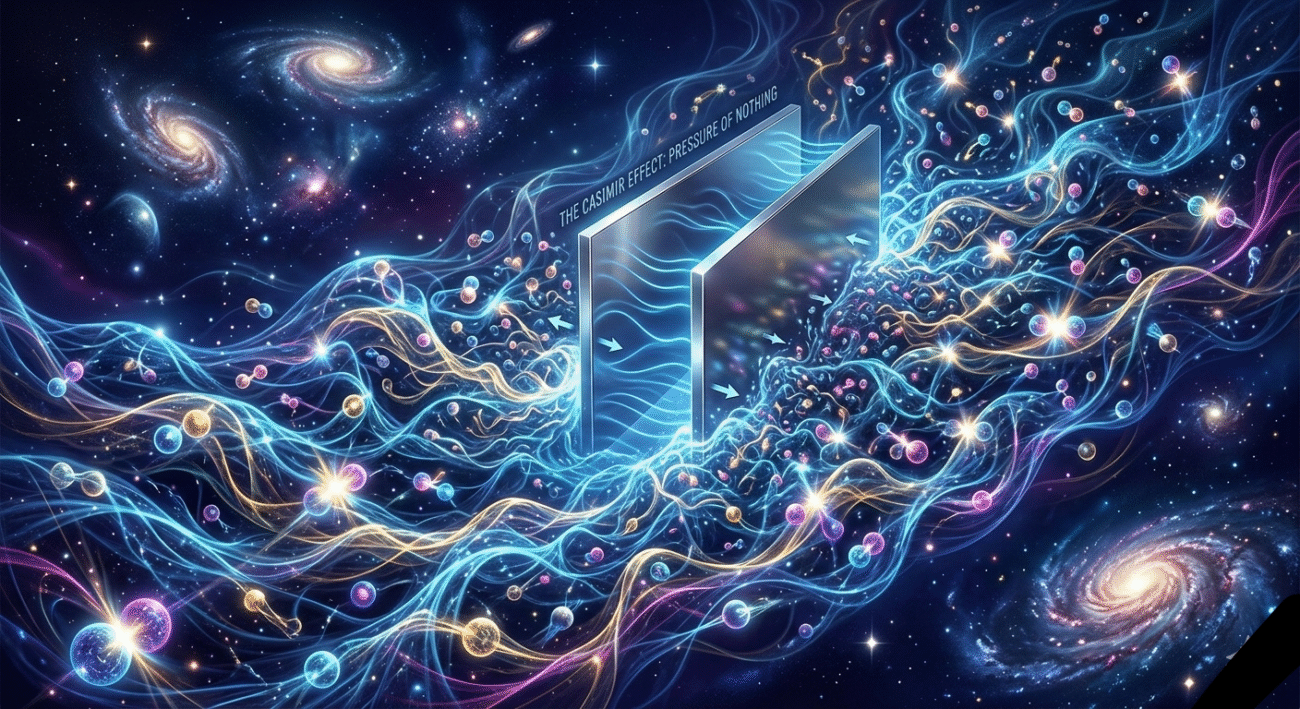
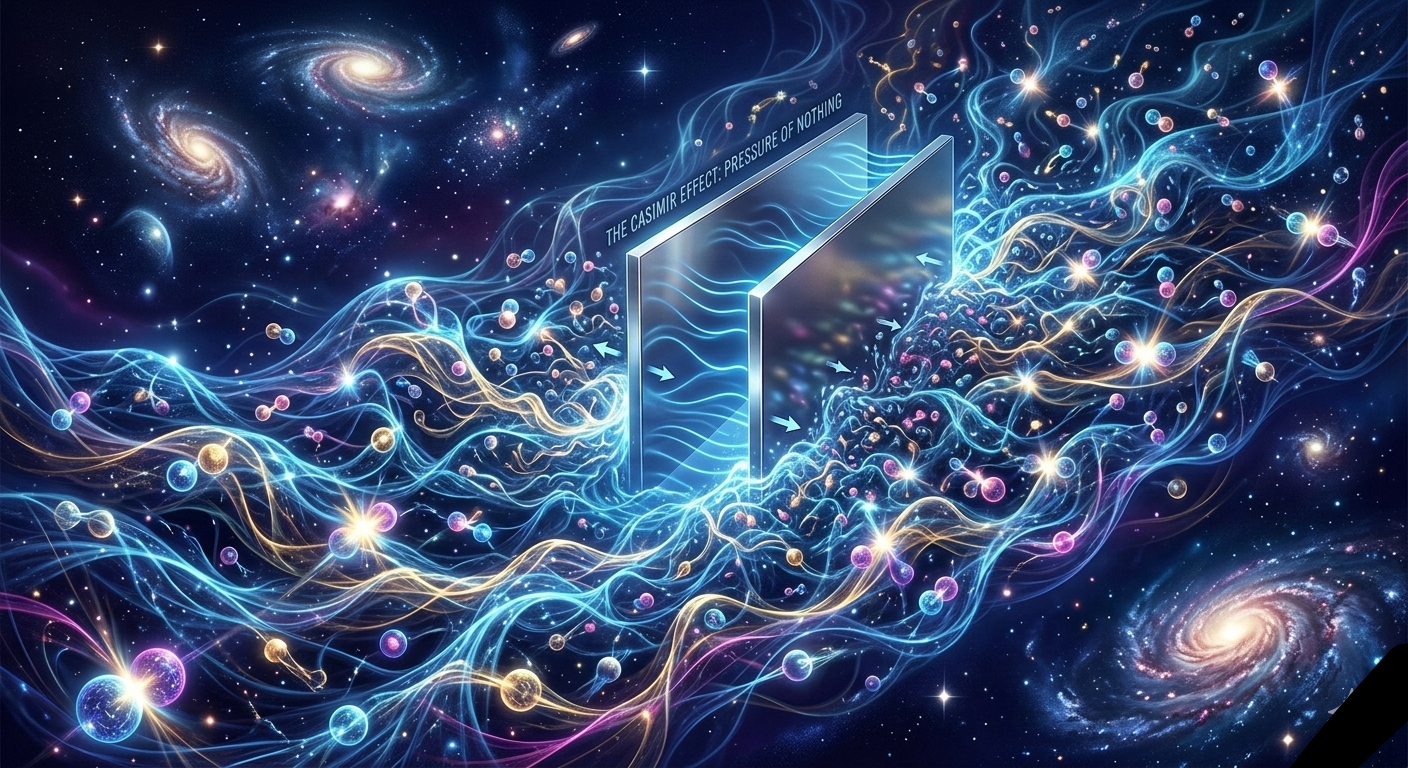
Back in 1948, a Dutch physicist named Hendrik Casimir proposed a brilliant experiment. He suggested that if you took two uncharged metal plates and placed them incredibly close together, we’re talking hair-width distances, the vacuum would actually push them together.
Because the space between the plates is so narrow, only certain “ripples” of the quantum vacuum can fit inside, while a whole sea of ripples exists on the outside. This creates a tiny bit more pressure on the outside than the inside, nudging the plates together. Decades later, experimentalists finally proved he was right. The vacuum was doing work. It was exerting force.
It’s hard to wrap your head around, but the “nothing” in that tiny gap was physically interacting with solid metal.
The Fabric of Reality
If you’ve ever seen a trampoline with a bowling ball sitting in the middle, you’ve seen the classic analogy for General Relativity. Einstein taught us that space isn’t just a stage where actors (planets and stars) perform; the stage itself is a flexible fabric.
But if space can bend, stretch, and ripple (which we’ve confirmed through the detection of gravitational waves), it has to be “something.” You can’t bend a literal nothing.
When we look at the universe on the largest possible scale, we see it expanding. Galaxies are flying away from each other at an accelerating rate. Many scientists believe this is driven by Dark Energy, a mysterious force that seems to be built into the very pixels of empty space. The more space there is, the more energy there is, which pushes the universe apart even faster.
Essentially, space acts like it has a “cost” or a weight. It’s a dynamic, living participant in the story of the cosmos.
Why This Matters to Us
You might wonder why any of this matters to someone who isn’t a theoretical physicist.
The truth is, this “fullness” of space is the reason everything else exists. According to our best theories, shortly after the beginning of the universe, a field called the Higgs Field turned on. This field permeates every inch of “empty” space. As particles moved through this field, they gained mass, sort of like how a person running through water feels resistance.
Without this invisible “stuff” filling the void, atoms would have no mass. They wouldn’t clump together. There would be no stars, no planets, and certainly no people to sit around wondering why space is empty.
A Moment for Reflection
There is something deeply humbling about the realization that the void is a treasure trove of energy. For centuries, we looked up at the night sky and saw the blackness between the stars as a lonely, hollow waste. We saw it as the absence of things.
Today, science tells a different story. It tells us that even in the darkest, loneliest corner of the universe, there is a hidden symphony of activity. The “nothing” is actually a “something” of incredible complexity and power.
It invites us to look at the world around us with a bit more wonder. If a simple cubic centimeter of empty air is actually a frothing sea of quantum potential, what else are we missing simply because our eyes aren’t tuned to see it? Perhaps the universe isn’t a collection of objects separated by voids, but a single, continuous, and vibrant tapestry where every “empty” stitch is just as vital as the brightest star.
