
Discover how Albert Einstein’s General Relativity replaced Newton’s “invisible force” with the warping of space and time. A simple guide to the curvature of the universe.
The Falling Man’s Insight
Einstein once called it “the happiest thought of my life.” He was sitting in his patent office in Bern when he realized that if a person falls freely, say, from a roof, they wouldn’t feel their own weight. To the person falling, gravity effectively disappears.
It sounds like a bit of a grim thing to daydream about, but for Einstein, it was the key that unlocked the secrets of the universe. Before this moment, we lived in Isaac Newton’s world. In that world, gravity was a mysterious, invisible tug-of-war rope that pulled objects toward one another. If the Sun vanished instantly, Newton’s math suggested the Earth would fly off into space at that exact same moment.
But Einstein knew nothing could travel faster than light, not even a “tug.” He realized gravity wasn’t a force being “sent” through space. Instead, gravity is space.
The Fabric of Reality
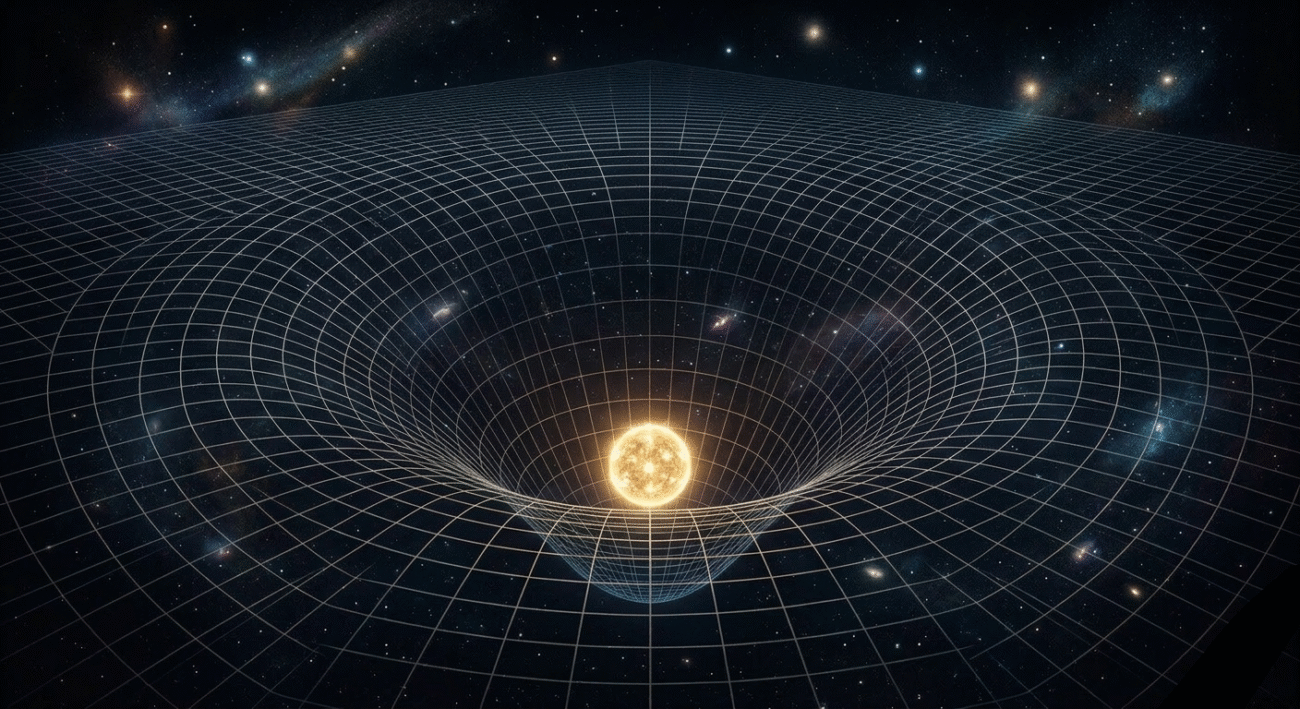
To understand General Relativity, we have to stop thinking of space as an empty room where things happen. Instead, think of it as a vast, flexible fabric, like a giant trampoline.
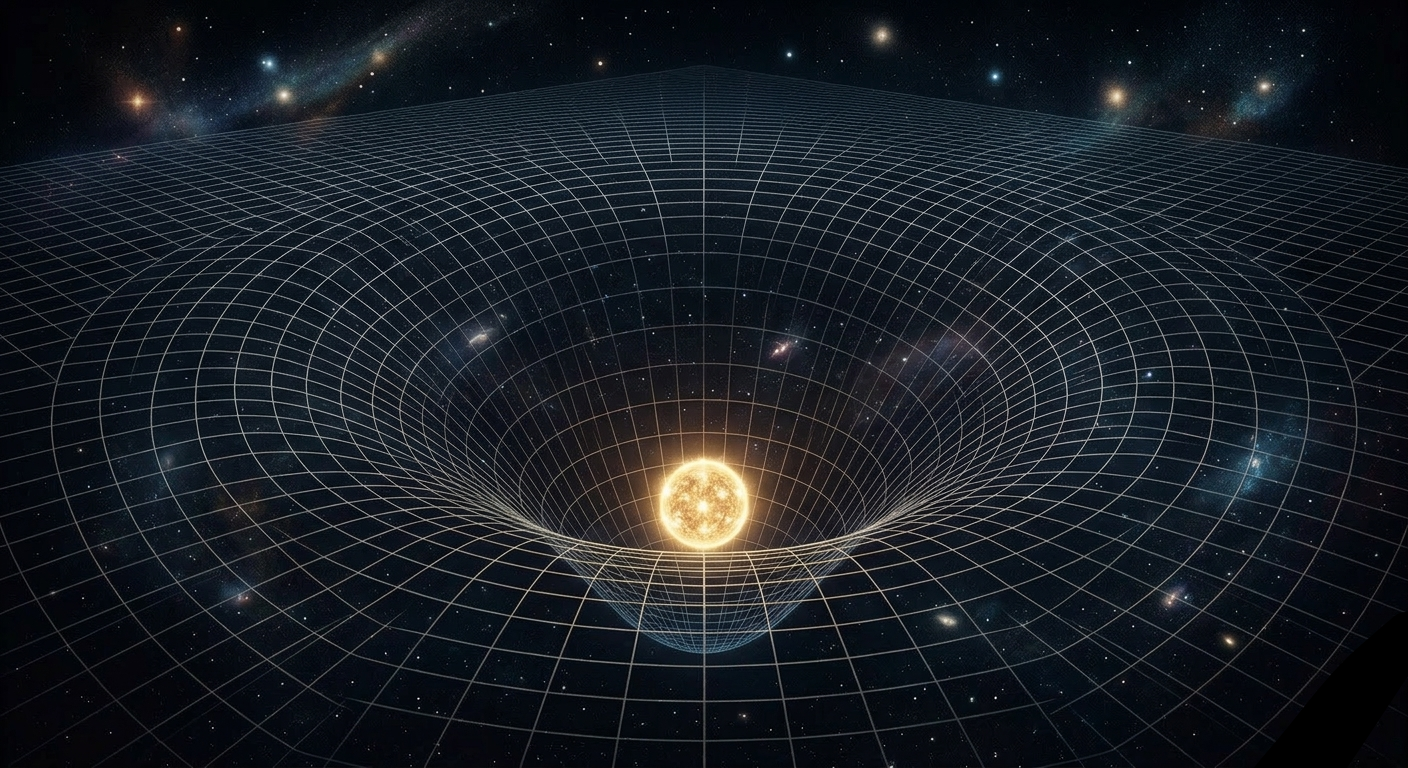
Imagine you stretch out a trampoline and place a heavy bowling ball in the center. The ball creates a dip or a “well” in the fabric. If you then roll a marble across the trampoline, it doesn’t move in a straight line. It follows the curve created by the bowling ball.
In this cosmic analogy, the bowling ball is the Sun, and the marble is the Earth. The Earth isn’t being “pulled” by an invisible rope; it is simply rolling along the curved path that the Sun’s mass has carved into the fabric of space. Einstein called this four-dimensional fabric spacetime.
This was a revolutionary shift. Gravity was no longer something in the universe; it was the very geometry of the universe.
Why Time Changes Near a Mountain
If mass warps space, it also warps time. This is where things get truly strange. In General Relativity, space and time are inextricably linked. If you stretch the fabric of space, you also stretch the ticking of the clock.
This phenomenon is known as Gravitational Time Dilation. The stronger the gravity (the deeper the “well” in the fabric), the slower time passes. We’ve actually proven this right here on Earth. Physicists have used incredibly precise atomic clocks to show that time moves slightly faster at the top of a mountain than it does at sea level (read about this here). Because you are physically further away from the Earth’s mass on a mountain, the “warp” in spacetime is a tiny bit thinner, and your clock ticks faster.
If you spent your whole life on a high-altitude plateau, you would technically be a few nanoseconds older than your twin who lived at the beach. It’s not a lot of time for us, but it’s a profound truth about the nature of our existence: gravity isn’t just about weight; it regulates the very rhythm of our lives.
The Eclipse That Proved It All
For years, Einstein’s ideas were just elegant math on a chalkboard. Most scientists were skeptical. After all, Newton had been right for 200 years. How could you prove that space itself was curved?
The answer came during a total solar eclipse in 1919.
Einstein predicted that if space is curved, even light, which has no mass, would have to follow that curve. If a star’s light passed near the Sun on its way to Earth, the Sun’s gravity should “bend” the light beam. Normally, you can’t see stars near the Sun because the Sun is too bright. But during an eclipse, the moon blocks the Sun, allowing us to see the stars behind it.
Sir Arthur Eddington traveled to an island off the coast of Africa to photograph the eclipse. When he developed the plates, he found that the stars had shifted. They weren’t where they were supposed to be. Their light had bent around the Sun exactly as Einstein predicted. The “trampoline” was real. Overnight, Einstein became a global celebrity.
Black Holes: The Ultimate Pits
If you take enough mass and squeeze it into a small enough space, you create a “gravity well” so deep that nothing, not even light, can climb back out. We call these Black Holes.
Think of them as holes in the trampoline that have no bottom. They represent the absolute limit of General Relativity. Within a black hole, the warping of spacetime becomes so extreme that our current understanding of physics begins to break down. They are the universe’s most extreme laboratories, testing the boundaries of what is possible.
The Architecture of the Heavens
What I find most beautiful about General Relativity is that it removes the “magic” from the universe and replaces it with a grand, logical architecture.
It tells us that the universe is not just a collection of random objects floating in a void. Instead, every planet, every star, and every person is part of a dynamic, shimmering web. We are all participants in the bending and folding of the cosmos.
When we look at the orbits of the planets or the dance of distant galaxies, we aren’t seeing a series of accidents. We are seeing the geometry of a creation that is far more intricate and flexible than we ever dared to imagine. It reminds us that there is still so much to learn, and that our “common sense” is often just a small window into a much larger, more magnificent reality.
