
Explore the incredible power of the strong nuclear force. Discover how this “cosmic glue” binds quarks and atoms, making our existence possible in a universe of energy.
The Invisible Anchor
Take a look at your hand for a moment. It feels solid, dependable, and permanent. But if we were to zoom in, past the skin cells, past the molecules, and deep into the heart of a single atom, we would find ourselves staring at a mathematical paradox that should, by all rights, result in an explosion.
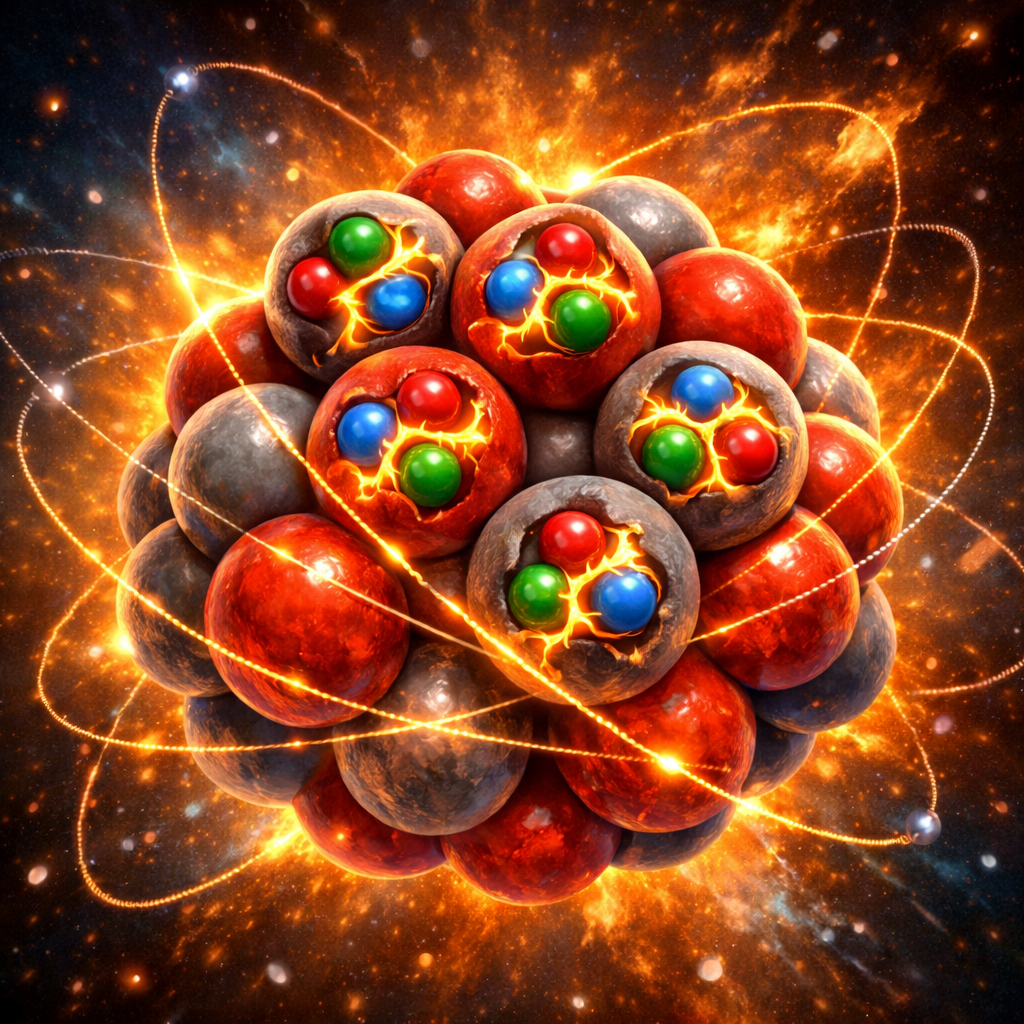
At the center of every atom sits a nucleus, a tiny bundle of protons and neutrons. Here’s the problem: protons are positively charged. If you’ve ever tried to force the matching ends of two powerful magnets together, you know they push back with a stubborn, invisible hand. Now, imagine trying to cram a dozen of those magnets into a space a trillion times smaller than a pinhead. The electrical repulsion should be so violent that the atom, and the entire universe, should fly apart in a flash of light.
Yet, it doesn’t. Something is holding the center together with a grip so fierce it defies our everyday intuition. Physicists call it the Strong Nuclear Force. It is the strongest of the four fundamental forces of nature, and without it, there would be no carbon, no oxygen, no stars, and certainly no one around to wonder why we exist.
Quarks and the Social Life of Subatomic Particles
To understand how this force works, we have to go even deeper than the proton. For a long time, we thought protons and neutrons were “fundamental,” meaning they couldn’t be broken down further. But in the mid-20th century, experiments at the Stanford Linear Accelerator Center (SLAC) revealed a hidden world inside. Protons are actually made of even smaller bits called quarks.
Quarks are social creatures; you will never find one sitting alone at a bus stop. They are bound together by the strong force in a way that is profoundly different from gravity or electricity.
Think about a rubber band. If you stretch it a little, it’s easy. But the further you pull it, the harder it snaps back. This is a property physicists call color confinement. The strong force doesn’t get weaker as quarks move apart; it gets stronger. If you tried to pull two quarks apart with enough energy, the “rubber band” wouldn’t just snap, the energy you used to pull them would actually spontaneously transform into new quarks. The universe would rather create new matter than let a quark be lonely.
The “Glue” That Really Sticks
How does a force actually “happen”? In the world of quantum physics, forces aren’t just magical auras; they are carried by particles. The messenger particle for the strong force has a name that sounds like it was chosen by a literal-minded toddler: the gluon.
Gluons act as the “sticky” exchange between quarks. But there is a twist that makes them unique. In electromagnetism, the photons that carry light don’t have an electrical charge themselves. But gluons do carry the very force they transmit. This creates a chaotic, bubbling “sea” of energy inside every proton.
When you step on a scale, you might think you’re measuring the mass of your atoms. But here’s a secret that most people find hard to believe: if you add up the mass of the individual quarks in your body, they only account for about 1% of your weight. The other 99%? That’s the raw energy of the strong nuclear force. You are, quite literally, held together by the sheer intensity of this cosmic glue.
From the Core to the Stars: Residual Strong Force
If the strong force is busy holding quarks together inside a proton, how does it manage to hold the protons to each other in the nucleus?
Think of it like a massive industrial magnet inside a box. Most of the magnetic pull is contained within the box, but a little bit of “leakage” reaches out past the edges. This “leakage” is what we call the residual strong force. It’s just enough of a reach to grab onto a neighboring neutron or proton and lock it into place.
This delicate balance is what makes life possible. If the strong force were just a few percentage points weaker, protons couldn’t stick together at all, and the only element in the universe would be hydrogen. If it were slightly stronger, protons would fuse so easily that stars would burn through their fuel in seconds rather than billions of years. We live in a universe where the “strength” of this glue is tuned to a terrifyingly perfect degree.
The Power Within the Silence
We don’t feel the strong nuclear force in our daily lives because its range is incredibly short, it doesn’t reach much further than the diameter of an atomic nucleus. It is a silent, microscopic titan.
However, we have seen what happens when that “glue” is tampered with. In nuclear fission, we split a heavy nucleus, releasing a fraction of that binding energy. The result is enough power to light a city or, unfortunately, to destroy one. It’s a sobering reminder that the stability of our world isn’t a given; it’s a constant, active process happening in every quadrillionth of a centimeter of your body.
A Moment of Reflection
It’s easy to feel small when contemplating the vastness of the galaxy, but there is an equal kind of wonder in the smallness of the atom. We often think of “matter” as something heavy and solid, but physics tells us a different story.
We are essentially a collection of energetic “knots” tied together by a force so powerful it borders on the miraculous. The strong nuclear force is the reason the sun shines, the reason the earth is solid beneath your feet, and the reason your very breath carries the weight of existence.
The next time you look at the world around you, remember that beneath the surface of the mundane, there is a fierce, invisible struggle for order. We exist in the grace of that balance, a universe held together by a bond that refuses to let go.
