
Explore Albert Einstein’s Special Relativity in plain English. Discover why time slows down, lengths shrink, and nothing can travel faster than light.
The Day the Universe Changed
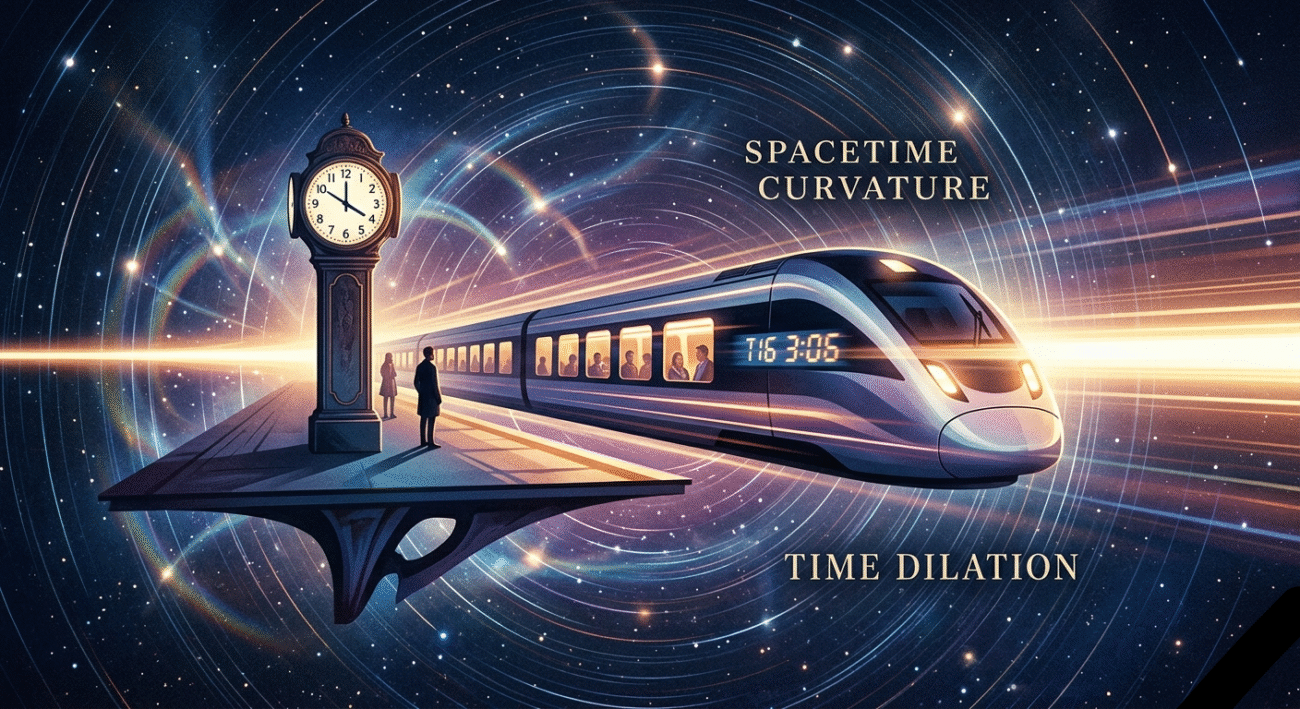
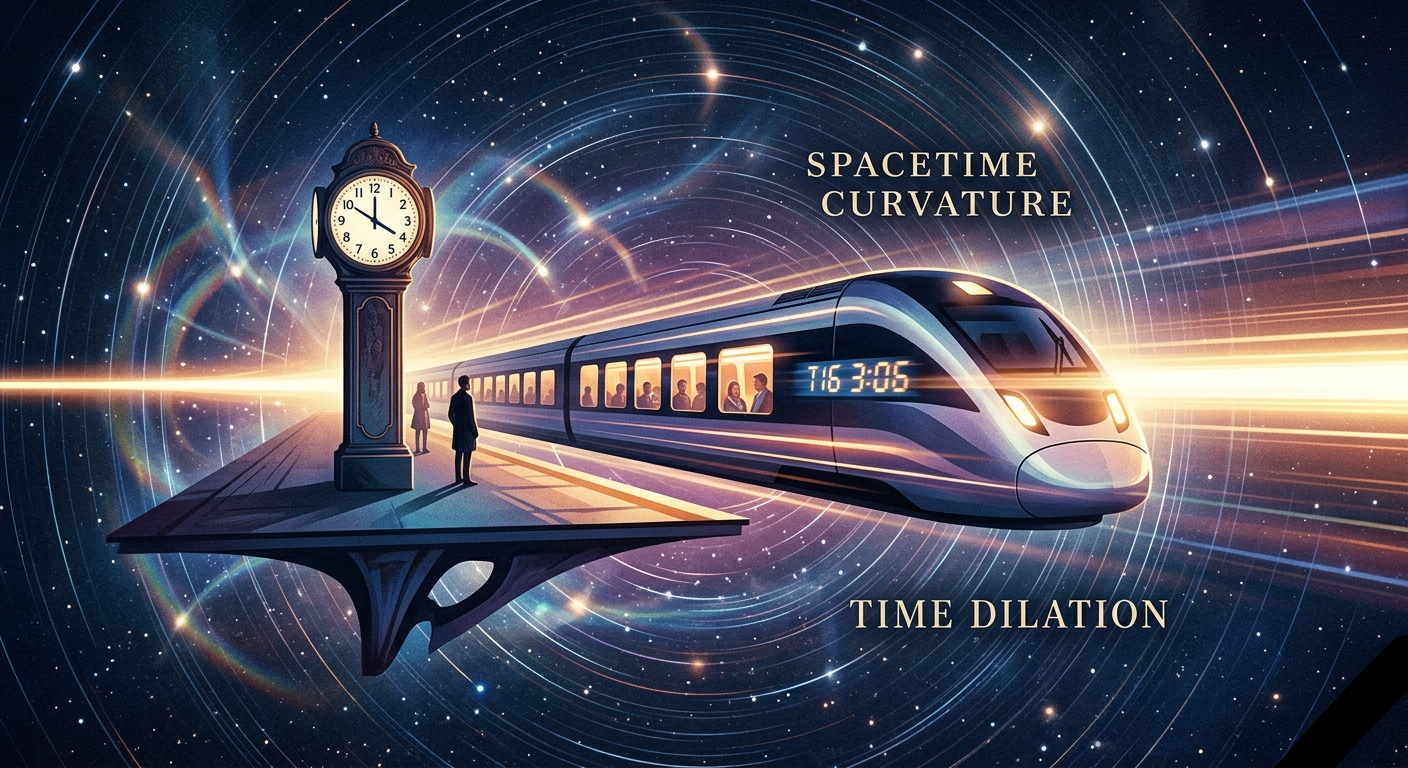
Imagine you are standing on a train platform. A sleek, high-speed express whizzes past you at 100 mph. Inside that train, a passenger tosses a baseball forward at 50 mph. To that passenger, the ball is moving at a modest 50 mph. To you, standing on the platform, the ball is screaming through the air at 150 mph.
This is basic addition. It’s intuitive, it makes sense, and for most of human history, we assumed the entire universe worked exactly like that. But then came Albert Einstein and a beam of light, and suddenly, the “common sense” math we used for centuries fell apart.
In 1905, Einstein realized something radical: Light doesn’t care how fast you are going. If you run toward a beam of light or away from it, it always passes you at the exact same speed, roughly 186,000 miles per second. This sounds like a minor technicality, but it’s the spark that ignited the Theory of Special Relativity. It implies that if the speed of light is a fixed constant, then everything else we take for granted, time, space, and even mass, must be flexible.
The Secret Life of Clocks
The most mind-bending consequence of Special Relativity is Time Dilation. In simple terms, the faster you move through space, the slower you move through time.
Now, I know what you’re thinking. “I’ve flown on a plane, and my watch didn’t look any different when I landed.” You’re right. At human speeds, the effect is so microscopic that it’s effectively zero. But the universe keeps the receipts.
Take, for example, subatomic particles called muons. These are created high in our atmosphere by cosmic rays. Muons are unstable and decay incredibly quickly, so quickly that, mathematically, they shouldn’t survive the trip down to the Earth’s surface. Yet, we detect them on the ground all the time. Why? Because they are traveling so close to the speed of light that their internal “clocks” slow down. From their perspective, only a fraction of a second has passed, even though from our perspective, they’ve traveled miles.
To put it in human terms: if you had a twin who spent five years traveling through space at 99% the speed of light while you stayed on Earth, when they returned, they would find you had aged decades more than they had. Time isn’t a steady river flowing at the same rate for everyone; it’s more like a rubber band that stretches depending on your speed.
The Shrinking Yardstick
If time is flexible, it turns out space has to be, too. This is called Length Contraction.
If you were to watch a spaceship fly past you at nearly the speed of light, it would look physically shorter to you than it did when it was parked in the hangar. The ship isn’t just appearing shorter because of an optical illusion; in a very real physical sense, the space it occupies has compressed.
It’s hard to wrap our heads around this because we view space as an empty stage where things happen. Einstein showed us that space and time are actually woven together into a single fabric called spacetime. You can’t pull on one thread without tightening the other.
Why Can’t We Break the Speed Limit?
We’ve all seen sci-fi movies where ships “jump” to warp speed. In reality, the universe has a strict “no speeding” policy, and the fine is infinite.
As an object moves faster, its energy increases. But Einstein discovered that energy and mass are actually two sides of the same coin, the famous E=mc^2. This means that as you push an object closer to the speed of light, that extra energy actually adds to its relatavistic mass.
The heavier an object gets, the more energy you need to make it go faster. By the time you get close to the speed of light, the object becomes so heavy that it would require an infinite amount of energy to give it that final nudge. Since there isn’t an infinite amount of energy in the universe, the speed of light remains the ultimate cosmic barrier.
Is This Just Theory?
It’s easy to dismiss this as “high-level math” that doesn’t affect our daily lives, but you actually use Special Relativity every time you check your phone for directions.
The GPS satellites orbiting Earth are moving at thousands of miles per hour. Because of their speed, their internal atomic clocks tick slightly slower (by about 7 microseconds a day) than clocks on the ground. If engineers didn’t program Einstein’s equations into the GPS software to account for this time difference, the location on your map would be off by several miles within a single day.
We also see this in the Michelson-Morley experiment, one of the most famous “failed” experiments in history. In the late 1800s, scientists tried to measure the Earth’s movement through a “luminiferous ether” (a medium they thought light traveled through). They found nothing. No matter which way the Earth moved, the speed of light was constant. It was a confusing result at the time, but it provided the perfect foundation for Einstein to say, “The ether doesn’t exist; the speed of light is just the law.”
A New Way of Seeing
Special Relativity forces us to give up the idea of an “absolute” reality. There is no master clock in the center of the universe keeping the “real” time. Your “now” might be someone else’s “then.”
This doesn’t mean the world is chaotic; it means the world is more deeply connected than we ever imagined. It suggests that our human perspective, seeing space as a fixed box and time as a ticking metronome, is just a narrow slice of a much grander, more flexible architecture.
When we look up at the stars, we aren’t just looking across vast distances; we are looking through the warped fabric of time itself. It invites us to wonder: if such fundamental things as time and space can change based on how we move, what other secrets is the universe hiding in plain sight?
