

Discover how neutrino astronomy allows scientists to peer into the heart of stars and black holes using “ghost particles” that pass through solid rock.
The Universe’s Most Reluctant Messengers
Imagine you’re trying to watch a high-stakes play, but someone has pulled a thick, heavy velvet curtain across the stage. You can hear the muffled shouts of the actors and see the faint glow of the spotlights leaking through the fabric, but the actual drama, the heart of the story, remains hidden.
For centuries, this was our relationship with the cosmos. We relied on light to tell us what was happening out there. But light is easily blocked. Dust clouds, gas, and even the dense outer layers of stars themselves act like that velvet curtain, keeping the most violent and fascinating events in the universe a secret.
But what if there was a particle that didn’t care about curtains? What if there was something so ghostly and indifferent to solid matter that it could fly straight through a star, a planet, or even your own body without slowing down?
Enter the neutrino.
Why Light Isn’t Enough
Traditional astronomy is essentially “light astronomy.” Whether it’s the visible light our eyes see, the radio waves that hum from distant galaxies, or the X-rays spitting out of black holes, it’s all electromagnetic radiation.
The problem is that light is “sociable.” It interacts with almost everything it touches. A photon (a particle of light) born in the center of our Sun takes about 100,000 years just to zigzag its way to the surface because it keeps bumping into atoms. By the time it reaches us, it has lost the “memory” of what the Sun’s core actually looks like.
Neutrinos are the opposite. They are the introverts of the subatomic world. They have almost no mass, no electrical charge, and they barely interact with anything. A neutrino born in the Sun’s core travels to Earth in about eight minutes, flying through the Sun’s bulk as if it weren’t even there. To a neutrino, a lead wall a light-year thick is basically a screen door.
Building a Telescope Out of Ice
If neutrinos go through everything, how on earth do we catch them? You can’t exactly build a lens out of glass to focus them. Instead, scientists have had to get creative, building “telescopes” that look nothing like the ones you’d find in a backyard.
The most famous of these is IceCube. No, not the rapper, the IceCube Neutrino Observatory located at the South Pole.
Scientists drilled 86 holes into the Antarctic ice, each over a mile and a half deep. They lowered strings of sensitive light detectors into these holes and waited. The idea is brilliant in its simplicity: every once in a long while, a neutrino flying through the Earth will accidentally “crash” into a water molecule in the ice. This collision creates a tiny flash of blue light called Cherenkov radiation.
By tracking the direction and intensity of that blue flash, astronomers can point back into the sky and say, “That! That’s where it came from.” For the first time, we aren’t just looking at the surface of the universe; we’re looking at its hidden engines.
A New Map of the Sky
So, what have these ghost particles told us so far?
Back in 2017, IceCube detected a high-energy neutrino that they traced back to a “blazar”, a giant elliptical galaxy with a massive, spinning black hole at its center. This was a “Eureka” moment. For decades, we wondered where the high-energy cosmic rays hitting Earth came from. Now, we had a “smoking gun” provided by a single, tiny particle that traveled billions of light-years to reach a block of ice in Antarctica.
We’ve also used neutrinos to look at our own Sun in a way never before possible. By detecting solar neutrinos, we’ve confirmed exactly how the Sun fuses hydrogen into helium. It’s one thing to have a mathematical model of a star; it’s another thing entirely to see the “exhaust” of the nuclear furnace in real-time.
The Future: Mediterranean Water and Deep Mines
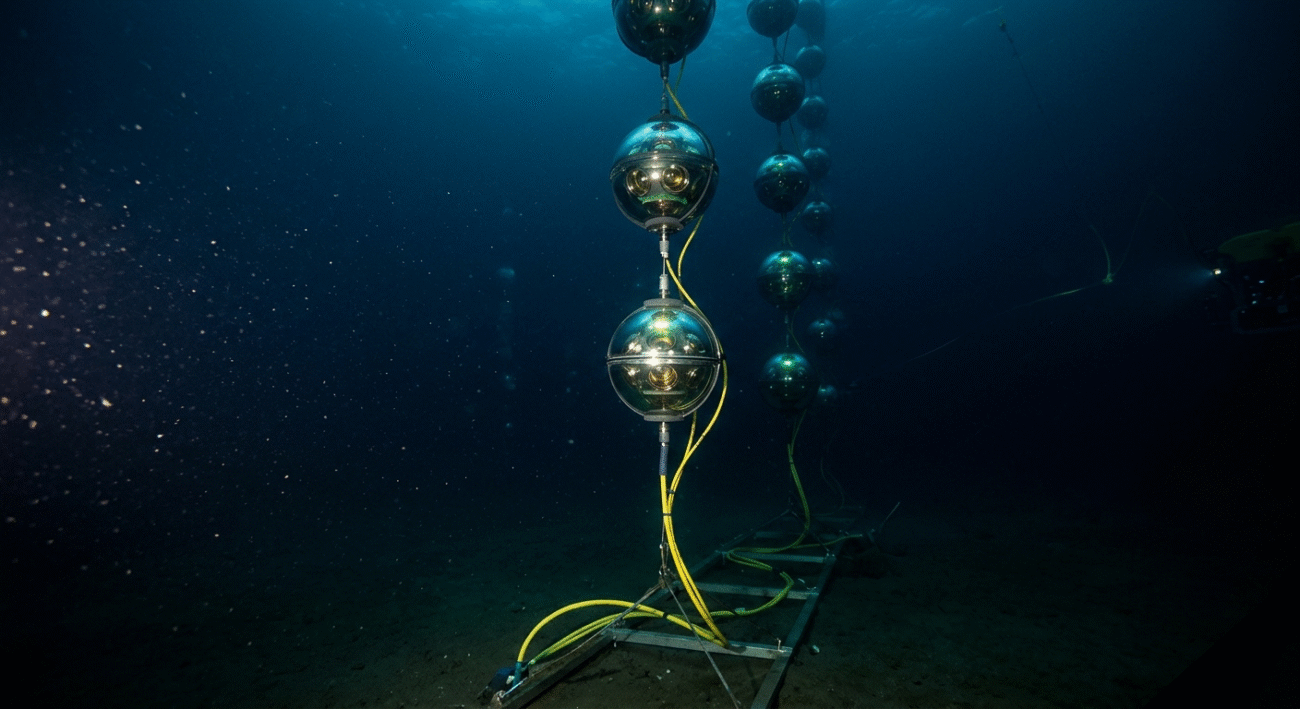
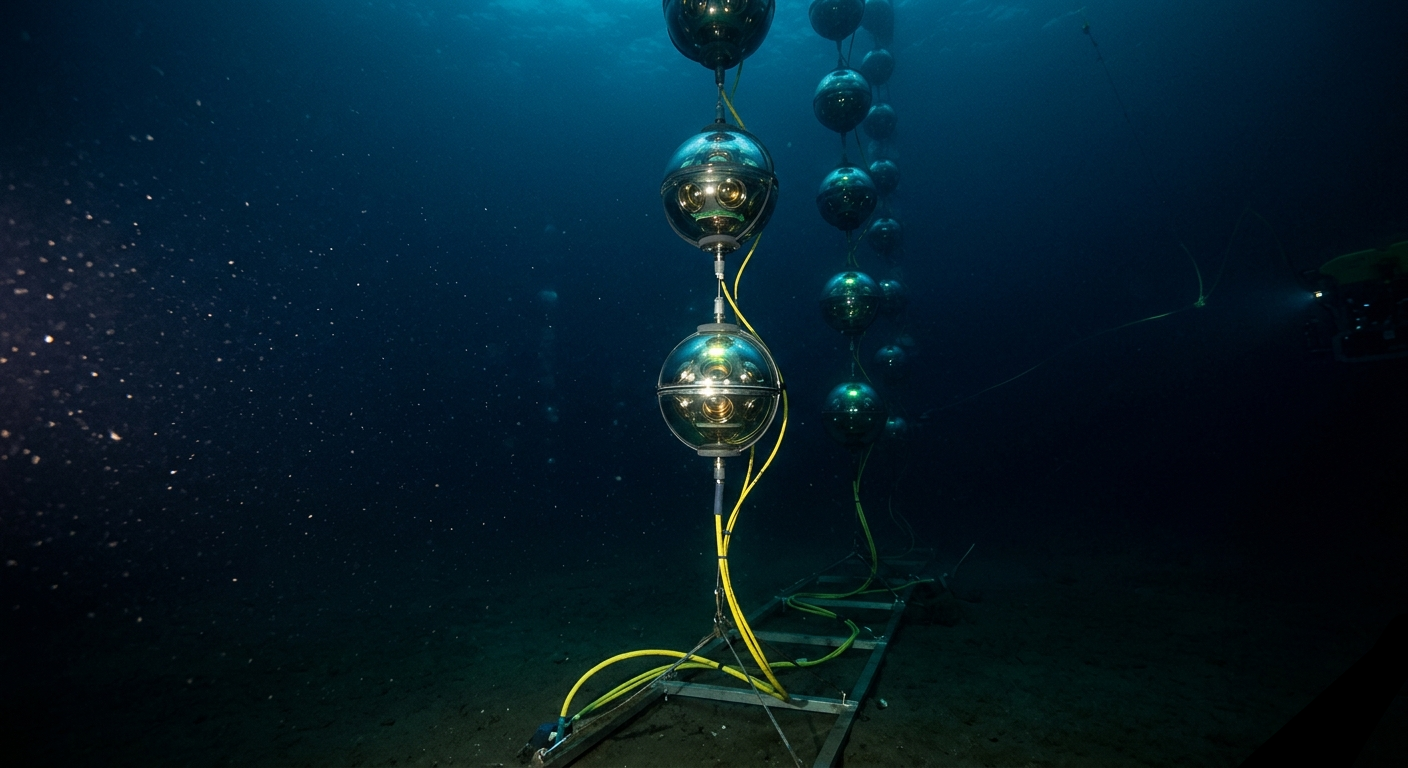
The hunt is expanding. Beyond the South Pole, experiments like KM3NeT are being built at the bottom of the Mediterranean Sea, using the deep, dark seawater as a detection medium. Others, like the Super-Kamiokande in Japan, use a massive stainless-steel tank filled with 50,000 tons of ultra-pure water buried deep inside a mountain to shield it from other cosmic noise.
These facilities are more than just physics labs; they are the new observatories of the 21st century. They are quiet, dark places waiting for a signal that has traveled across the vastness of space and through the heart of monsters to tell us a story.
A Humble Perspective
There is something profoundly humbling about neutrino astronomy. It reminds us that there is a whole “invisible” universe happening right in front of us. As you read this, roughly 65 billion neutrinos are streaming through every square centimeter of your thumbnail every single second.
We don’t feel them. We can’t see them. Yet, they carry the secrets of the first moments of the universe and the final breaths of dying stars.
As we refine our ability to “see” with these particles, we are likely to find things we haven’t even dreamed of yet. We are moving away from being mere observers of the light and becoming participants in a much deeper cosmic conversation. The “ghost particles” are finally being heard, and they have quite a lot to say about the majesty of the world we inhabit.
