
Explore the fascinating links between the smallest subatomic particles and the vast scale of the cosmos. Discover how physics binds everything in the universe together.
I was sitting in a crowded coffee shop the other day, watching the steam curl off my latte, when it hit me: the water molecules dancing in my cup are playing by the exact same rules as the gas clouds collapsing in the Orion Nebula.
It’s a dizzying thought. We often walk through our lives feeling like isolated actors in a very small play. We worry about our commutes, our grocery lists, and our phone batteries. But physics tells a much grander story. It suggests that there is a literal, physical thread connecting the “small” things, the quarks inside your atoms, to the “big” things, the sprawling spiral galaxies spinning millions of light-years away.
The Tiny Giants: Life at the Subatomic Scale
To understand the big picture, we have to start where everything begins: the subatomic world. If you were to zoom into your own hand, past the skin cells and the DNA, you’d eventually find atoms. Inside those atoms are protons and neutrons, and inside those are quarks.
Quarks are strange little things. They never like to be alone; they are bound together by the “strong force,” which is so powerful that it’s practically impossible to pull them apart. But here is where it gets interesting. The way these quarks cluster together determines the stability of all matter.
Think of it this way: if the mass of a quark or the strength of that force were just a tiny bit different, atoms wouldn’t form. No atoms means no chemistry. No chemistry means no coffee, no planets, and no people to wonder about them. This “fine-tuning” is the first hint that the universe isn’t just a collection of random parts, but a finely calibrated system.
As Above, So Below
In the early 20th century, physicists began to notice a weird trend. The laws that governed the tiny world of the atom seemed to echo in the vastness of space. While the math is different (gravity rules the stars, while electromagnetism and nuclear forces rule the atoms), the patterns persist.
Take the concept of Angular Momentum. It’s the reason a figure skater spins faster when they pull their arms in. It’s also the reason why the Earth spins, why the Moon orbits us, and why entire galaxies take on that beautiful, flat spiral shape. When a massive star dies and collapses into a tiny neutron star, it spins hundreds of times per second for the same reason your coffee swirl tightens as it reaches the center of the cup.
There is a profound consistency to the universe. We don’t wake up to find that gravity has decided to take a day off or that light has slowed down. Whether you are looking through a microscope or a telescope, the “manual” for the universe remains the same.
The Great Cosmic Web
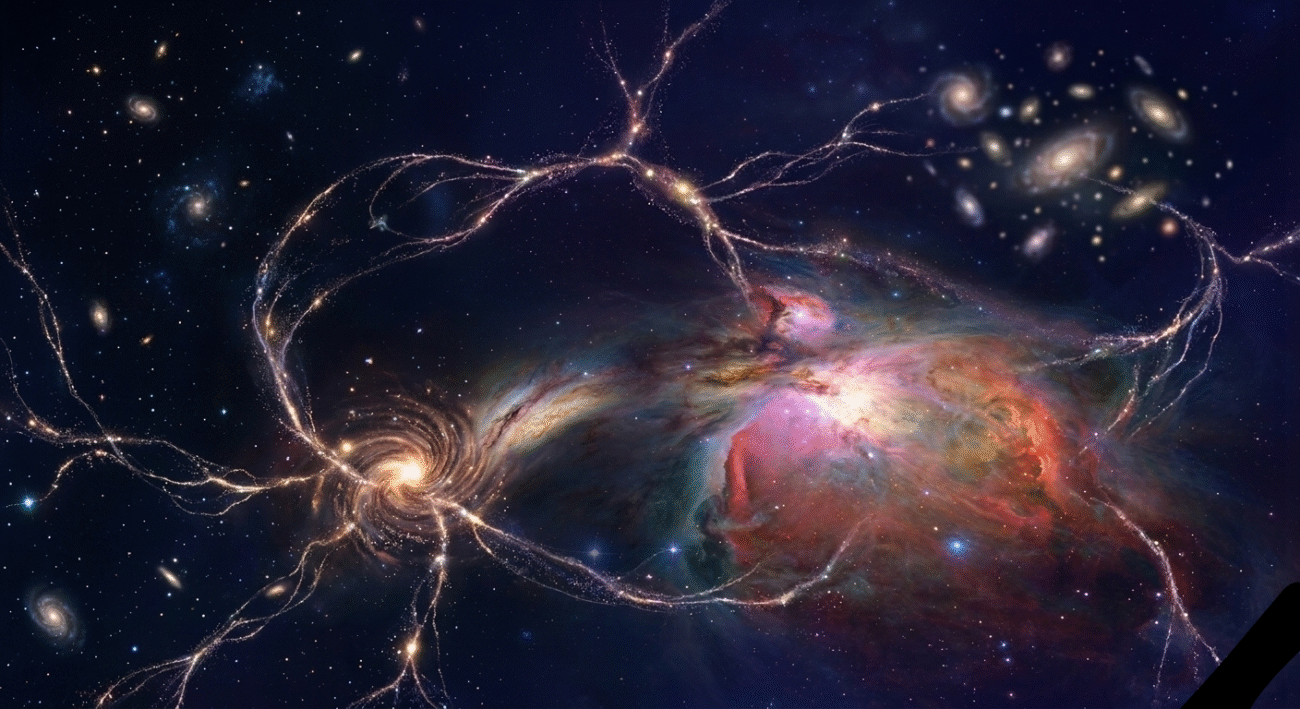
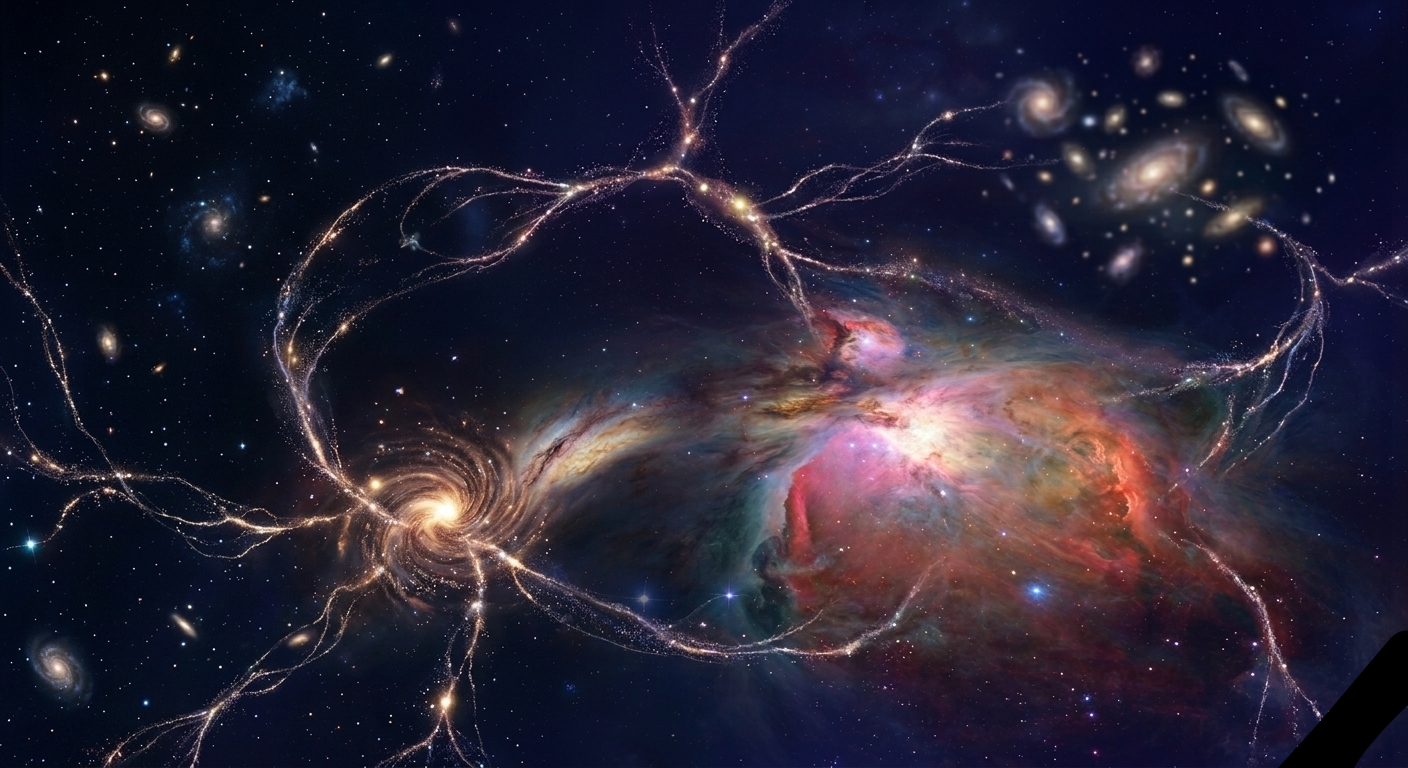
If you could zoom out far enough, past the Milky Way, past our local cluster of galaxies, you would see something breathtaking. Astronomers call it the Cosmic Web.
Space isn’t just an empty void with random dots of light. Galaxies are actually strung along invisible filaments of dark matter, looking very much like a glowing spiderweb or the neural network of a human brain.
- The Connection: The large-scale structure of the universe was actually determined by tiny “quantum fluctuations” that happened moments after the Big Bang.
- The Experiment: Projects like the Sloan Digital Sky Survey have mapped millions of these galaxies, confirming that the “clumpiness” of the universe today matches the mathematical predictions of how subatomic particles behaved billions of years ago.
It’s a bit of a mind-bender: the largest things in existence were shaped by the smallest things imaginable.
We Are Stardust (Literally)
We can’t talk about connections without mentioning the most famous one of all. Every carbon atom in your body, the iron in your blood, and the calcium in your teeth was forged inside the heart of a star.
When a massive star runs out of fuel, it doesn’t just go out quietly. It explodes in a supernova, scattering its guts across the vacuum of space. Those “guts” eventually settle into clouds of dust, which collapse to form new stars and, eventually, planets.
We often think of ourselves as being “on” the Earth, like a passenger on a bus. But in reality, we are of the Earth. We are a way for the universe to look back at itself and say, “Wow.” When you look at the night sky, you aren’t looking at something distant and separate. You are looking at your ancestors.
The Invisible Glue: Entanglement
If you want to get really “spooky,” we have to look at Quantum Entanglement. This is a phenomenon where two particles become so linked that what happens to one instantly affects the other, regardless of whether they are an inch apart or on opposite sides of the galaxy.
Albert Einstein famously called it “spooky action at a distance.” Experiments, such as the ones involving Bell’s Theorem, have proven that this connection is real. While we don’t yet use this to send text messages across the stars, it suggests that at a fundamental level, the universe “knows” about its various parts. Separation might just be an illusion created by our limited human senses.
A Meaningful Tapestry
So, what does this all mean for us?
In a world that often feels chaotic or disconnected, physics offers a different perspective. It shows us a universe of incredible order, where the fall of a leaf and the birth of a star are governed by the same elegant principles.
There is a sense of inherent purpose in the way things fit together. We aren’t just accidents floating in a void; we are part of a continuous, 13.8-billion-year-old story.
