
We’ve all heard that nothing travels faster than light. But is that a hard rule or a challenge waiting to be broken? Explore tachyons, quantum entanglement, and the quirks of the universe.
Breaking the Cosmic Speed Limit: Can Anything Actually Outrun Light?
We’ve all seen the sci-fi tropes. A pilot pushes a lever, the stars stretch into long neon streaks, and suddenly the ship is halfway across the galaxy. It’s a beautiful dream, fueled by our innate desire to see what’s over the next horizon. But in the real world, we’re constantly told there’s a cosmic “No Trespassing” sign posted at exactly 299,792,458 meters per second.
That is the speed of light in a vacuum, the absolute limit. Or is it?
If you’ve ever wondered why the universe seems to have a built-in speedometer, or if there are any “loopholes” in the fine print of physics, you’re in good company. Physicists have spent over a century trying to see if there’s a way to cheat the system.
The Weight of Going Fast
To understand why breaking the light barrier is so hard, we have to talk about Albert Einstein. Before he came along, people thought of space and time as a fixed stage where things happened. Einstein realized that space and time are actually woven together into a fabric called spacetime.
He also realized something slightly annoying for future starship captains: as you move faster, you get “heavier.” Not in the sense that you need a bigger belt, but in the sense that your relativistic mass increases.
The closer you get to the speed of light, the more energy it takes to push you just a little bit faster. To actually reach the speed of light, an object with mass would require an infinite amount of energy. Since the universe doesn’t have an infinite energy supply, most things are stuck in the “slow lane.”
The Tachyons: Ghosts in the Math
But what if you didn’t have to accelerate to the speed of light? What if you were just… born there?
In the 1960s, physicists started playing with the idea of tachyons. These are hypothetical particles that always travel faster than light. In the strange world of tachyonic math, these particles actually gain energy as they slow down. To them, the speed of light is a lower limit they can never drop below.
It sounds like a perfect loophole, right? There’s just one catch: we’ve never actually found one. Tachyons are a “mathematical possibility,” but they bring a lot of baggage. If they existed, they could technically be used to send signals back in time, which creates all sorts of headaches for causality. If you could send a text message to your past self telling them not to buy that overpriced latte, you’ve just broken the fundamental sequence of cause and effect.
The “Shortcut” Strategy
If we can’t go through the barrier, can we go around it? This is where physics gets really creative.
Think of a piece of paper with two dots on opposite ends. The fastest way to get from one dot to the other is a straight line, right? But if you fold the paper so the dots touch, you’ve traveled the distance instantly without ever actually “moving” fast.
This is the concept behind wormholes (or Einstein-Rosen bridges). While they are theoretically possible under General Relativity, we haven’t found any evidence that they exist in nature, nor do we know how to keep one open without it collapsing instantly.
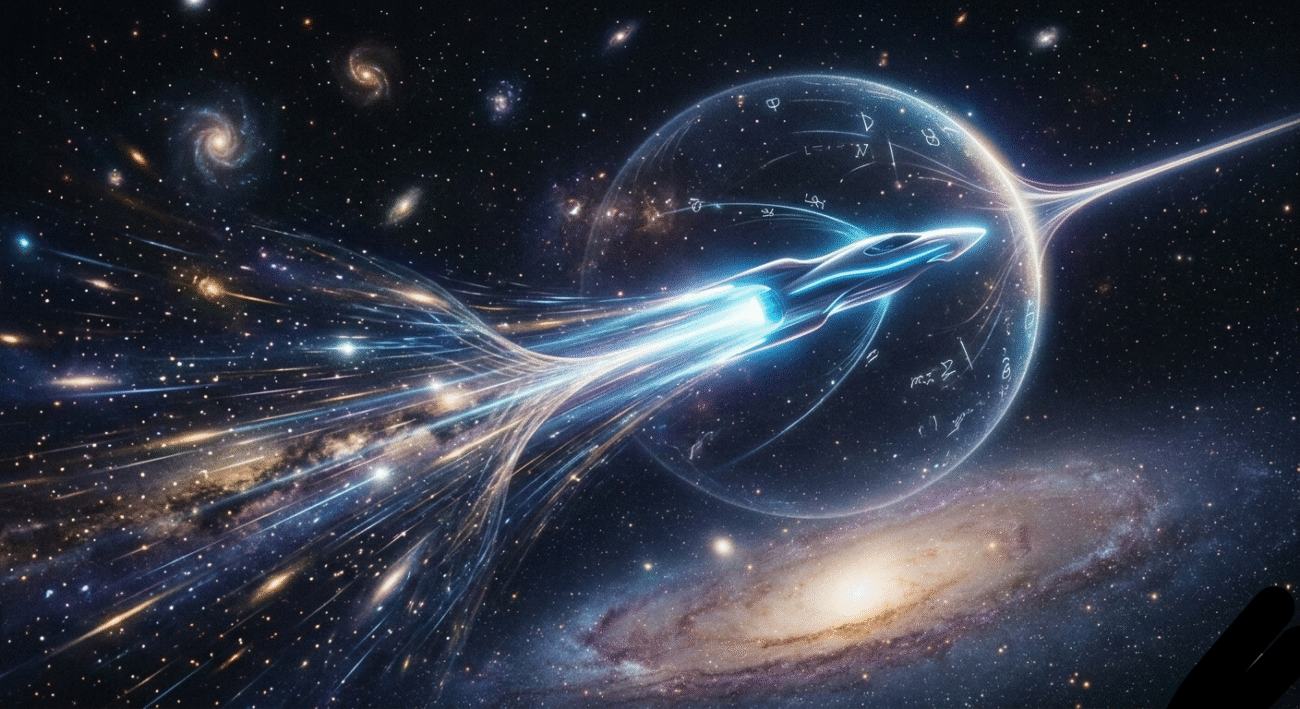
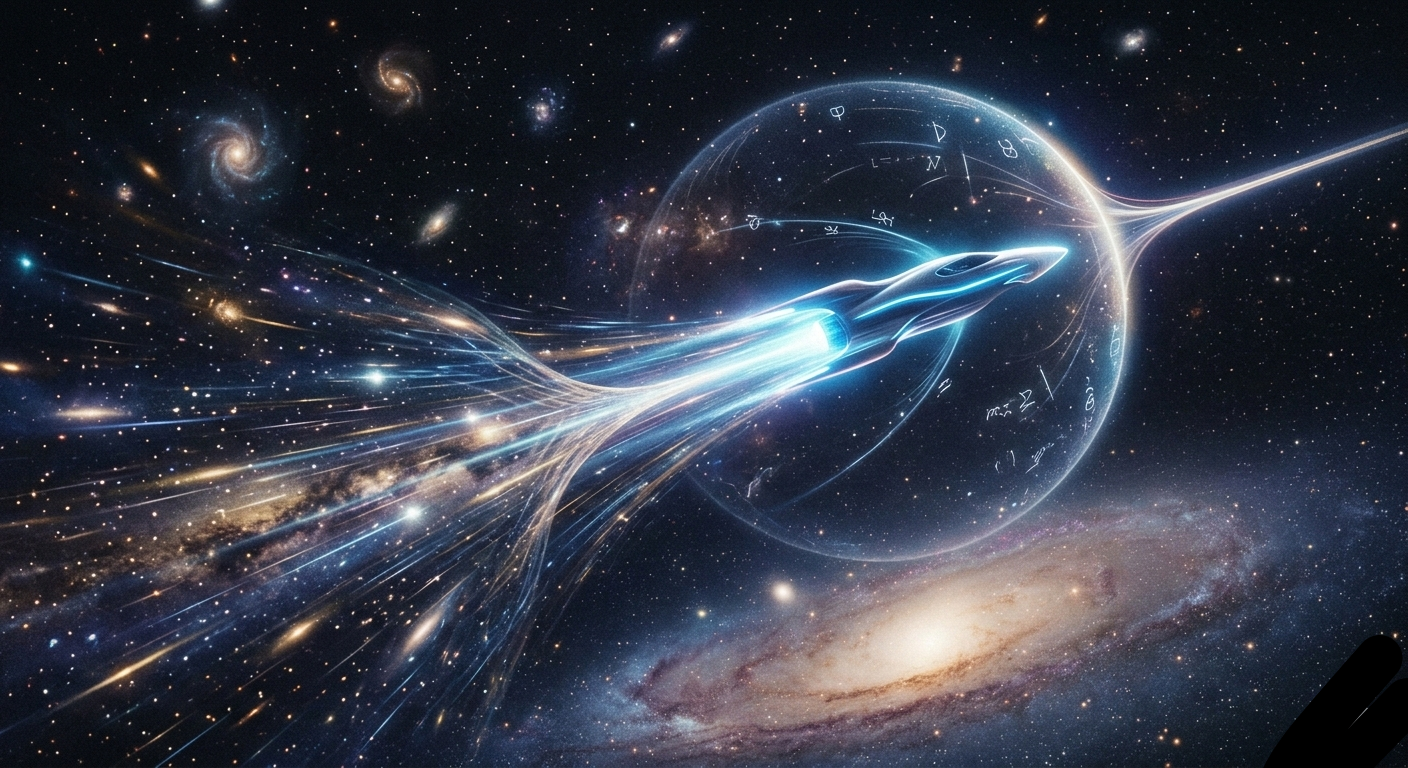
Then there’s the Alcubierre Drive, the “Warp Drive” made famous by Star Trek. The idea here isn’t to move the ship through space, but to move the space around the ship. By contracting space in front of the vessel and expanding it behind, you could effectively surf a wave of spacetime. The ship itself stays still within a “bubble,” so it never technically breaks the local speed limit. It’s brilliant, but it requires “negative energy,” something we haven’t figured out how to manufacture yet.
Quantum Entanglement: The “Spooky” Connection
You might have heard about Quantum Entanglement, which Einstein famously called “spooky action at a distance.”
When two particles become entangled, they are linked regardless of how far apart they are. If you measure the state of one particle on Earth, you instantly know the state of its partner on the Moon. This happens faster than light. Much faster.
Does this mean we can send faster-than-light emails? Sadly, no. While the connection is instantaneous, you can’t use it to transmit actual information. It’s like having a pair of magic coins: if one comes up heads, the other always comes up tails. You see the result instantly, but you can’t “force” the coin to show a specific side to send a message. The randomness of quantum mechanics keeps the cosmic speed limit intact.
The Glow of the “Sonic Boom”
Interestingly, there is one way to travel faster than light, as long as you aren’t in a vacuum.
Light slows down when it travels through media like water or glass. In these environments, high-energy particles (like those in a nuclear reactor) can actually outrun the photons. When this happens, it creates a beautiful blue glow called Cherenkov Radiation. It’s essentially an optical version of a sonic boom.
So, in a sense, we can beat light in a race, provided we’re racing in a pool of water. But in the vast, empty vacuum of space? The record remains unchallenged.
Also read: Neutrinos: the Ghost Particles and One of the Biggest Mysteries.
Reflections on the Limit
Why does this limit exist at all? Some see it as a fundamental flaw in our travel plans, a frustrating wall that keeps us from the stars. But others see it as a necessary structure that gives the universe its order. Without a maximum speed, the concepts of “before” and “after” would lose their meaning. The universe would be a chaotic jumble of events with no clear sequence.
There is a certain beauty in the idea that the universe has rules, that it isn’t just a collection of random accidents, but a finely tuned system with specific boundaries. The speed of light isn’t just a number; it’s a stitch in the fabric of reality that keeps time moving forward.
Will we ever find a way to break the limit? History is full of people saying “never” only to be proven wrong by the next generation of thinkers. For now, the speed of light remains the ultimate horizon. But even if we can’t outrun it, the very fact that we can understand the limit, and dream of ways to bypass it, says something incredible about the human spirit. We are small creatures on a small planet, yet we’ve managed to figure out the rules of a game that spans billions of light-years.
Maybe the point isn’t to break the speed limit, but to appreciate the vastness it protects. After all, the journey is often more interesting than the arrival.
