
Discover how the world’s smallest particles are tackling our biggest health challenges. Explore the fascinating link between high-energy physics and life-saving medical treatments.
Imagine, for a second, the Large Hadron Collider in Switzerland. You’ve probably seen the photos: a massive, 27-kilometer ring of shimmering magnets buried deep underground, designed to smash atoms together at nearly the speed of light. It feels like the ultimate “ivory tower” project, brilliant, expensive, and perhaps a bit detached from the grit and grime of everyday life.
But what if I told you that the same technology used to find the Higgs Boson is currently sitting in a hospital basement ten minutes from your house?
It’s one of the great ironies of modern science. To understand the vastness of the universe, we had to build the most complex machines ever conceived. In doing so, we accidentally handed doctors a new set of superpowers. Particle physics isn’t just about the beginning of time; it’s about extending the time we have here on Earth.
The Antimatter in Your Local Clinic
The word “antimatter” usually belongs in a Star Trek episode or a thriller novel. It sounds dangerous, exotic, and frankly, impossible. Yet, if you’ve ever known someone who had a PET scan, they’ve had a direct encounter with it.
PET stands for Positron Emission Tomography. Here’s the “physics for poets” version: a positron is the antimatter twin of an electron. In a PET scan, doctors inject a patient with a tiny amount of radioactive tracer. As this tracer decays, it spits out positrons.
When a positron meets an electron inside your body, they don’t just bump into each other, they annihilate. They vanish in a tiny flash of pure energy, sending two gamma-ray photons flying out in opposite directions. The scanner detects these “back-to-back” signals and works backward to map exactly where they came from.
It’s a beautiful bit of cosmic detective work. By watching these subatomic explosions, doctors can see a tumor “lighting up” as it hungrily consumes the tracer. We are literally using the most exotic substance in the known universe to find disease before it becomes visible on a standard X-ray.
Sharpshooting with Protons
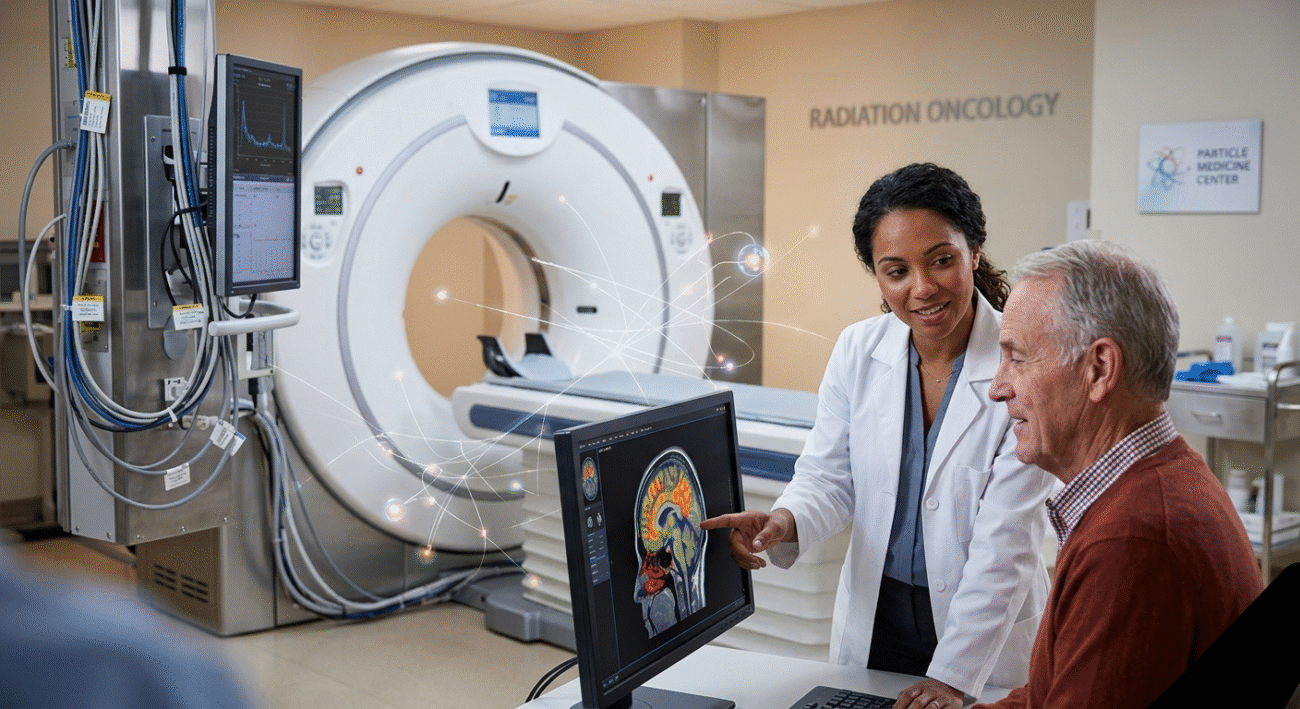
Traditional radiation therapy is a bit like using a shotgun. When we fire X-rays at a tumor, the beam travels all the way through the body, damaging the healthy tissue in front of and behind the target. It works, but the “collateral damage” can be brutal for the patient.
Enter the Proton.
Protons are heavy, positively charged particles. Unlike X-rays, protons have a very specific “braking distance.” Physicists call this the Bragg Peak. By tuning the speed of the protons in a particle accelerator (a smaller cousin of the ones at CERN), scientists can make the beam stop exactly inside a tumor.
Think of it like a “smart bomb.” The proton travels through the skin with very little energy loss, dumps its maximum destructive power directly onto the cancer, and then, this is the magic part, it stops. There is no “exit dose.” This makes it a godsend for treating tumors nestled near delicate structures, like the optic nerve or a child’s developing brain.
The Legacy of the Big Experiments
You might wonder how we got here. It wasn’t by accident.
In the 1930s, a physicist named Ernest Lawrence at Berkeley invented the cyclotron, a circular accelerator designed to probe the nucleus of the atom. While Lawrence was chasing the fundamental laws of nature, his brother John, a physician, saw the machine and wondered, “Could we use this to kill cancer?” That curiosity sparked a century of cross-pollination. The massive detectors used at CERN to track subatomic debris use the exact same crystal technology now found in high-end medical imaging. Even the software, the complex algorithms that help physicists sort through petabytes of data, is being adapted to help radiologists spot tiny patterns in an MRI that the human eye might miss.
More Than Just Machines
Beyond the hardware, particle physics has given us a new way to look at the human body. We’ve stopped seeing ourselves as just a collection of organs and started seeing a complex dance of charges, spins, and fields.
MRI (Magnetic Resonance Imaging) is perhaps the best example. It relies on a property called nuclear spin. Every hydrogen atom in your body acts like a tiny, spinning compass needle. By using powerful superconducting magnets, technology perfected for high-energy physics, we can flip those “needles” and listen to the radio signals they emit when they flip back.
It’s a non-invasive way to peer into the skull or the knee joint without a single drop of radiation. We are essentially “tuning in” to the frequency of our own atoms.
A Moment for Reflection
There is something profoundly humbling about this intersection of scales. We built these gargantuan machines to look at the smallest things in existence, particles so tiny they have no physical size at all. And yet, in our quest to understand the “big questions” of the cosmos, we found the tools to heal our neighbors, our parents, and ourselves.It reminds us that knowledge is never truly siloed. A discovery about a quark in a laboratory today might be the reason a grandmother gets to see her grandson’s graduation ten years from now.
Nature doesn’t categorize itself into “physics” and “medicine.” It’s all one tapestry. When we pull on a single thread at the subatomic level, we find it’s connected to everything else, including the heartbeat of a patient in a recovery room. The more we learn about the fundamental building blocks of reality, the more we realize how precious and intricate the gift of life truly is.
