
Explore how the extreme conditions of the early universe act as a natural laboratory, helping scientists uncover the hidden connections between the fundamental forces of nature.
The Laboratory of the Beginning
Imagine you are trying to understand how a complex, multi-piece clock works, but you only have a few blurry photos of the gears. You can see how they move now, but you have no idea how they were assembled or if they were once part of a simpler, more elegant machine.
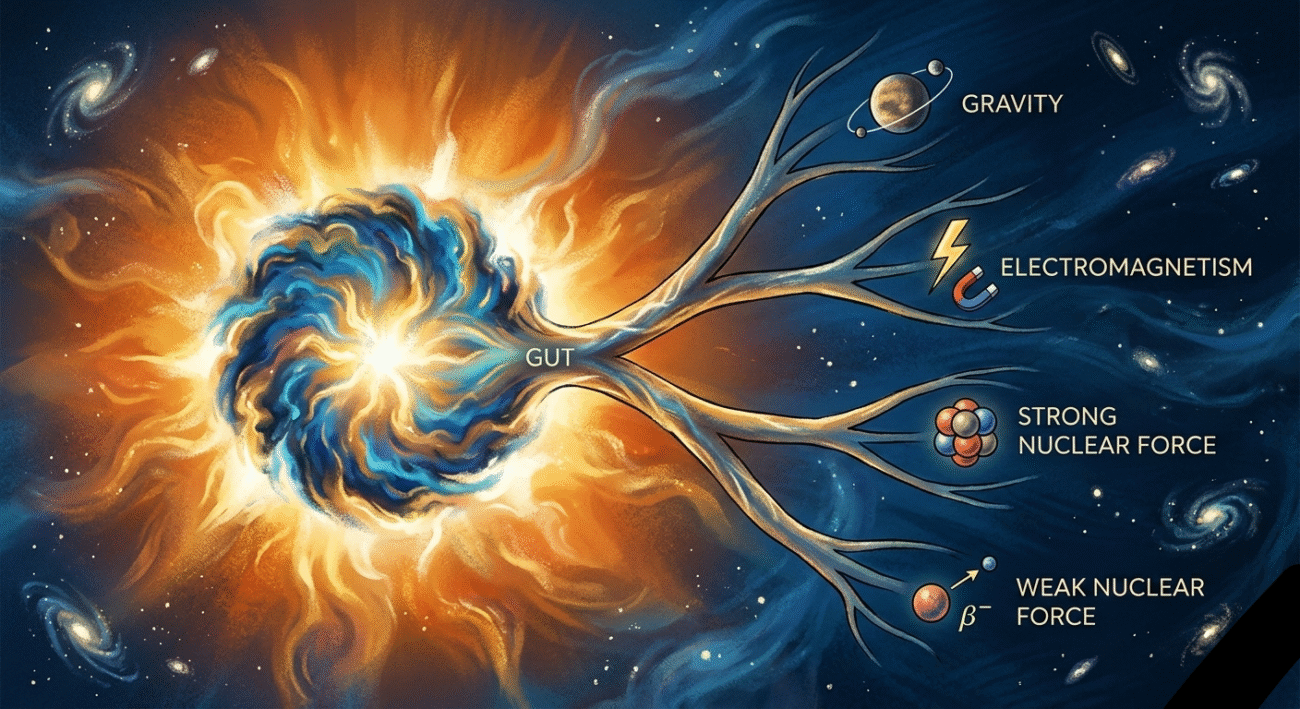
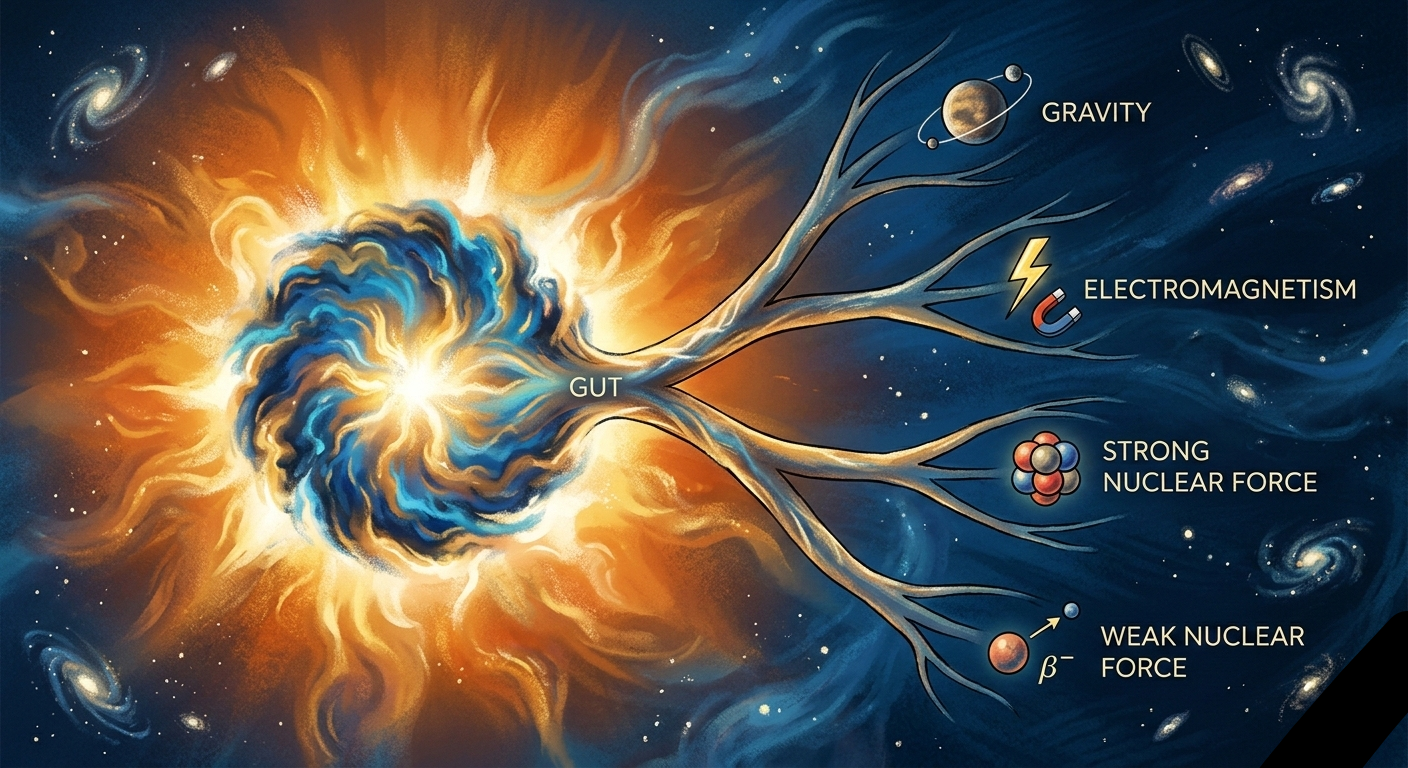
This is essentially the challenge facing modern physicists. We live in a universe governed by four distinct forces: gravity, electromagnetism, and the strong and weak nuclear forces. They seem to have nothing in common. Gravity keeps your feet on the ground; the strong force glues atomic nuclei together; electromagnetism powers your smartphone; and the weak force handles radioactive decay.
They are like four siblings who have grown up and moved to different cities, taking on entirely different personalities. But physicists suspect they all share the same “DNA.” To prove it, we can’t just look at the universe as it is today. We have to look back at the “family reunion”, the incredibly hot, dense moments of the early universe where these forces were forced to interact in ways we can no longer see.
When Forces Melt Together
One of the most profound concepts in physics is “symmetry.” In this context, it’s the idea that at high enough temperatures, the differences between forces start to disappear.
Think about a snowflake. It has a beautiful, complex structure. But if you heat it up, it melts into a drop of water. The “complexity” of the snowflake is gone, replaced by a simpler, more uniform state. Physicists believe the fundamental forces are like that. Today, the universe is “cold” (on a cosmic scale), so the forces look like distinct snowflakes. But in the first trillionth of a second after the Big Bang, the temperature was so high that these forces “melted” together.
We have already seen this happen in particle accelerators. When we smash particles together at high energies, we can see the electromagnetic force and the weak nuclear force merge into a single “electroweak” force. It’s a bit like seeing two different people and realizing they are actually the same person wearing different hats.
However, to see the strong force or gravity join the party, we would need a particle accelerator the size of a galaxy. Since we can’t build one of those, we look to the only event in history that provided that kind of energy: the very beginning of the universe.
The Search for the “Grand Unified Theory”
If we can understand how the strong force merges with the electroweak force, we reach what scientists call a Grand Unified Theory (GUT). This isn’t just about making the math prettier; it’s about understanding the fundamental logic of our reality.
The early universe acts as a high-speed recording of this “un-melting” process. As the universe expanded and cooled, the forces “crystallized” one by one. By studying the ripples left behind from that era, such as the Cosmic Microwave Background or the distribution of the lightest elements like helium and lithium, we are essentially looking at the “scars” left behind when these forces split apart.
If the forces hadn’t split exactly the way they did, the universe would be a very different place. Atoms might never have formed, or stars might have burned out in seconds rather than billions of years. By studying the early universe, we aren’t just doing abstract math; we are investigating the specific “settings” that allow us to exist.
Gravity: The Final Frontier
The biggest mystery remains gravity. While we’ve made progress linking the other three forces, gravity is the stubborn sibling that refuses to move back home. It works perfectly on the scale of planets and galaxies, but it breaks down when you try to apply it to the subatomic world.
The early universe is the only place where gravity was “small” (acting on tiny particles) and “strong” (because everything was so dense) at the same time. This is the “Holy Grail” of physics: a Theory of Everything.
Some scientists look for clues in “primordial gravitational waves”, ripples in the fabric of space-time that have been traveling since the universe was a fraction of a second old (read here about gravitational waves and how we catch them). If we can detect these, we might finally see how gravity fits into the puzzle. It would be the ultimate confirmation that the universe started with a single, unified plan rather than a chaotic collection of random rules.
Why Should We Care?
It’s easy to feel like this is all too distant to matter. After all, the “early universe” happened a long time ago. But the forces we are talking about are the same ones that govern your heartbeat, the light from the sun, and the stability of the ground beneath you.
By looking back, we are essentially performing a cosmic forensics investigation. We are trying to find out why the laws of nature are the way they are. We aren’t just observing the universe; we are trying to read the blueprint.There is something deeply humbling about the realization that the entire history of everything we know, every star, every mountain, every person, is written in the behavior of these forces during those first fleeting moments. It suggests a universe that is not just a collection of accidents, but a coherent system with a profound underlying order.
Reflection: The Order in the Chaos
As we peel back the layers of the cosmic past, we don’t find more chaos; we find more simplicity. We find that the vast complexity of our world today likely sprang from a single, unified state of incredible elegance.
Perhaps the most exciting thing about this research is that we are still in the middle of the story. Every new satellite we launch and every new theoretical breakthrough brings us closer to seeing the “oneness” of the physical world. It invites us to wonder: if all the forces were once one, what else in our universe is more connected than it appears?
