
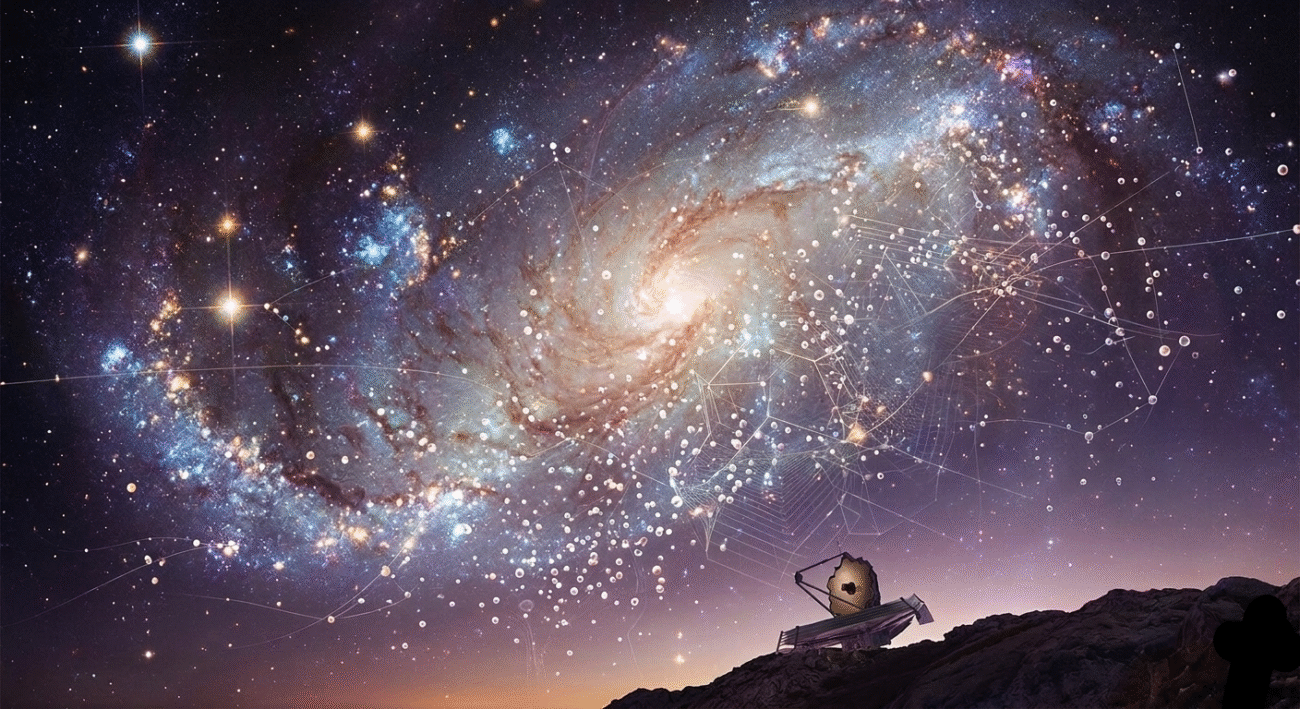
Explore the frontier of cosmology as we ask a daring question: Is the mysterious force stretching our universe actually a ghost-like particle waiting to be found?
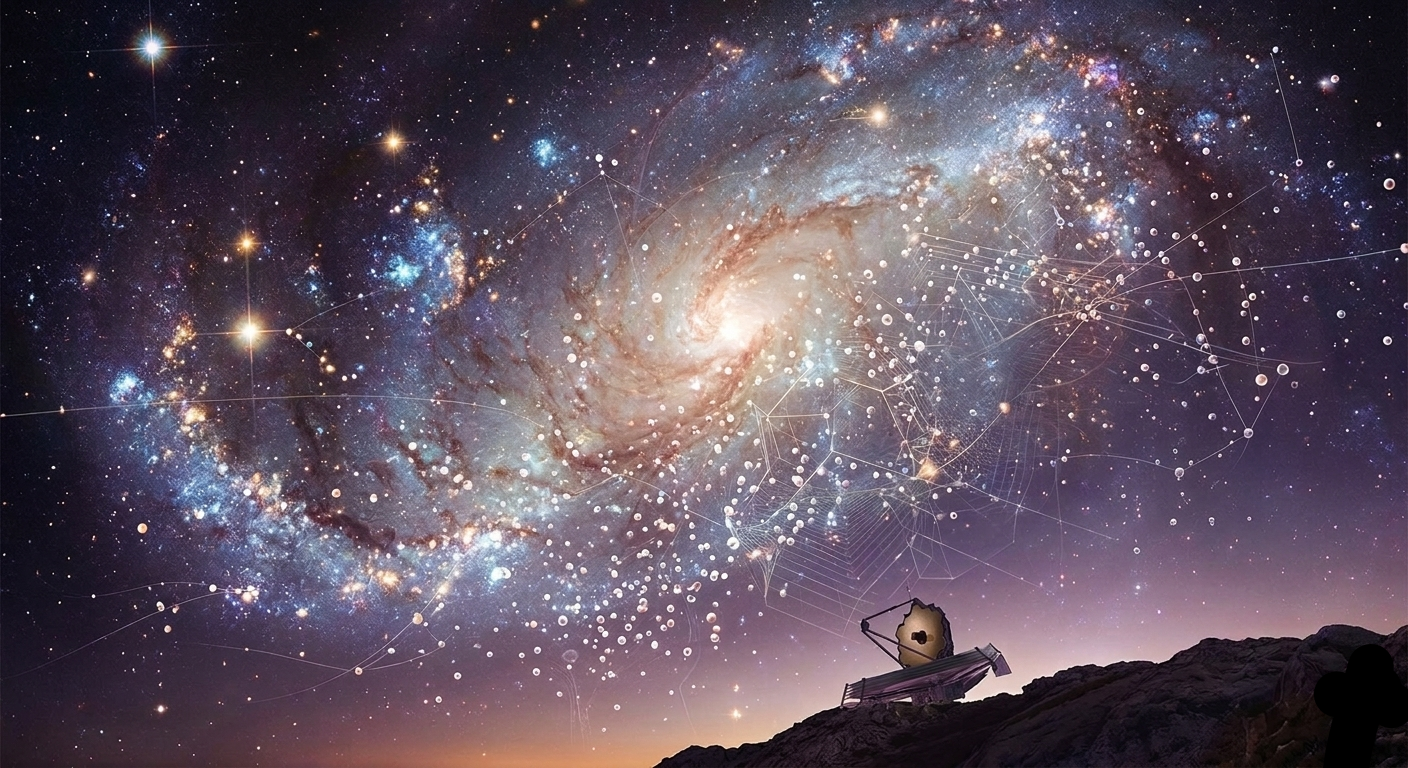
Imagine you’re throwing a ball straight up into the air. You expect it to slow down, pause for a heartbeat, and then tumble back into your hands. Gravity is the dependable scriptwriter of that story. But now, imagine watching that same ball fly upward, and instead of slowing down, it suddenly kicks into high gear. It screams away from you, accelerating faster and faster until it vanishes into the blue.
That is essentially what our universe is doing. Since the late 1990s, we’ve known that the expansion of space isn’t just coasting; it’s speeding up. Astronomers gave the culprit a placeholder name: Dark Energy.
For years, the leading theory was that dark energy is just a property of space itself, a “cosmological constant.” In this view, even “empty” space has a tiny bit of energy, and as the universe expands and creates more space, that energy pushes outward. It’s elegant, but it has a massive problem: the math doesn’t quite add up. The predicted strength of that energy is off by a factor of 10^{120}.
Because of that staggering mismatch, physicists are starting to wonder if we’ve been looking at the wrong map. What if dark energy isn’t a built-in feature of the vacuum? What if it’s a physical thing, a ghost-like particle we haven’t caught yet?
The “Fifth Force” Hypothesis
Most of us grew up learning about the four fundamental forces: gravity, electromagnetism, and the two nuclear forces that hold atoms together. If dark energy is a particle, we are essentially talking about a fifth force.
Think of it like a field that permeates everything. In physics, fields and particles are two sides of the same coin. Just as the electromagnetic field gives us the photon (light), a “dark energy field” would have its own carrier particle.
Some theorists call this “Quintessence.” Unlike the static cosmological constant, quintessence would be dynamic. It could change over time, slowing down or speeding up. If dark energy is a particle-based field, it means the fate of our universe isn’t set in stone. It’s a living, breathing part of the cosmic fabric.
Why Haven’t We Found It?
If the universe is drowning in these particles, you might wonder why they aren’t tripping our sensors or showing up in the Large Hadron Collider. The answer likely lies in a bit of cosmic “chameleon” logic.
Some scientists propose that these dark energy particles are Chameleon Fields. These particles would change their properties based on their environment. In a dense place like Earth or a laboratory, they would become “heavy” and have a very short range, making them effectively invisible to our instruments. But in the vast, lonely voids between galaxies, they would become “light” and exert a massive, repulsive force.
It’s a clever bit of hide-and-seek. It explains why we see the effects of dark energy on a grand, universal scale, but can’t seem to get a grip on it in our own backyard.
Testing the Untestable
The jump from “cool idea” to “scientific fact” requires evidence, and that’s where things get tricky. How do you catch a particle that is specifically designed to be elusive?
Surprisingly, some of the best clues might come from high-precision experiments right here on Earth. Scientists are using “atom interferometry”, essentially dropping atoms in a vacuum, to see if they experience any tiny, unexplained tugs that can’t be accounted for by known gravity.
We are also looking at the stars. If dark energy is a particle, it might affect how stars burn or how galaxies clump together in ways that a simple “constant” wouldn’t. New missions, like the Euclid space telescope, are currently mapping the shapes and distributions of billions of galaxies. They are looking for “wiggles” in the history of the universe’s expansion. If those wiggles exist, they might be the footprints of a particle.
A New Layer of Reality
It’s easy to feel small when we talk about dark energy. It makes up roughly 68% of everything in the universe, yet we are still in the “educated guessing” phase of understanding it.
If dark energy does turn out to be a particle, it would represent one of the greatest shifts in human perspective. It would mean that the “emptiness” of the night sky is actually a crowded, bustling frontier. It would suggest that we aren’t just living in a house made of matter, but are floating in a vast, invisible ocean of something entirely new.
I often think about how the people of the 1800s felt about electricity, it was a strange, invisible “fluid” they barely understood. Today, it powers the device you’re using to read this. We are currently at that same threshold with dark energy.
The Mystery of the Infinite
So, is dark energy a particle? We don’t have the smoking gun yet, but the hunt is changing the way we see the cosmos.
Science has a beautiful way of peeling back layers. First, we thought the Earth was the center. Then we thought atoms were the smallest bits of reality. Then we discovered dark matter. Now, we are staring into the “nothingness” of space and realizing it might be the most complex thing of all.
Whether it’s a particle, a field, or a fundamental law we haven’t quite grasped, dark energy reminds us that the universe still has secrets. It invites us to keep looking up, not just with telescopes, but with a sense of wonder. After all, if the very space between the stars is alive with a hidden force, what else is waiting to be discovered?
