
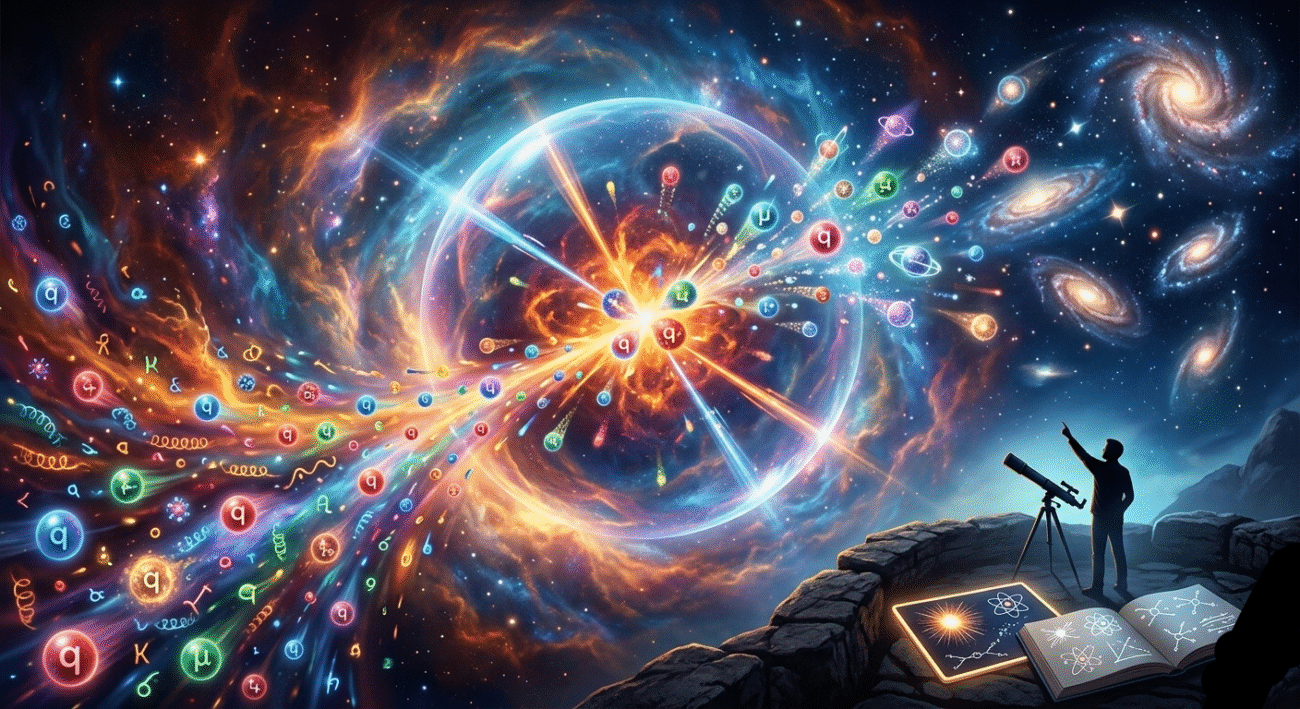
Journey back to the first seconds of time. Discover how the smallest particles in the universe explain the biggest events in cosmic history, from the Big Bang to the stars above.
The Tiny Engines of the Infinite
Imagine standing in a room where every single thing you see, the chair you’re sitting on, the screen in your hand, even the air you’re breathing, is suddenly compressed into a space smaller than a single grain of sand. It sounds like the plot of a surrealist sci-fi film, but this is the actual history of our home.
For a long time, astronomy and particle physics felt like two entirely different worlds. One looked up at the vast, silent majesty of the stars; the other looked down into the frantic, invisible world of subatomic debris. But over the last few decades, we’ve realized something profound: you cannot understand the “Big” without understanding the “Small.” To figure out how the universe began, we have to talk about the tiny engines that built it.
The Ultimate “Hot Mess”
If we could rewind the cosmic clock about 13.8 billion years, we wouldn’t find a void of nothingness. Instead, we’d find a universe that was unimaginably small, dense, and, above all, hot.
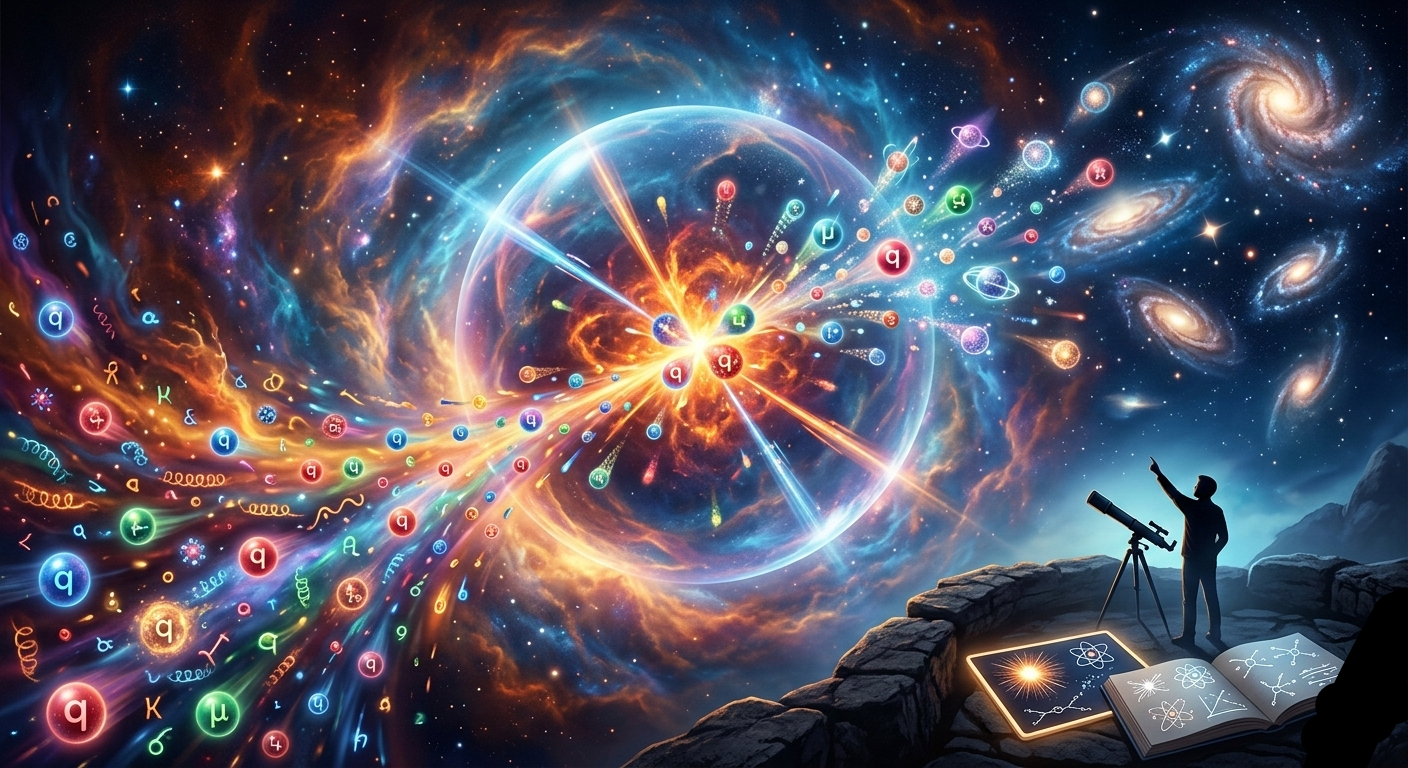
In these first few fractions of a second, the universe was too energetic for atoms to exist. It was a “primordial soup,” but not the kind you’d want to eat. It was a chaotic sea of quarks, gluons, and leptons. If you’re not a physics hobbyist, think of these as the “Lego bricks” of reality. Usually, these bricks are stuck together. Quarks, for instance, are the social butterflies of the subatomic world; they almost never exist alone, preferring to huddle in threes to form protons and neutrons. But in the early universe, it was so hot that the very forces holding them together were overwhelmed. Everything was flying around in a state we call a Quark-Gluon Plasma. It was the ultimate “hot mess,” a liquid-like fire where the laws of physics as we know them today were still being written.
Why Is There “Stuff” at All?
One of the biggest mysteries that keeps physicists up at night is why we even exist. This isn’t a philosophical question, but a mathematical one.
According to the laws of particle physics, every time energy turns into matter, it also creates an equal amount of antimatter. Matter and antimatter are like twins who hate each other: the moment they touch, they annihilate in a flash of pure energy.
Logically, the early universe should have produced equal amounts of both, they should have canceled each other out, and the universe should be nothing but a boring cloud of light. Yet, here we are. You, me, the Earth, and the distant galaxies are all made of matter.
This suggests that in the first moments of creation, there was a tiny, infinitesimal imbalance, a “mistake” in the symmetry. For every billion particles of antimatter, there were a billion and one particles of matter. That “plus one” is everything we see today. We are the leftovers of a cosmic skirmish that happened before the universe was even a second old.
The Great Cooling and the Birth of Light
As the universe expanded, it began to cool down. Think of it like steam turning into water droplets on a cold window.
- At one microsecond old: The quarks finally slowed down enough to stick together, forming the first protons and neutrons.
- At three minutes old: These protons and neutrons began to fuse, creating the first nuclei of hydrogen and helium. This is known as Big Bang Nucleosynthesis.
- The long wait: Even though we had the building blocks, the universe was still a glowing, opaque fog. Light couldn’t travel far because it kept bumping into free-roaming electrons.
It took about 380,000 years, a blink of an eye in cosmic time, for the temperature to drop enough for electrons to settle into orbits around nuclei. This created the first stable atoms. Suddenly, the fog cleared. Light was free to travel across the cosmos for the first time. We can still see this “first light” today; we call it the Cosmic Microwave Background, and it’s like a grainy baby photo of the universe.
Breaking the Laws of Physics (Sort Of)
You might wonder how we can possibly know what happened billions of years ago. We weren’t there with a thermometer.
This is where the giant machines come in. Facilities like the Large Hadron Collider (LHC) in Switzerland act like time machines. By smashing protons together at nearly the speed of light, scientists recreate the high-energy conditions of the early universe in a controlled environment.
When we found the Higgs Boson in 2012, we weren’t just checking a box on a list of particles. We were confirming how particles got their mass in the first place. Without the Higgs field “turning on” a fraction of a second after the start, particles would have zipped around at the speed of light forever, never slowing down to form stars or planets.
A Universe of Order and Mystery
The more we look at the intersection of particle physics and cosmology, the more we see a universe that is incredibly fine-tuned. If the strength of the nuclear force were just a tiny bit different, stars would never have ignited. If gravity were a fraction stronger, the universe would have collapsed back on itself eons ago.
It’s a humbling realization. We are living in a moment of cosmic history where the temperature is just right, the forces are balanced, and the particles have settled into a stable enough configuration for us to sit around and wonder about it.
Where Do We Go From Here?
We still don’t have all the answers. We don’t know what Dark Matter is, that invisible “glue” that keeps galaxies from flying apart, even though it makes up the vast majority of the universe’s mass. We don’t fully understand Dark Energy, the mysterious force pushing everything away from everything else.
But that’s the beauty of it. Science isn’t a finished book; it’s an ongoing detective story. Every time we smash a particle or peer through a more powerful telescope, we’re looking for the next clue in the greatest “origin story” ever told.
Does it make you feel small? Perhaps. But there is also something deeply moving about the fact that we, creatures made of stardust and ancient atoms, have the capacity to look back across billions of years and begin to understand how it all began. We are the universe trying to understand itself.

One thought on “How Particle Physics Unlocks the Secrets of Our Origins”