

Explore the mind-bending world of quantum entanglement. Learn how two particles can stay connected across the universe and why Einstein called it “spooky.”
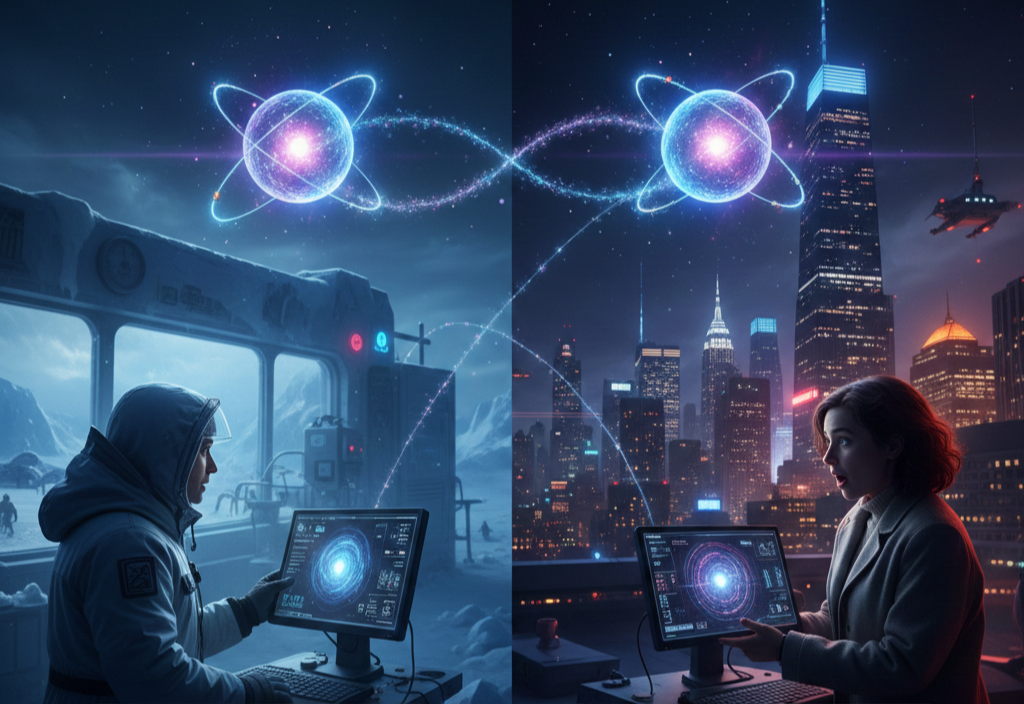
Imagine you have a pair of magical dice. You keep one in your pocket in New York, and you give the other to a friend heading to a research station in Antarctica. When you get home, you roll your die and land on a six. At that exact same microsecond, thousands of miles away, your friend’s die also tumbles to a stop. It’s a six.
You try again. A two. Your friend gets a two. You could do this a million times, and the results would always match, despite no wires, no Wi-Fi, and no possible way for the dice to “talk” to each other.
In our everyday world, this is impossible. It’s the stuff of stage magic or low-budget sci-fi. But in the subatomic realm, this isn’t just a theory, it’s a measured, proven reality. Scientists call it quantum entanglement, and it is arguably the most unsettling discovery in the history of physics.
Einstein’s “Spooky” Problem
Even Albert Einstein couldn’t quite stomach it. He famously dismissed the idea as “spooky action at a distance.”
Einstein’s discomfort came from a very logical place. He believed in locality, the idea that an object is only influenced by its immediate surroundings. For one particle to affect another instantly across a vast distance, information would have to travel faster than the speed of light. According to his own Theory of Relativity, that’s a hard “no.” Nothing travels faster than light. He assumed there must be some “hidden variables”, internal instructions the particles carry with them, like a pre-programmed script. He thought we just weren’t smart enough yet to see the script.
However, as the decades rolled by, experiment after experiment proved Einstein wrong. The particles aren’t following a script. They are truly, fundamentally linked. When you measure one, the other “knows” and reacts instantly, whether it’s in the next room or the next galaxy.
What Does “Entangled” Actually Mean?
To understand this, we have to throw away our intuition about how objects work. In our world, a chair is a chair. It has a position, a color, and a weight, regardless of whether you’re looking at it.
In the quantum world, things are a bit more… blurry. Before they are observed, particles exist in a state of superposition. This is a fancy way of saying they are a messy cloud of possibilities. They don’t have a definitive “spin” or “position” until we check on them.
Read more about Superposition here.
When two particles become entangled, usually by being born from the same event, like a single laser beam hitting a crystal, they stop being two separate entities. They become a single mathematical system.
Think of it this way: If you have two gloves, a left and a right, and you put them in separate boxes, the moment you open one box and see the “Left” glove, you instantly know the other is “Right.”
But there’s a catch: in the quantum version, the gloves aren’t “Left” or “Right” inside the boxes. They are both and neither until you open the lid. The act of looking forces the universe to make a choice for both of them simultaneously.
Why Should You Care? (Beyond the Cool Factor)
If this all feels like a headache, you’re in good company. Richard Feynman, one of the greatest physicists of the 20th century, once said, “If you think you understand quantum mechanics, you don’t understand quantum mechanics.” But this isn’t just a playground for philosophers. Entanglement is the engine behind the next technological revolution.
- Quantum Computing: Standard computers use “bits” (0s and 1s). Quantum computers use qubits, which use entanglement to perform massive calculations simultaneously. This could help us design new life-saving drugs or solve climate puzzles that would take today’s supercomputers a billion years to crack.
- Unbreakable Encryption: Because looking at an entangled particle changes its state, any “hacker” trying to eavesdrop on a quantum communication line would leave a literal mark on the data. It’s the ultimate burglar alarm.
- Quantum Teleportation: No, we aren’t “beaming” people up like in Star Trek yet. But we are already teleporting information, the specific state of a particle, across kilometers of fiber optic cable using entanglement as the bridge.
The Fabric of Reality
There is a deeper, more poetic question lurking beneath the math. If particles can be entangled, and all the matter in the universe originated from a single point (the Big Bang), does that mean everything is, in some infinitesimal way, still connected?
Some physicists are beginning to suspect that entanglement might be the “glue” that holds space-time itself together. Without these invisible links, the universe might just be a collection of disconnected dots with no geometry or structure.
It suggests that our perception of “separation”, the idea that I am here and you are there, and we are distinct islands, is a bit of an illusion. At the most fundamental level, the universe is a deeply social place.
Looking into the Abyss
Quantum entanglement forces us to confront a reality that is far more vibrant and strange than our five senses lead us to believe. It tells us that the universe doesn’t play by our “common sense” rules.
Next time you look up at the stars, consider the possibility that a particle in your eye might be entangled with a particle in a star at the edge of the visible universe. It sounds like poetry, but it might just be physics. We are still just kids standing on the shore of a very deep, very weird ocean, trying to figure out why the waves move the way they do.
Does it bother you that the world works this way? Or is there something comforting about a universe where everything is, at its core, whispering to everything else?

3 thoughts on “Spooky Action: Why Quantum Entanglement Is the Universe’s Weirdest Secret”