

If electrons are attracted to the atomic nucleus, why don’t they just fall into it ? According to classical physics, they should spiral inward and crash into the nucleus, meaning atoms couldn’t exist at all.
But the world around us does exist. The reason lies in one of the most profound principles of quantum mechanics: Heisenberg’s Uncertainty Principle.
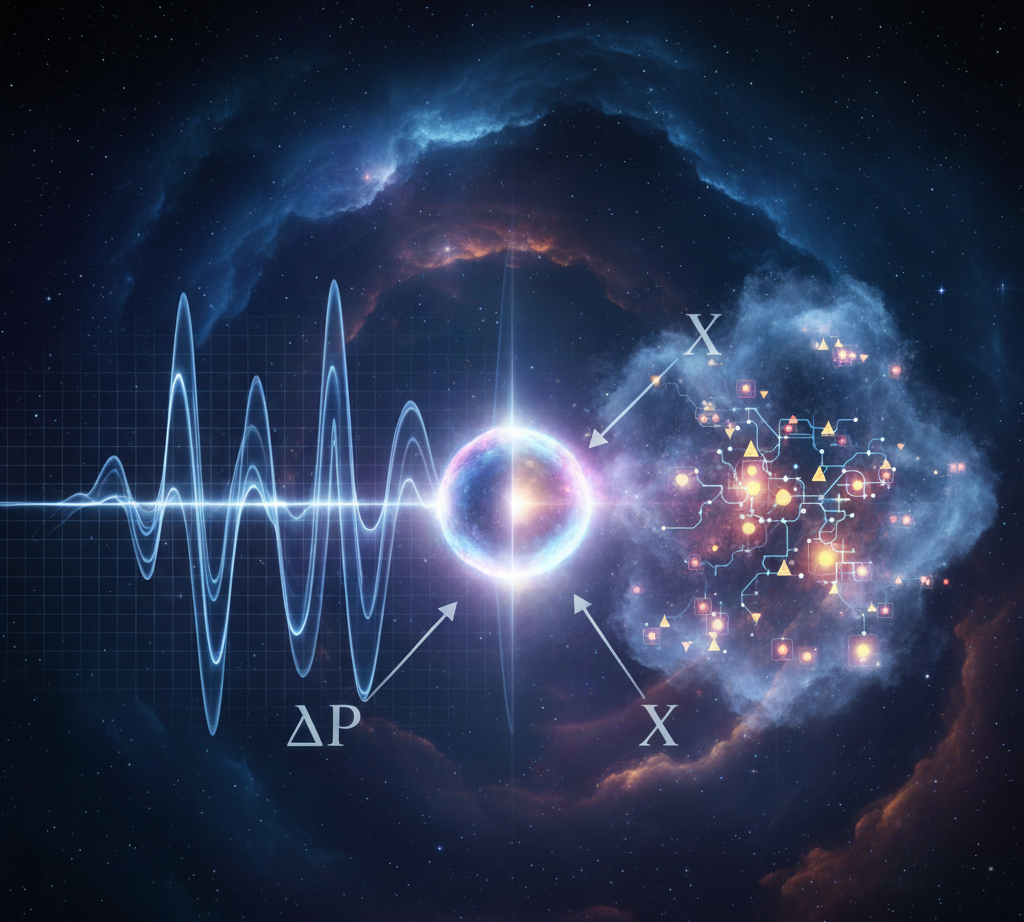
In the classical picture, electrons orbit the nucleus much like planets orbit the Sun. However, a moving electric charge emits electromagnetic radiation and loses energy over time.
That would cause the electron to spiral toward the nucleus, shrinking the orbit until it collapses completely. In that model, atoms, and therefore matter, would be unstable. Clearly, nature doesn’t work that way.
In 1927, Werner Heisenberg proposed a principle that redefined how we understand the microscopic world:
(1) 
It means that we cannot know both the exact position and momentum of a particle at the same time. The more precisely we know where an electron is (Δx small), the less precisely we know how fast it’s moving (Δp large).
This uncertainty is not due to measurement errors, it’s a fundamental property of nature.
Here’s how the principle saves atoms from collapse:
The nucleus attracts the electron due to electrostatic force. If the electron gets too close, its position becomes well-defined, meaning that Δx decreases. But then its momentum uncertainty (Δp) skyrockets, thus its kinetic energy increases. That kinetic energy pushes the electron away, creating a stable balance between attraction and uncertainty.
This delicate balance defines the average size of the atom: the region where the electron is most likely to be found.
Imagine trapping a cat in a small box: the smaller the box, the more the cat moves and struggles. Likewise, the more tightly you try to confine an electron, the more energetic it becomes, preventing it from being trapped completely.
Also read: Born in the Heart of Suns: The Astonishing Journey of the Extraterrestrial Atom.
Heisenberg’s uncertainty principle doesn’t just explain atomic stability. It explains why matter itself is stable.
In stars like white dwarfs and neutron stars, this principle generates degeneracy pressure, a quantum force that resists gravity and keeps these stars from collapsing entirely.
So, from the smallest atom to the densest star, uncertainty keeps the universe standing.
It is thanks to Heisenberg’s uncertainty principle that atoms, and therefore the entire universe, remain stable.
What we might call “quantum fuzziness” is, in fact, the foundation of stability in nature.
Without uncertainty, there would be no atoms, no stars, no life.
The universe exists precisely because perfect precision is impossible.

2 thoughts on “Why Don’t Atoms Collapse? The Role of Heisenberg’s Uncertainty Principle”