
Explore the cosmic dance of binary black holes. Discover how these invisible giants collide, warp spacetime, and send ripples across the universe.
The Cosmic Waltz: Do Black Holes Ever Really Touch?
Imagine two of the most massive, mysterious objects in the universe, monsters so dense that not even light can escape their grip, finding themselves locked in a gravitational embrace. It sounds like the plot of a high-budget sci-fi epic, but for astrophysicists, this is one of the most profound questions in the study of our cosmos.
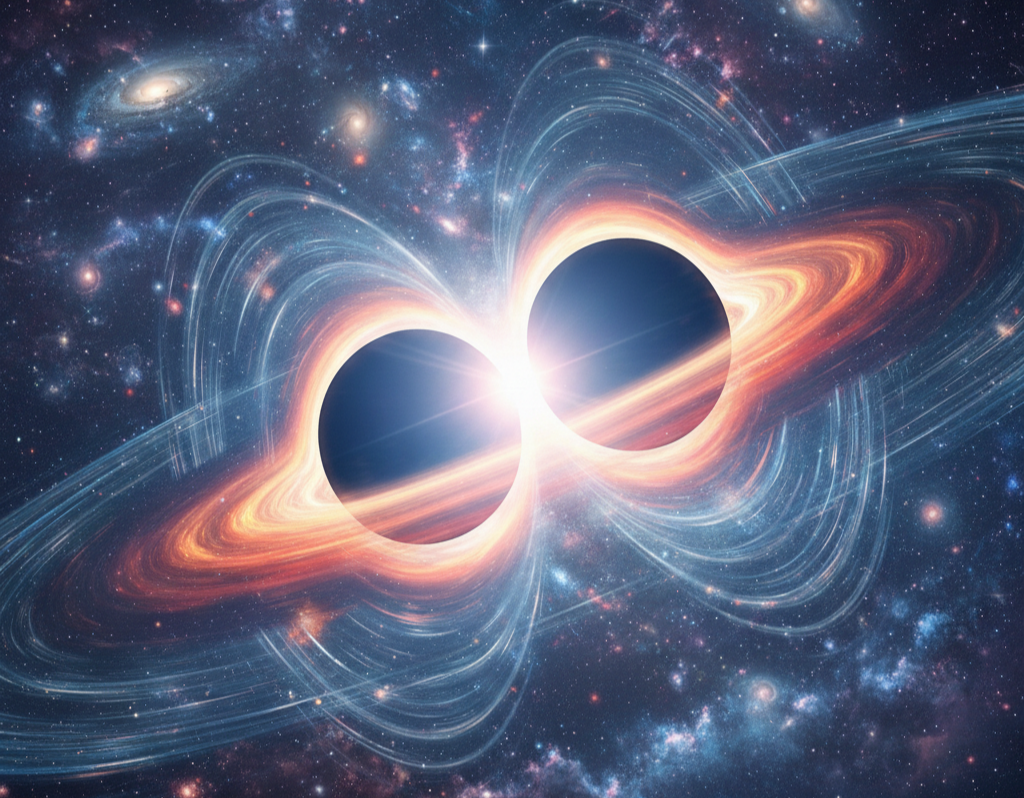
We’ve all seen the artist’s depictions: swirling vortices of darkness, glowing rings of fire, and a final, violent “pop” as they merge. But in a universe governed by the strange laws of general relativity, does a “collision” mean the same thing for a black hole as it does for two billiard balls hitting each other on a table?
The answer is both simpler and far more mind-bending than you might expect.
Finding a Partner in the Dark
Most black holes aren’t lonely wanderers. Because they often form from the remains of massive stars, and many stars exist in pairs (binary systems), black holes frequently find themselves with a companion.
For millions of years, these two giants might just orbit one another peacefully. But gravity is a patient hunter. As they whirl around a common center of gravity, they begin a slow, agonizingly long spiral inward.
The strange part? They aren’t just moving through space; they are actually “dragging” the fabric of reality along with them. This is the beginning of the end for a binary black hole system, a process known as the inspiral phase
The Speed of a Ripple
If you’ve ever skipped a stone across a still pond, you’ve seen the ripples move outward from the center. In 1916, Albert Einstein predicted that moving masses should do the same thing to the fabric of spacetime itself. He called these gravitational waves.
As two black holes spiral closer, they shed an enormous amount of energy in the form of these waves. This loss of energy is what forces them closer together. Think of it like a spinning figure skater: as they lose momentum, their path changes.
For a long time, these waves were purely theoretical. We knew the math worked, but we couldn’t “hear” them. That changed in 2015, when the LIGO (Laser Interferometer Gravitational-Wave Observatory) detected the faint “chirp” of two black holes colliding over a billion light-years away. It was the first time humanity actually caught two black holes in the act of merging.
The Final Parsec Problem
Here is where things get tricky for scientists. While we’ve seen the evidence of the collision, there’s a famous hurdle in physics called the “Final Parsec Problem.”
Theoretically, as two black holes get closer, they should reach a point where they are about one “parsec” (roughly 3.26 light-years) apart. At this distance, some models suggested they might just stall out, orbiting each other forever without ever actually touching.
So, how do they overcome this cosmic stalemate? Most researchers believe that gas, dust, and nearby stars act as a sort of “friction,” robbing the pair of enough energy to bridge that final gap. Once they get close enough, gravitational waves take over completely, and the final plunge becomes inevitable.
The “Collision” That Isn’t a Crash
When we talk about two cars colliding, we think of metal crumpling and glass shattering. But black holes don’t have “surfaces” in the traditional sense. They are defined by their Event Horizon, the point of no return.
When two black holes collide, their event horizons begin to deform. They stretch toward each other like two drops of oil in water. When they finally touch, they don’t bounce; they merge. They become a single, larger, distorted black hole that wobbles violently, a phase scientists call the “Ringdown.”
During this fraction of a second, the power output of the collision is greater than the light of all the stars in the observable universe combined. Yet, because black holes are dark, this “explosion” is completely invisible to traditional telescopes. It is a silent, invisible earthquake in the very geometry of the universe.
Why This Matters to Us
You might wonder why we spend so much time and money trying to “hear” the collisions of objects trillions of miles away. It isn’t just about checking Einstein’s homework.
These collisions are the ultimate laboratory. We cannot recreate the gravity of a black hole on Earth. By watching, or rather, listening to these mergers, we are learning about the history of galaxies and the fundamental building blocks of our reality. Every time two black holes merge, they tell us a story about how the universe grows and evolves.
Also read: Nature’s Cosmic Metronomes: The Incredible Story of Pulsars.
Reflection: A Symphony of Gravity
There is something deeply humbling about the idea of binary black holes. In the vast, silent stretches of the vacuum, these titans perform a dance that lasts for eons, only to end in a sudden, perfect union.
It reminds us that even in the furthest reaches of the cosmos, there is a sense of order and connection. The ripples created by a collision eons ago are passing through your body right now, stretched so thin they are undetectable to our senses, but present nonetheless. We are part of a universe that is constantly vibrating with the echoes of its own creation and transformation.
The next time you look up at a clear night sky, remember that behind the twinkling stars, there is a hidden symphony playing, a dance of shadows that proves, quite literally, that the universe is far more connected than we ever dared to imagine.

One thought on “When Titans Meet: Can Two Black Holes Actually Collide?”