

Ever wonder what the James Webb Space Telescope is actually looking at? From “tasting” the air of alien worlds to spotting galaxies from the dawn of time, discover how Webb uses infrared vision to reveal the hidden secrets of our universe.
For decades, we’ve been spoiled by the Hubble Space Telescope. It gave us the “Pillars of Creation”, those towering, majestic clouds of gas that look like a celestial landscape painting. We got used to seeing the universe in “visible light,” which is essentially the same kind of light our own eyes use to navigate the grocery store or watch a sunset.
But when the James Webb Space Telescope (JWST) sent back its first images, something felt different. The “Pillars” suddenly looked like ghosts. The thick, chocolatey clouds of dust were transparent, revealing thousands of sparkling stars we never knew were there.
It begs the question: What is Webb actually looking at? Is it just a “better” Hubble, or is it showing us a reality that has been hidden from us since the beginning of time?
The Ultimate Pair of Night-Vision Goggles
To understand what Webb sees, you have to think about what happens when you try to look through a thick fog. If you use a regular flashlight, the light just bounces off the water droplets and blinds you. But if you have an infrared camera, you can see the heat from a person standing on the other side.
The universe is incredibly “dusty.” Space is filled with massive clouds of soot and gas that block our view of where stars are born. Hubble, for all its greatness, often got “blinded” by this dust. Webb, however, is an infrared telescope. It doesn’t care about the dust; it looks right through it.
When you look at a Webb photo, you aren’t seeing “colors” in the way we usually talk about them. You’re seeing heat signatures and light stretched out by the vastness of space. Scientists then “translate” these infrared signals into colors we can see, reds, blues, and golds, so our human brains can make sense of the data.
Peering Into the “Cosmic Dawn”
One of the most mind-bending things about Webb is that it’s essentially a time machine. Because light takes time to travel, when we look at a star that is 100 light-years away, we’re seeing it as it was 100 years ago.
Webb is so sensitive that it can see light that has been traveling for over 13.5 billion years. This is light from the very first galaxies that ever flickered into existence. Because the universe is expanding, that ancient light has been stretched out over billions of miles until it shifted from visible light into the infrared spectrum.
Just recently, in early 2026, astronomers using Webb confirmed the existence of galaxy MoM-z14, which existed just 280 million years after the universe began. Before Webb, we didn’t think the universe could organize itself into such bright structures that quickly. It’s forcing us to rewrite the history books on how the cosmos grew up.
Can It See “Aliens”?
This is the question everyone asks. While Webb can’t take a “passport photo” of a creature on a distant planet, it can do something nearly as cool: it can “taste” their air.
When a planet passes in front of its star, the starlight filters through the planet’s atmosphere. Webb’s instruments can analyze that light to see what chemicals are hiding in the air.
- Carbon Dioxide? Found it.
- Methane? Check.
- Water Vapor? We’re seeing hints of it everywhere.
By identifying these “biosignatures,” Webb is helping us narrow down which planets might actually be habitable. We aren’t just looking at pretty pictures; we’re looking for signs of life.
Bringing It Closer to Home: The Recent Uranus Reveal
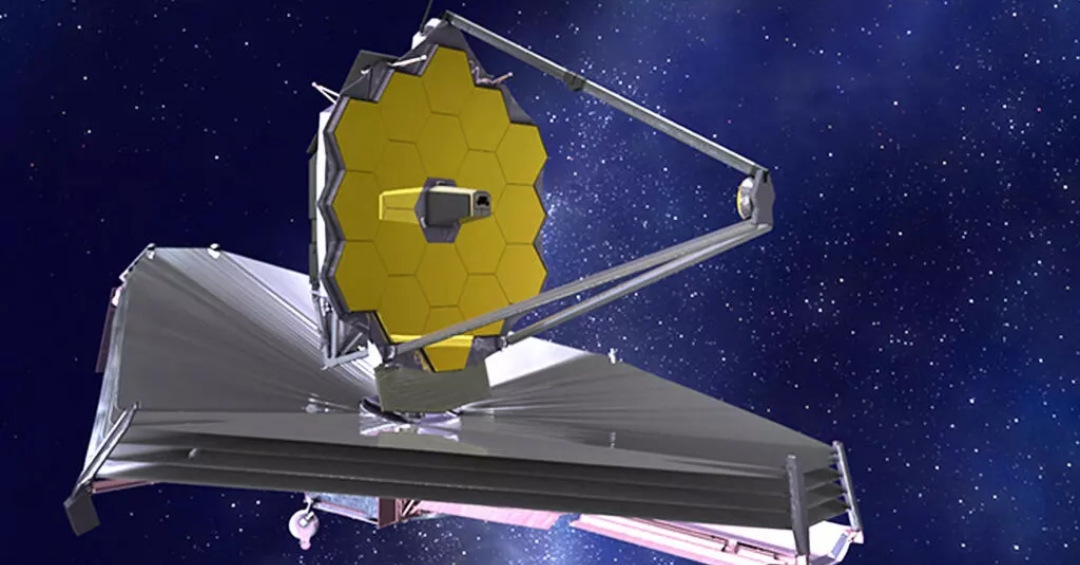
You don’t always have to look billions of light-years away to be wowed. Just this February 2026, Webb turned its golden eye toward Uranus.
Usually, Uranus looks like a featureless, pale blue ball in most telescopes. But in Webb’s infrared view, it’s a dynamic world. We’ve now seen its faint rings with incredible clarity and even mapped the “auroras” at its poles in 3D for the first time. It’s a reminder that even in our own “backyard,” there are wonders we’ve been missing because we simply didn’t have the right eyes to see them.
Also read: How to Spot an Exoplanet: Hunting for Life Among the Stars.
A New Perspective on the Infinite
There is something deeply humbling about what Webb reveals. For most of human history, we looked at the night sky and saw a beautiful, but mostly dark, void. Webb has shown us that the “void” is actually teeming with life, energy, and history.
Every time we point this telescope at a “blank” patch of sky, it comes back with thousands of galaxies, each containing billions of stars. It suggests a universe that is far more crowded, far more ancient, and far more intricate than we ever dared to imagine.
As we continue to receive these images, perhaps the most important thing Webb “sees” isn’t a distant galaxy or a chemical in an atmosphere. Maybe it’s a reflection of our own curiosity, the persistent, human need to reach out into the dark and ask, “What else is out there?”
The more we see, the more we realize that we are part of a vast, unfolding story that is much bigger than ourselves. And isn’t that a wonder worth looking for?
