
Discover how scientists detect gravitational waves, the ripples in spacetime caused by cosmic collisions, using the world’s most sensitive “ears.”
The Day the Earth Trembled (Very, Very Slightly)
Imagine you’re standing on the edge of a perfectly still pond. If a pebble drops into the water, you see the ripples. If two giant boulders crashed into the center, the waves would be massive, physically moving the water and everything in it.
For centuries, we’ve looked at the universe as if it were a silent movie. We had telescopes to see the light of stars, but we were essentially deaf to the vibrations of the cosmos. That changed in 2015, when a pair of massive detectors in the United States felt a “shiver” that had been traveling through space for over a billion years.
That shiver was a gravitational wave, a literal ripple in the fabric of reality. But how do you catch a wave that doesn’t move through space, but moves space itself?
What Exactly Is a Ripple in Spacetime?
Before we get to the “how,” we need to understand the “what.” Albert Einstein, back in 1916, suggested that space and time aren’t just an empty void. Instead, they form a four-dimensional “fabric.” Think of it like a giant trampoline.
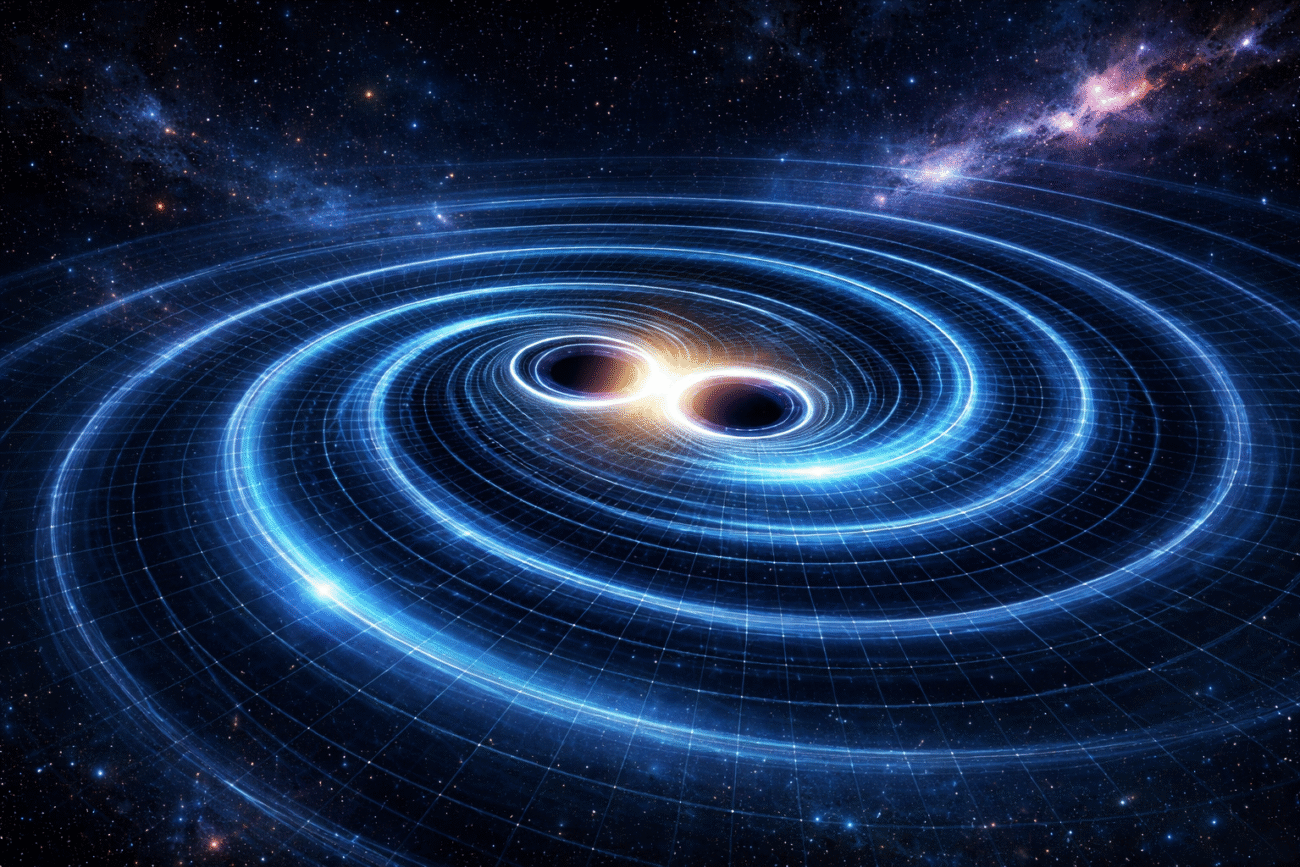
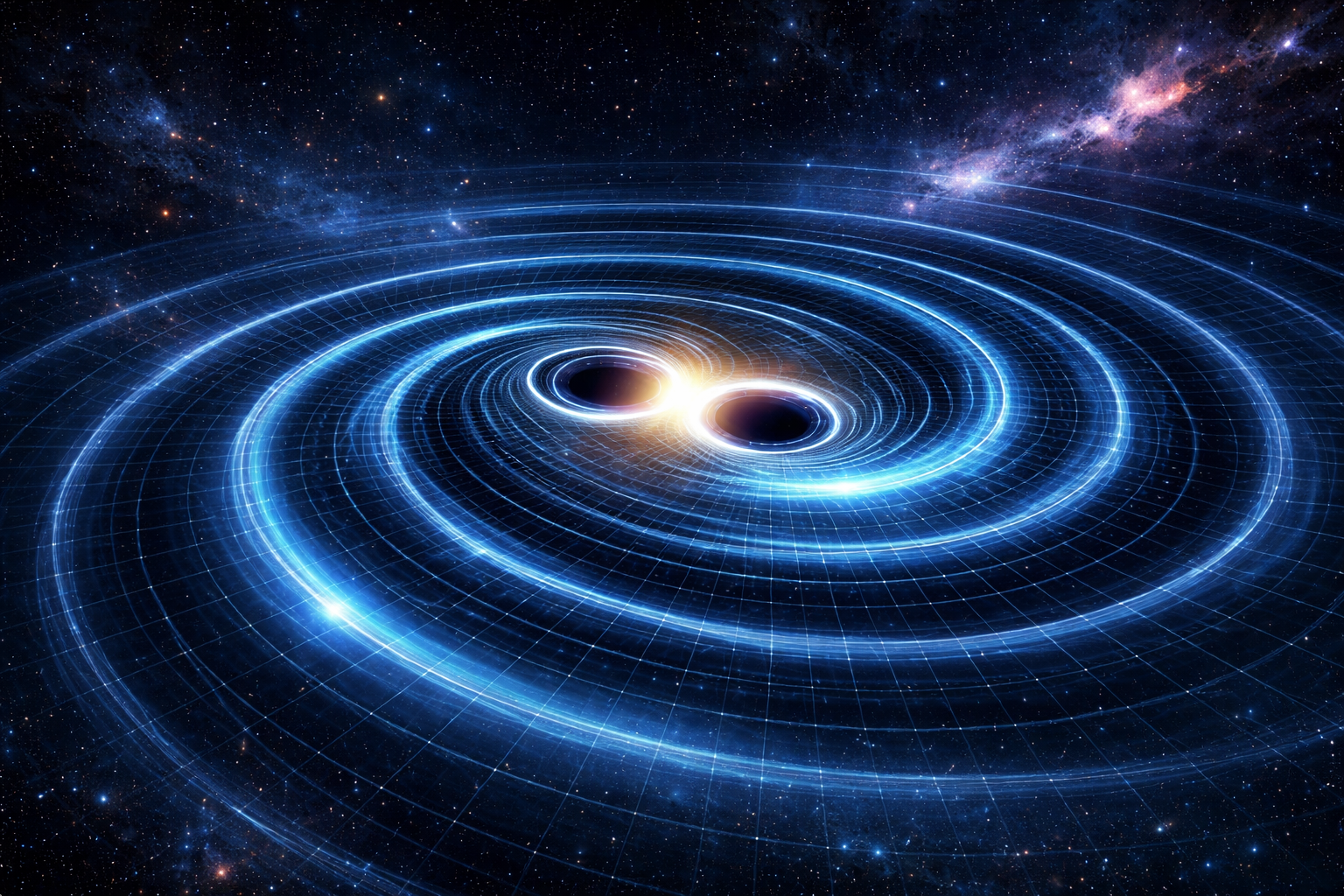
If you put a bowling ball (a star) on that trampoline, it curves the fabric. If you take two incredibly heavy objects, like black holes, and spin them around each other at nearly the speed of light, they create a violent churning. This sends out waves in the fabric, stretching and squeezing everything in their path.
When a gravitational wave passes through you, you actually get a tiny bit taller and thinner, then shorter and wider. The catch? The change is so incredibly small that no human sense could ever hope to feel it. We’re talking about a change in distance smaller than the width of a single proton.
LIGO: The World’s Most Sensitive “L“
To hear these cosmic whispers, we built LIGO (the Laser Interferometer Gravitational-Wave Observatory). There are two of them, one in Washington state and one in Louisiana.
From the air, LIGO looks like a giant, metallic “L” dropped into the landscape. Each arm of the “L” is exactly four kilometers (about 2.5 miles) long. Inside those arms are vacuum tubes so empty that they contain less air than the space surrounding the International Space Station.
The setup is brilliantly simple in concept, but a nightmare to build:
- The Laser: A single laser beam is fired at a “beam splitter.”
- The Split: The splitter sends half the light down one 4km arm and the other half down the second arm.
- The Bounce: At the end of each arm, the light hits a mirror and bounces back toward the starting point.
- The Reunion: The two beams meet back at the splitter.
If the arms are exactly the same length, the light waves from both arms will cancel each other out when they meet, resulting in total darkness at the detector. But if a gravitational wave passes through, it stretches one arm and squeezes the other. Suddenly, the paths are no longer equal. The light waves don’t cancel out anymore, and a flash of light hits the sensor.
Filtering Out the Noise
If LIGO is sensitive enough to detect a change smaller than an atom, it’s also sensitive enough to detect… well, everything else.
Early on, the engineers had a massive problem. A truck driving on a highway miles away felt like a massive earthquake to the detector. Even the waves of the ocean crashing on a distant coastline or a heavy footstep in the control room could drown out the signal from a collapsing star.
To fix this, the mirrors in LIGO are suspended by thin glass fibers in a complex “quadruple pendulum” system. This acts like the world’s most advanced noise-canceling headphones. It isolates the mirrors so perfectly that they remain still even if the ground beneath them is vibrating.
When scientists see a signal, they compare the data from both the Washington and Louisiana sites. If both detectors feel the exact same “chirp” at almost the exact same time, they know it’s not a local truck or a disgruntled badger, it’s the universe talking.
Why Should We Care?
You might wonder why we spend decades and billions of dollars to detect a tiny wiggle in a laser beam. The answer lies in what these waves represent.
Most of the universe is “dark.” We can’t see black holes because they swallow light. We can’t see the very beginning of the universe because the early cosmos was an opaque fog. However, gravitational waves pass through everything. They don’t get blocked by dust, planets, or stars.
By “listening” to these waves, we’ve been able to watch black holes collide for the first time. We’ve seen neutron stars, city-sized balls of pure density, smash into each other, creating gold and platinum in the explosion. We are no longer just looking at the campfire of the universe; we are feeling the heat and hearing the crackle of the wood.
Also read: What the James Webb Space Telescope Really Sees.
A New Window Into the Sky
There is something deeply humbling about the fact that we can even do this. We are small creatures on a small planet, yet we’ve figured out how to measure the trembling of the vacuum itself.
Every time LIGO or its European cousin, Virgo, detects a new event, we add a page to a brand-new book of physics. We are beginning to understand the limits of gravity and the true nature of time. It reminds us that the universe is far more dynamic and interconnected than it appears when we just look up at the quiet night sky.
The next time you look at the stars, try to imagine the invisible ripples passing through you at this very moment, the echoes of ancient cosmic battles, finally reaching our shores. We’ve spent thousands of years watching the light; it’s finally time to listen to the music.
