

Ever wondered how a microwave really heats food? Forget “inside-out” cooking, discover the fascinating physics of water molecules, electromagnetic waves, and why your leftovers have cold spots.
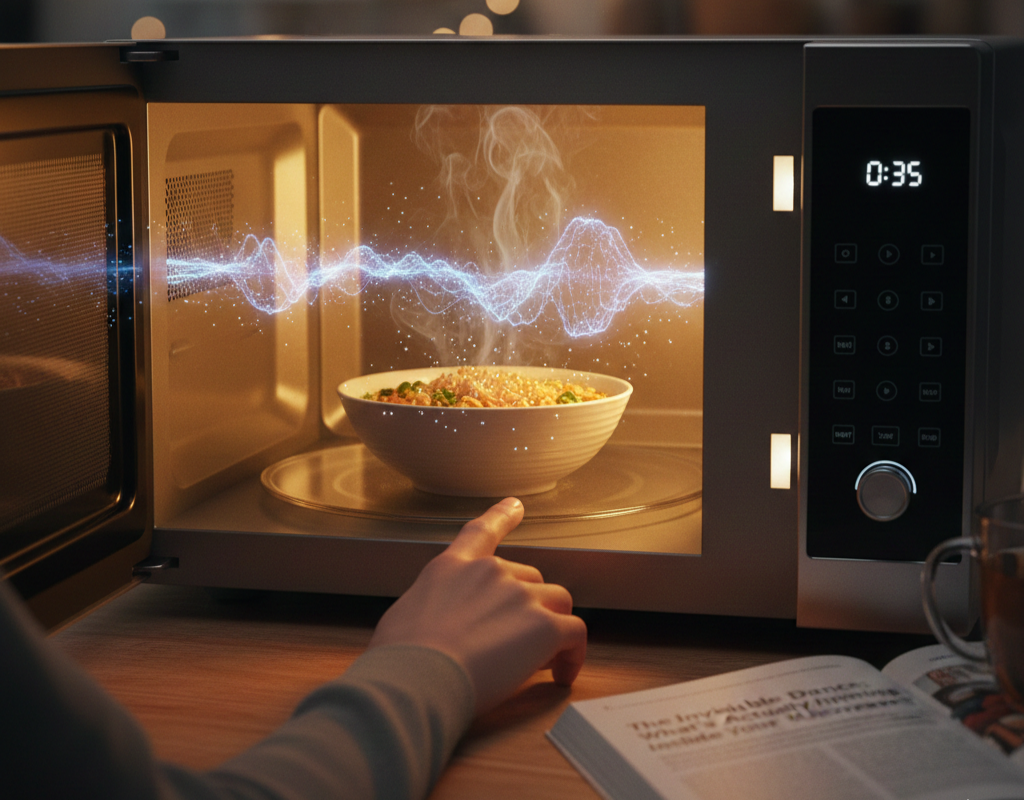
Most of us treat the microwave oven like a magic box. You put in a cold slice of pizza, press a few buttons, and ninety seconds later, you’re dealing with molten cheese and a burnt tongue. It’s one of the few pieces of high-tech laboratory equipment we’ve invited into our kitchens, yet our collective understanding of how it functions is usually limited to “it uses rays.”
If you’ve ever heard that microwaves cook food “from the inside out,” I hate to break it to you, but that’s a bit of an urban legend. The reality is far more interesting, and a little more chaotic. It involves a high-stakes game of molecular tug-of-war happening billions of times per second.
The Magnetron: The Heart of the Machine
Before we talk about the food, we have to talk about the “engine.” Tucked away behind the keypad of your microwave is a device called a magnetron. This is a vacuum tube that converts electricity from your wall outlet into short, high-energy radio waves, microwaves. These waves are part of the electromagnetic spectrum, sitting right between the radio waves that carry your favorite FM station and the infrared light that makes a heat lamp glow. But while radio waves might be meters long, microwaves are roughly 12 centimeters (about 5 inches) from crest to crest.
Once generated, these waves are pumped into the metal cooking chamber. Because the interior is made of metal, the waves don’t escape; they bounce around like crazy, reflecting off the walls until they find something to soak into. That “something” is usually your lunch.
Molecular Gymnastics
So, how does a wave of energy turn into heat? It all comes down to the water molecule.
Think of a water molecule (H_2O) as a tiny, microscopic magnet. It has a positive charge on one end (the hydrogen atoms) and a negative charge on the other (the oxygen atom). In physics, we call this a “polar molecule.” The microwaves generated by your oven are basically oscillating electromagnetic fields. As these waves pass through your food, they flip their polarity back and forth, 2.45 billion times every single second. Because the water molecules are polar, they try to align themselves with this rapidly shifting field. Every time the field flips, the water molecule spins around to keep up. Imagine a billion tiny dancers trying to pull a 180-degree turn every nanosecond. All that frantic spinning and jostling against neighboring molecules creates friction, and on a microscopic scale, friction is heat.
Fun Fact: This is why a dry ceramic plate stays relatively cool while the soup on top of it gets piping hot. The plate lacks the “spinny” water molecules that the microwave can grab onto.
The Myth of “Inside Out”
Let’s address the elephant in the kitchen: the idea that microwaves cook from the center first. If you’ve ever bitten into a Hot Pocket that was boiling on the ends and frozen in the middle, you already know this isn’t true.
Microwaves actually penetrate from the outside in, just like a traditional oven. However, they can reach about an inch or two deep into the food before they’re fully absorbed. In a conventional oven, heat has to crawl its way from the surface to the center via conduction. In a microwave, the “cooking zone” starts deeper, which makes the process much faster, but it still relies on heat drifting toward the center to finish the job.
The Secret of the Turntable
Have you ever wondered why your microwave has a spinning glass plate? It’s not just to give your food a scenic tour of the oven.
When microwaves bounce around the metal interior, they interfere with each other. In some spots, the waves reinforce each other (creating “hot spots”); in others, they cancel each other out (creating “cold spots”). This creates what physicists call a standing wave. Without the turntable, your food would sit in one place, with some parts getting blasted by energy while other parts stay stone cold. By rotating the food, you’re ensuring that every part of your meal eventually passes through those high-energy hot spots.
Why Metal is a No-Go
We’ve all been warned: never put metal in the microwave. But why?
Metal is a great conductor of electricity. When microwaves hit a thick piece of metal (like the walls of the oven), they reflect. But when they hit thin or pointed metal (like the tines of a fork or gold leaf on a fancy tea cup), the electrons in the metal start moving so fast they have nowhere to go. The energy builds up until it “jumps” through the air to reach a lower-energy surface, creating a spectacular, and dangerous, arc of plasma. It’s essentially a tiny lightning bolt inside your kitchen.
Also read: Why the sky isn’t violet ?
A New Perspective on the Leftovers
The next time you’re standing in front of your microwave, watching the timer countdown, take a second to appreciate the sheer complexity of what’s happening. You aren’t just “heating up” food. You are using a repurposed piece of World War II radar technology to command billions of molecules to perform a synchronized, high-speed dance.
It’s a reminder that even the most mundane household tasks are rooted in the profound laws of physics. We’ve mastered the ability to manipulate the invisible forces of the universe just so we can have warm coffee in thirty seconds. If that isn’t a marvel of modern science, I don’t know what is.

One thought on “The Invisible Dance: What’s Actually Happening Inside Your Microwave?”