
Explore the mind-bending possibility of extra dimensions beyond our three-dimensional world. From Flatland to String Theory, discover why the universe might be much larger than it looks.
The Room You Can’t Enter
Take a moment to look around you. You’re likely sitting in a room, or perhaps walking down a street. You intuitively understand how to move: left and right, forward and backward, up and down. Since the moment you crawled as a toddler, you’ve mastered the three dimensions of space. They feel absolute, like the only walls in the house of reality.
But what if our “house” has rooms we’ve never stepped into? What if there are directions, entirely new ways to point, that we simply cannot see?
The idea that there are more than three dimensions isn’t just the plot of a late-night sci-fi marathon. It is a serious, mathematically grounded pursuit in modern physics. From the tiny vibrations of subatomic strings to the vast architecture of the cosmos, scientists are beginning to suspect that our 3D world is just the surface of a much deeper, more complex ocean.
A Lesson from Flatland
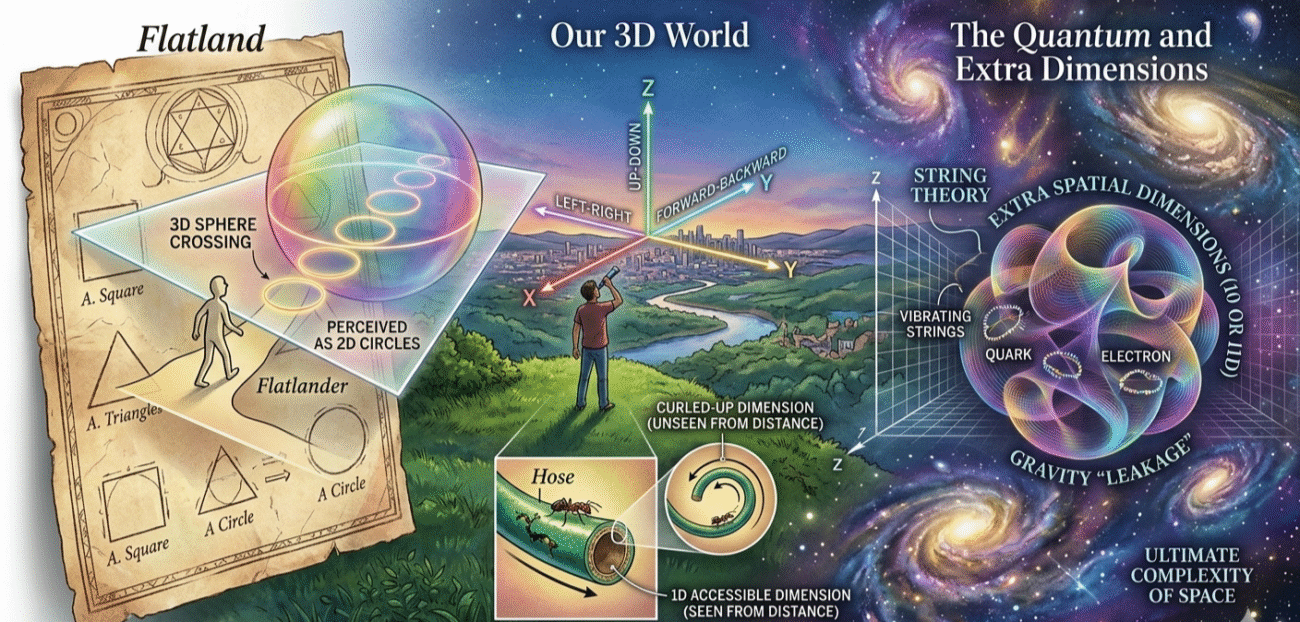
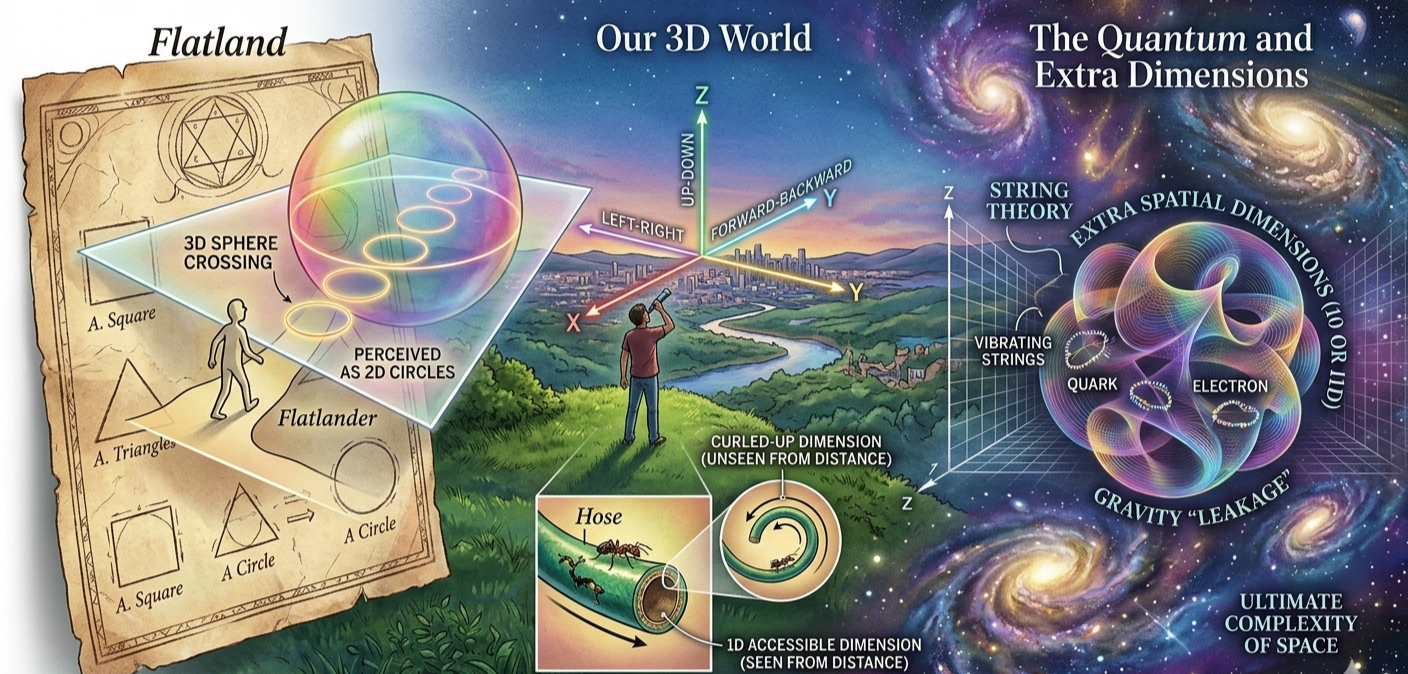
To understand how a dimension could be “hidden,” we have to humble ourselves. In 1884, a schoolmaster named Edwin Abbott wrote a novella called Flatland. He imagined a world that was a simple, two-dimensional plane, inhabited by geometric shapes like squares and circles. If you were a Square living in Flatland, your entire reality would be a tabletop. You’d have no concept of “up.” If a 3D sphere were to pass through your world, you wouldn’t see a ball; you would see a point appear out of nowhere, grow into a widening circle, and then shrink back into nothingness. You’d be witnessing a higher-dimensional event, but your brain would interpret it as a strange, flickering 2D miracle.
We might be the “Squares” of our own universe. If a fourth spatial dimension exists, we wouldn’t see it as a new direction. Instead, we might see its effects as strange ripples in gravity or the behavior of particles that seem to vanish and reappear. We aren’t looking for a “place” far away; we’re looking for a direction we don’t have the biological hardware to perceive.
Why Do We Need Extra Dimensions?
You might wonder why physicists bother with this at all. Isn’t three dimensions enough? The problem is that our current understanding of the universe has a few “glitches.”
One of the biggest headaches in physics is gravity. Compared to the other forces of nature, like the electromagnetism that keeps your fridge magnets stuck or the strong nuclear force that holds atoms together, gravity is incredibly, embarrassingly weak. Think about it: a tiny toy magnet can pull a paperclip upward, defeating the gravitational pull of the entire Earth.
Where is all that “missing” gravity going? Some theorists suggest that gravity is actually just as strong as the other forces, but it “leaks” into extra dimensions. If space has extra folds, gravity might be spreading itself thin across them, while the other forces are stuck on our 3D “membrane.”
The Tightrope and the Ant
If these dimensions exist, where are they hiding? Why don’t we bump into them on our way to get coffee?
The most common explanation involves the concept of compactification. Imagine looking at a garden hose from a hundred yards away. It looks like a one-dimensional line. But as you get closer, you realize that an ant walking on that hose can move in two ways: it can go back and forth (the dimension you saw), or it can crawl around the circumference of the hose.
That circular direction is a second dimension, but from a distance, it’s curled up so tightly that it’s invisible. Physicists believe that extra dimensions in our universe might be “curled up” at a scale so small, the Planck length, that even our most powerful particle accelerators can’t “see” the loop yet.
The Symphony of Strings
This brings us to String Theory. While it remains unproven, it is one of our best shots at a “Theory of Everything.” String theory suggests that the fundamental building blocks of the universe aren’t point-like particles, but tiny, vibrating loops of string.
Here’s the catch: for the math of string theory to work, these strings need more than three dimensions to vibrate in. In fact, most versions of the theory require ten or eleven dimensions.
Think of a violin string. The note it plays depends on how it vibrates. In our universe, the “notes” are particles like electrons and photons. For the universe to produce the rich “music” of matter and energy we see, the strings need a complex, multi-dimensional stage. Without those extra directions, the symphony of reality simply falls flat.
A Universe of Hidden Depth
The search for these dimensions isn’t just about math; it’s about the fundamental nature of our existence. If extra dimensions exist, they change our perspective on what is “real.” We often think of the physical world as a complete, finished product. But if we are living in a higher-dimensional reality, our 3D experience is just a slice, a cross-section of a much grander design.
It suggests a universe that is far more interconnected than it appears. Objects that seem distant in our 3D space might actually be touching in the fourth or fifth dimension. It hints at a level of complexity and order that we are only just beginning to peek at through the keyhole of mathematics.
Also read: Why Things Have Weight: the Secret of the Higgs Boson.
Final Reflections
As we peer into the quantum world and look out at the furthest galaxies, we are forced to remain curious. History has shown us that every time we think we’ve reached the edge of the map, there is more territory to be found.
Perhaps one day, we will look back at our current understanding of “three dimensions” with the same fondness we have for the idea that the Earth is flat. Until then, we live as the Squares of Flatland, sensing that there is a “depth” to our world that we cannot yet touch, but that we can certainly feel in the elegant logic of the stars.
The universe is under no obligation to be simple enough for us to understand. But isn’t the possibility of a hidden, multidimensional masterpiece much more exciting than a world where what you see is all you get?
