

Ever wondered where stars come from? Discover the incredible journey from cold cosmic dust to the birth of a star in this easy-to-follow guide to stellar evolution.
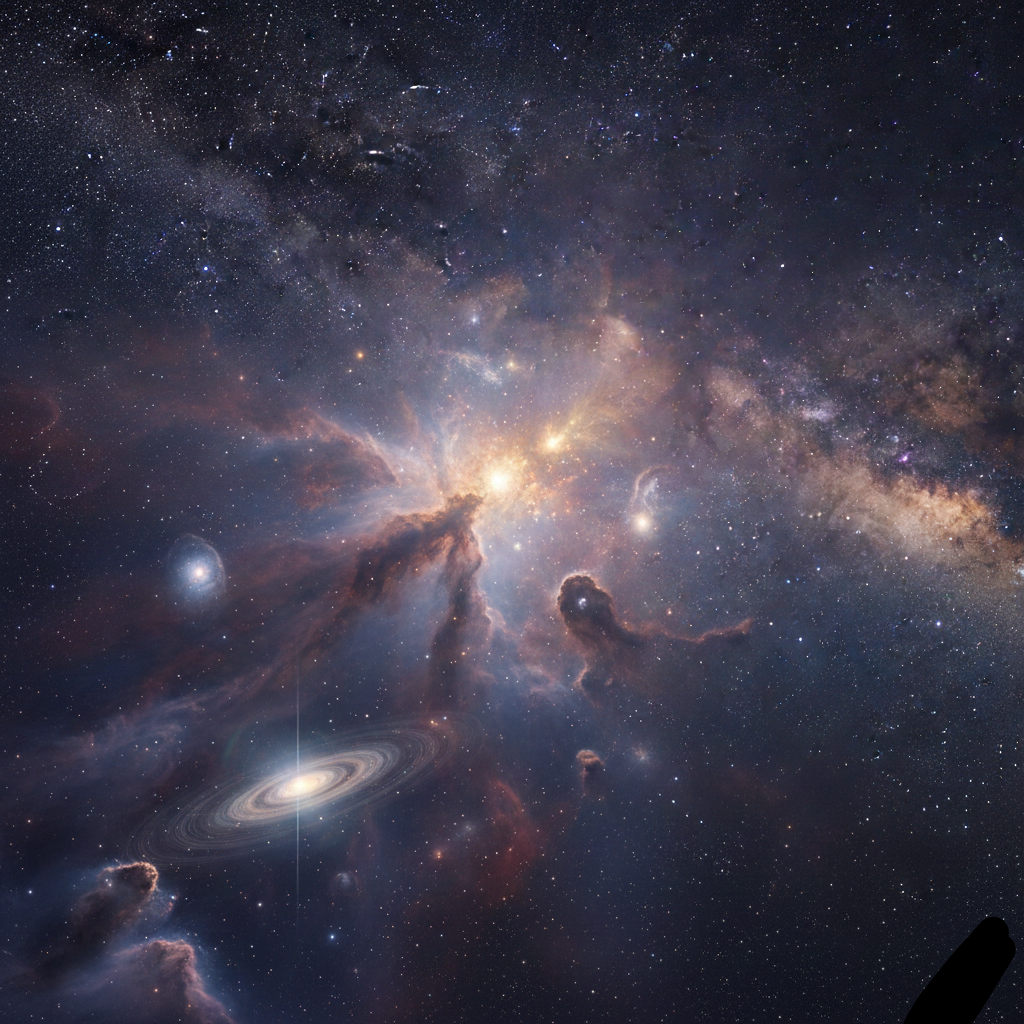
On a truly dark night, away from the hum of city lights, you might look up and see the Milky Way stretching across the sky like a spilled bottle of milk. It looks peaceful, almost static. But if you had eyes that could see “heat” (infrared light) and a few million years to spare, you’d realize that the space between those stars isn’t empty. It’s a construction site.
Right now, in the silent reaches of our galaxy, unimaginable quantities of soot, gas, and ice are swirling together to build the next generation of suns. It is a process that bridges the gap between the microscopic and the monumental.
The Coldest Places in the Universe
Every star you see began its life in a Giant Molecular Cloud. These are the “nurseries” of the cosmos, but they don’t look like much at first. Imagine a fog bank, but one that spans hundreds of light-years.
These clouds are incredibly cold, just a few degrees above absolute zero. You might think heat would be necessary to start a fire, but in the case of a star, you actually need the cold. Why? Because heat makes gas expand and move quickly. For a star to form, the gas needs to be sluggish and dense enough for gravity to take the wheel.
Within these dark, chilly pockets, atoms of hydrogen and tiny grains of silicate and carbon (basically space dust) hang in a delicate balance. They are waiting for a “shove.”
The Big Squeeze
Gravity is a patient architect, but it often needs a little help to get started. Usually, something disrupts the cloud. It could be the shockwave from a distant supernova (a dying star) or the gravitational tug of a passing galaxy.
Once a portion of the cloud becomes just a bit denser than its surroundings, gravity wins the tug-of-war. The cloud begins to collapse inward. As it shrinks, it starts to spin, much like a figure skater pulling in their arms to whirl faster.
As the cloud collapses, it flattens into a disc. In the very center, a hot, glowing ball begins to form. At this stage, we don’t call it a star yet; we call it a Protostar.
The Pressure Cooker
If you’ve ever used a bicycle pump, you know that when you compress air quickly, the nozzle gets hot. The same thing happens on a galactic scale. As gravity crushes the protostar, the temperature in the core skyrockets.
However, a protostar is a bit of a “fake.” It glows with light and heat, but it hasn’t found its own power source yet. It’s just living off the energy of its own collapse. To become a true star, it has to achieve something much more difficult: Nuclear Fusion.
Think of the core of this young star as a crowded subway station where everyone is being shoved together. The atoms of hydrogen want to stay apart, they are positively charged and repel each other like the “North” ends of two magnets.
But gravity is relentless. It squeezes the core so tightly and heats it so intensely (reaching about 15 million degrees) that the hydrogen atoms have no choice. They crash into each other so hard that they stick, fusing together to become helium.
A Star is Born
This moment of fusion is the “First Cry” of a newborn star. When those atoms fuse, they release a tiny burst of energy. Multiply that by trillions of reactions every second, and you have the “nuclear fire” that powers a sun.
This creates an incredible balance called Hydrostatic Equilibrium. It’s a beautiful standoff:
- Gravity is trying to crush the star inward.
- Nuclear Fusion is pushing outward with immense pressure.
As long as the star has fuel to burn, these two forces stay locked in a stalemate. This balance is what allows a star to shine steadily for billions of years, providing the light and warmth necessary for planets, and perhaps life, to thrive.
Why Does This Matter to Us?
It’s easy to feel small when talking about light-years and nebulae, but there is a deeply personal connection between us and these dusty nurseries.
The early universe was mostly just hydrogen and helium. The heavier elements, the oxygen we breathe, the calcium in our teeth, and the iron in our blood, didn’t exist yet. They had to be forged in the bellies of stars. When those stars eventually grow old and pass away, they scatter those elements back into the cosmic dust clouds, seeding the next generation of stars and planets.
Also read: Flat, Round, or a Giant Donut? Unlocking the Mystery of the Universe’s Shape.
A Moment of Reflection
When you look at a star tonight, you aren’t just looking at a distant campfire in the sky. You are looking at a finished masterpiece of physics, a testament to the fact that out of cold, dark chaos, the universe has a remarkable way of creating light and order.
The process of stellar birth is a reminder that we live in a creative cosmos, one that is constantly renewing itself through a cycle of birth, life, and legacy. It makes you wonder: if this is what happens in just one corner of our galaxy, what other wonders are currently being assembled in the dark?

One thought on “The Great Cosmic Alchemy: How Giant Clouds of Dust Become Shining Suns”