

Scientists know that 85% of the matter in the universe is invisible “dark matter.” Explore what we know, what we don’t, and why this cosmic mystery matters.
The Weight of Nothing
Imagine you’re sitting in a darkened theater, watching a performance of Hamlet. You can see the stage, the spotlight, and the actors moving through their scenes. But as the play progresses, you notice something impossible: an actor leaps into the air and stays there, suspended, as if sitting on an invisible chair. Later, a sword flies across the stage, guided by a hand you cannot see.
By the end of the show, you realize that for the play to make any sense at all, the stage must be crowded with invisible people, moving the props and supporting the actors.
This is exactly the predicament modern astronomers find themselves in. When we look at the universe through our most powerful telescopes, we see glowing stars, swirling gas clouds, and majestic galaxies. But when we do the math, none of it adds up. The visible stuff, the stars and planets, isn’t nearly heavy enough to hold galaxies together.
There is a “ghost” in the cosmic machine, and we’ve named it Dark Matter.
The Cosmic Glue
The discovery of dark matter wasn’t a “Eureka!” moment in a lab; it was a slow-burn realization that the universe was breaking the laws of gravity, or so it seemed.
In the 1970s, astronomer Vera Rubin observed how spiral galaxies rotate. According to the standard laws of physics, the stars at the outer edges of a galaxy should move much slower than the stars near the crowded center, similar to how the outer planets in our solar system crawl along compared to zippy Mercury. Instead, Rubin found that the outer stars were flying around at breakneck speeds. They were moving so fast that they should have been flung off into deep space, like children being thrown off a merry-go-round that’s spinning too quickly.
The only explanation was that some invisible “glue” was providing extra gravity to hold everything in place. There had to be a massive amount of invisible material, way more than the visible stars, shrouding every galaxy.
Also read: What happens if we exceed the speed of light?
What It Isn’t (and What It Might Be)
So, what is this stuff? We’re still not entirely sure, but we’ve gotten very good at crossing things off the list.
First, it’s not just “space is dark.” Dark matter isn’t made of clouds of normal dust or dead stars that we just haven’t spotted yet. We know this because dark matter doesn’t interact with light. It doesn’t reflect it, absorb it, or emit it. You could shine a flashlight right through a clump of dark matter, and the beam would pass through as if nothing were there. Physicists currently suspect that dark matter is made of a new kind of subatomic particle. The leading candidate for a long time has been the WIMP (Weakly Interacting Massive Particle). The idea is that these particles are everywhere, trillions of them passing through your body every second, but because they don’t feel electromagnetism, they never “touch” the atoms in your cells.
The Search for a Shadow
If we can’t see it, how do we find it? Scientists are currently attacking this problem from three angles:
- Direct Detection: Building ultra-sensitive detectors deep underground (to shield them from cosmic rays) hoping a single dark matter particle will finally “bump” into a normal atom.
- Indirect Detection: Using space telescopes to look for places where dark matter might be colliding with itself and creating a faint glow of gamma rays.
- Creation: Using the Large Hadron Collider to smash normal particles together so hard that they might actually break apart and create a dark matter particle in the debris.
So far? Silence. We’ve found plenty of evidence that dark matter exists out there in space, but we haven’t caught a single “piece” of it in a jar yet.
Why Should You Care?
It’s easy to feel like this is all just academic hair-splitting. Does it really matter if there’s invisible “stuff” floating between the stars?
Actually, it’s the reason you’re here.
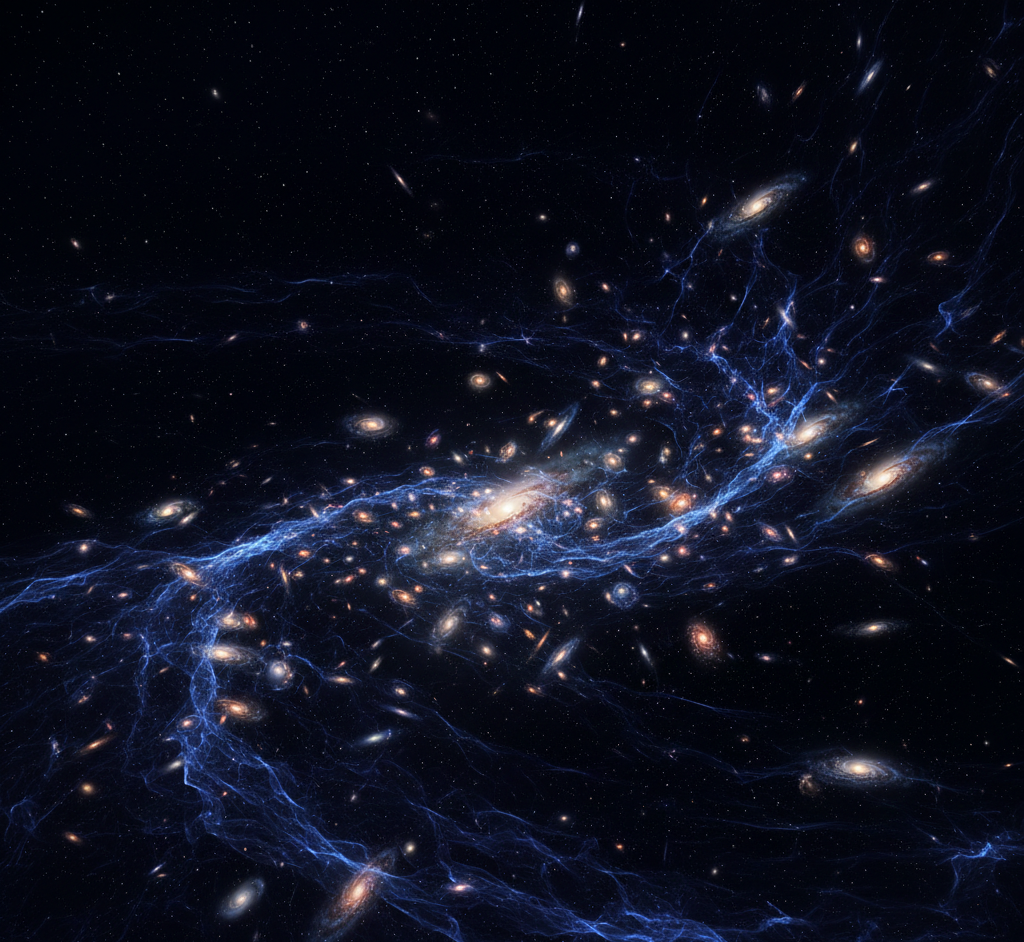
In the early universe, dark matter acted as the “scaffolding” for everything else. Because it has mass, it clumped together first, creating gravitational wells that pulled in the regular gas and dust. Without dark matter, the hydrogen gas in the early universe would have remained spread out too thinly. Stars wouldn’t have ignited, and galaxies wouldn’t have formed.
We are, quite literally, living in the shadow of a mystery.
The Great Unknown
There is something deeply humbling about the realization that everything we have ever seen, every star in every galaxy, every person you’ve ever met, every grain of sand—accounts for only about 5% of the universe. About 27% is dark matter, and the rest is an even weirder force called dark energy.
We are like a few bright bubbles of foam on top of a vast, dark ocean.This isn’t a failure of science; it’s an invitation. History shows that every time humans have discovered a “missing” piece of reality, it has led to a revolution in how we live. When we discovered the invisible world of microbes, we mastered medicine. When we discovered the invisible force of electromagnetism, we lit up the world.
Who knows what we will find once we finally look the “ghost” in the eye?
What do you think? Does the idea of an invisible universe make you feel small, or does it make the world feel more magical?
