
Explore the mind-bending “Fine-Tuning” problem in physics. Discover why the laws of nature seem perfectly calibrated for life and what it means for our place in the cosmos.
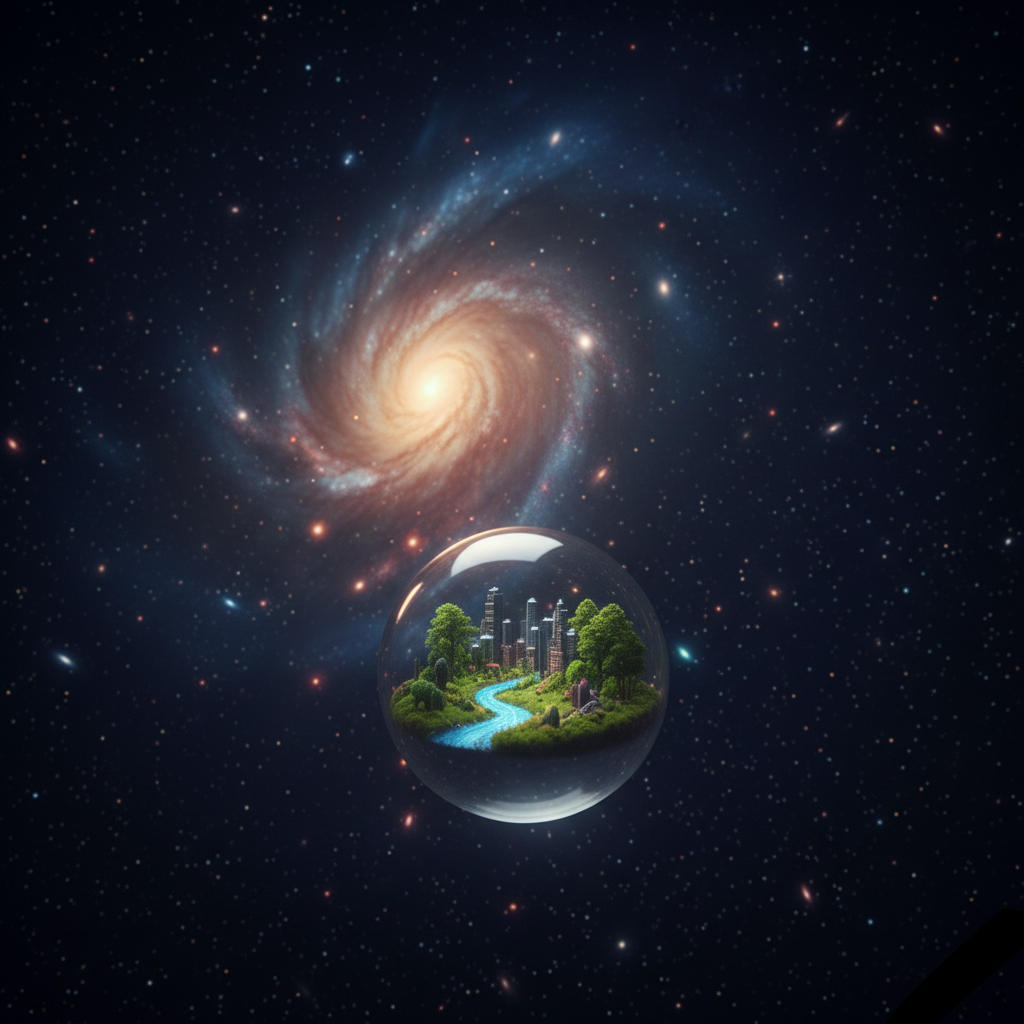
If you’ve ever spent a summer evening staring up at the stars, you’ve likely felt that familiar shiver of insignificance. The universe is impossibly vast, cold, and, for the most part, deadly. Yet, here we are. You’re breathing, your heart is pumping, and your brain is currently processing these words.
But if you ask a physicist how likely our existence is, they might give you a look that suggests we’ve won the ultimate lottery. In fact, many scientists have started to notice something strange: the fundamental laws of nature seem to be balanced on a razor’s edge. If any one of a dozen physical constants were even slightly different, the universe would be a barren wasteland, or wouldn’t exist at all. This is the mystery of Cosmic Fine-Tuning. It’s the idea that our universe isn’t just a random accident, but a place where the “settings” are dialed in specifically to allow life to flourish.
The Universe’s “Control Knobs”
Think of the universe as a massive control room filled with dials and sliders. Each dial represents a fundamental constant of nature, things like the strength of gravity, the mass of an electron, or the speed of light.
As far as we can tell, there is no logical reason why these dials are set to their specific values. They could have been anything. But if you were to walk into that room and nudge even one of those dials by a fraction of a millimeter, the consequences would be catastrophic.
Take the Strong Nuclear Force, for example. This is the “glue” that holds atoms together. If this force were just 2% stronger, protons would bond so easily that stars would burn through their fuel in seconds, leaving no time for life to evolve. If it were 2% weaker, atoms like carbon and oxygen, the very building blocks of your body, could never form. We’d be a universe of nothing but loose hydrogen.
The Gravity of the Situation
Gravity is another perfect example of this precision. We often complain about gravity when we trip or drop a phone, but it is actually remarkably weak compared to other forces. However, its specific strength is vital.
If gravity was slightly stronger, the universe would have collapsed back in on itself long ago in a “Big Crunch” before the first planet even had a chance to cool. If it were slightly weaker, the gas and dust from the Big Bang would have drifted apart forever, never clustering together to form stars or galaxies.
We live in a “Goldilocks” universe, not too heavy, not too light, but just right.
The Expansion Problem
Perhaps the most mind-bending example involves the Cosmological Constant, which describes the expansion of space itself. This value is tuned to an almost incomprehensible degree of precision, roughly one part in 10^{120}.To visualize that level of accuracy, imagine trying to throw a dart from Earth and hitting a bullseye the size of an atom on the edge of the observable universe. If the expansion rate had been even a hair faster, the universe would have thinned out too quickly for stars to form. A hair slower, and the whole thing would have collapsed before it even got started.
Why Does This Matter?
Now, you might be thinking, “Well, of course the universe is this way. If it weren’t, we wouldn’t be here to talk about it!”
That’s a fair point, often called the Anthropic Principle. But it doesn’t really explain why the numbers are what they are. It just notes that we happen to be the lucky observers. For many thinkers and scientists, the sheer mathematical improbability of these “coincidences” suggests there is more to the story.
It raises a profound question that moves beyond the realm of simple physics and into the territory of wonder: Why does the universe seem to expect us?
A Masterpiece of Calibration
When we look at a complex machine, like a Swiss watch or a high-end computer, we don’t assume it fell together by chance. We recognize the precision as a sign of purposeful design. The universe presents us with a similar, albeit much larger, puzzle.
Whether you view this fine-tuning through a lens of scientific curiosity or a deeper sense of cosmic purpose, it’s hard to deny that the cosmos feels remarkably “hospitable.” It isn’t just a chaotic explosion of energy; it is a finely choreographed dance.
The elements required for life, carbon, nitrogen, oxygen, weren’t there at the beginning. They had to be forged in the hearts of stars, which in turn required a perfectly balanced set of physical laws to exist in the first place. Every step of the way, the universe took the “right” path to lead to us.
Also read: Is the Universe Infinite? What Modern Cosmology Actually Tells Us.
Reflections on a Tailor-Made Cosmos
We are currently in a golden age of cosmology. We’re mapping the edges of the universe and peering back to the dawn of time. Yet, the more we learn, the more “fine-tuned” the world appears to be.
It’s a humbling thought. We aren’t just passengers on a rock flying through space; we are the result of a series of cosmic settings that are so precise they defy easy explanation. It suggests that life isn’t just a minor byproduct of the universe, but perhaps a central part of its story.
Next time you look up at the night sky, remember that you aren’t just looking at distant lights. You’re looking at a system that was calibrated, against all odds, to ensure that one day, you would be there to look back at it.

2 thoughts on “The Cosmic Goldilocks: Is the Universe Actually Built for Us?”