
Explore the Big Crunch theory, the cosmic “undo” button. Learn how gravity might one day stop the expansion of the universe and pull everything back together.
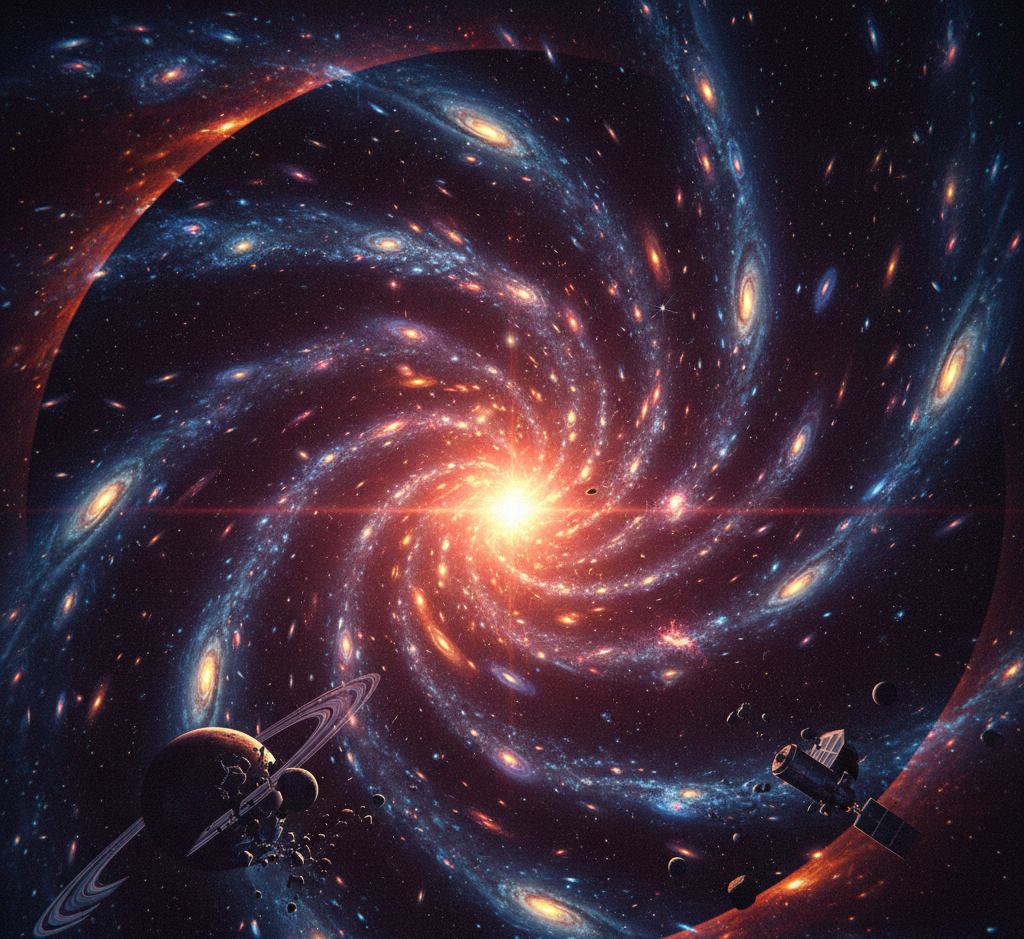
We’ve all heard the story of how the universe began. A tiny, unimaginably hot speck suddenly erupted, stretching space itself into the vast, star-studded expanse we see today. It’s the Big Bang, the ultimate “Once Upon a Time.” But if you’re anything like me, you can’t help but skip to the final chapter. How does it all end?
For decades, one of the most cinematic possibilities has been the Big Crunch. It’s essentially the Big Bang in reverse. Instead of expanding forever into a cold, dark void, the universe decides it’s had enough, stops in its tracks, and starts falling back inward. It’s the cosmic “undo” button, and the physics behind it is as fascinating as it is terrifying.
The Cosmic Tug-of-War
To understand the Big Crunch, you have to think of the universe as a giant game of tug-of-war. On one side, we have the initial momentum of the Big Bang, pushing everything apart. On the other side, we have gravity, the great attractor.
Gravity is relentless. Every star, every galaxy, and every stray atom of gas is pulling on everything else. In the early days of modern cosmology, the big question was: “Is there enough stuff in the universe for gravity to win?” Imagine throwing a ball into the air. If you throw it gently, gravity wins almost immediately, and it falls back to your hand. But if you could throw it at 11 kilometers per second (Earth’s escape velocity), it would break free and head into orbit. The Big Crunch theory suggests that the universe doesn’t have that “escape velocity.” It posits that the collective weight of all the matter in existence will eventually act like a celestial brake, slowing the expansion until it grinds to a halt.
The Long Road Back
If the Big Crunch were to happen, we wouldn’t notice anything for a very long time. The universe is incredibly big, and things are very far apart. But eventually, the “stop” would happen. For a brief, cosmic moment, the universe would be static, neither expanding nor contracting.
Then, the slide begins.
Initially, the changes would be subtle. Galaxies would stop moving away from us and start drifting closer. Over billions of years, this drift would accelerate. The night sky would begin to change as distant island universes, once visible only through the Hubble or James Webb telescopes, become bright enough to see with the naked eye.
As the universe shrinks, the blue-shift (the opposite of the famous red-shift) would take over. Light from approaching galaxies would be compressed, shifting toward the blue end of the spectrum. The cosmos, which is currently getting colder as it grows, would start to heat up.
Turning Up the Heat
This is where things get uncomfortable. In an expanding universe, the Cosmic Microwave Background (the leftover heat from the Big Bang) is currently sitting at a chilly -270°C. In a Big Crunch scenario, that radiation gets compressed and energized. Eventually, the universe becomes so small and the radiation so intense that stars can no longer shed their own heat. They would literally cook from the outside in. In the final stages, the space between stars would be hotter than the surfaces of the stars themselves. Atoms would be ripped apart into a soup of plasma, reversing the process of “recombination” that happened shortly after the Big Bang.
The end result? Everything (planets, black holes, and the very fabric of space-time) is crushed back into a singularity. A point of infinite density where our current laws of physics simply break down and stop making sense.
Also read: What actually happens inside a black hole ?
The “Dark Energy” Problem
Now, I have to be honest with you: the Big Crunch isn’t as popular as it used to be. In the late 1990s, astronomers looking at distant supernovae discovered something that threw a massive wrench in the “falling back” theory. They found that the universe isn’t just expanding; it’s accelerating.
Something is pushing the universe apart faster and faster, acting like “anti-gravity.”
We call this Dark Energy, though “We Don’t Know What This Is” would be a more accurate name. Because of Dark Energy, most current models suggest we are headed for a “Big Freeze” or a “Heat Death,” where the universe just keeps growing until it’s too cold and empty for anything to happen. However, science is rarely settled. Some theorists suggest that Dark Energy might not be a constant. If its strength fluctuates or decays over billions of years, the Big Crunch could be back on the table. In physics, as in life, it’s never wise to count gravity out.
The Big Bounce: A Silver Lining?
There is a version of the Big Crunch that offers a bit of hope for the existentialists among us. It’s called the Big Bounce.
Some physicists, working with theories like Loop Quantum Gravity, suggest that once the universe reaches that final, ultra-dense state, a sort of quantum pressure kicks in. Instead of collapsing into a dead-end point of nothingness, the universe “bounces” back out, starting a brand-new Big Bang.
This creates a “cyclic” universe, an infinite loop of expansion and contraction. In this view, our current universe is just one breath in a cosmic cycle of inhalation and exhalation that has been going on forever. There is something strangely poetic about the idea that our end is simply the “Go” signal for the next version of reality.
Reflection: Our Place in the Timeline
Looking up at the stars, it’s easy to feel small. Whether we end in fire (the Big Crunch) or ice (the Big Freeze), the scale of these events is so far beyond human experience that it can feel irrelevant.
But there’s a flip side to that coin. We live in a very specific window of cosmic history, a time when the universe is old enough to have formed complex life, but young enough that the stars are still burning bright. We are the witnesses to the middle of the story.
Whether the universe eventually folds back like a closing book or continues to grow until the ink fades away, the fact that we can even ask these questions is a miracle of its own. We are a way for the cosmos to contemplate its own ending.
What do you think? Does the idea of a “Big Bounce” make the end of the universe feel less final, or does the thought of a “Big Crunch” make our current moment feel more precious?
