

Discover how cosmic inflation shaped our universe in a fraction of a second. A look at the fastest expansion ever and the mystery of our cosmic origins.
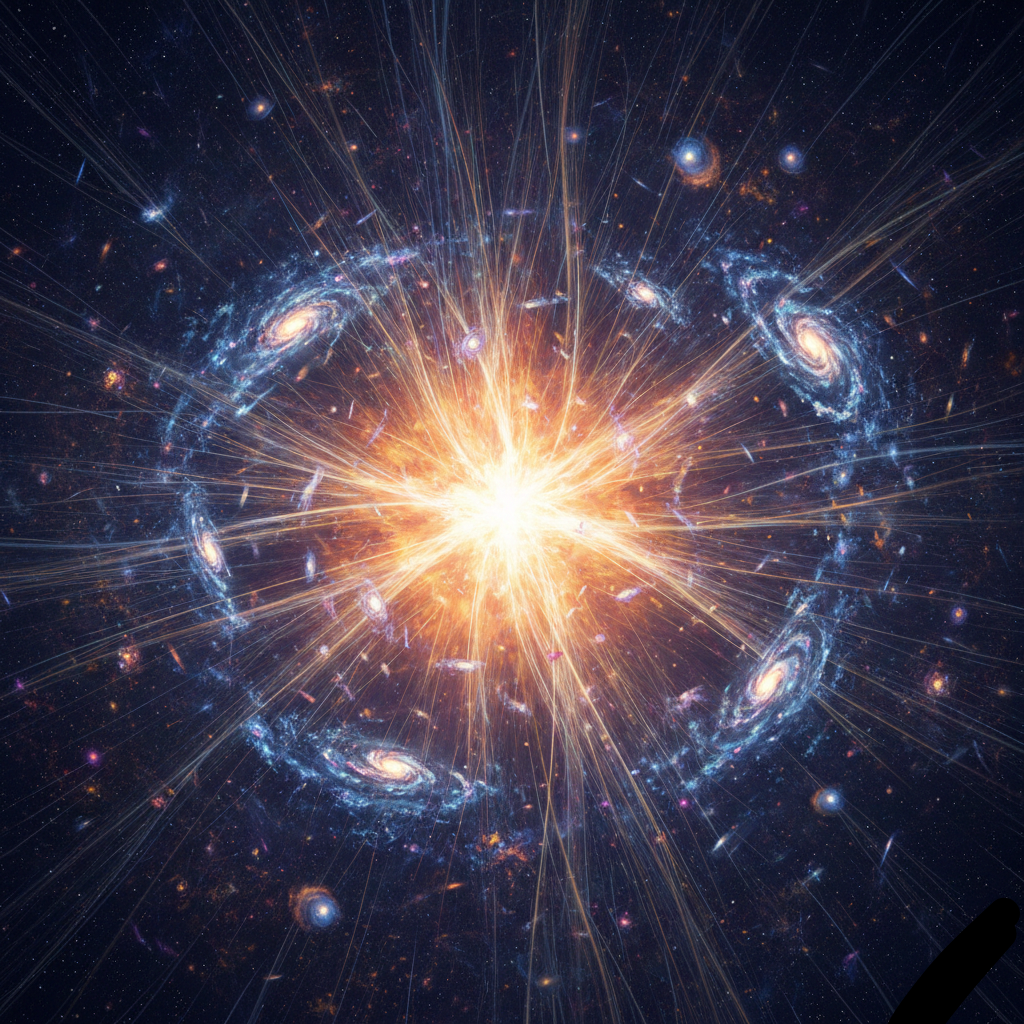
The Mystery of the Smooth Horizon
If you look at the night sky, it seems like a chaotic masterpiece, a splatter of stars, galaxies, and vast voids. But if you could zoom out far enough, past the individual galaxies and into the very “fabric” of the universe, you’d find something deeply unsettling to physicists: it’s too perfect.
Imagine walking into a room that is ten miles wide, and every single corner of that room is exactly 22.5°C. Not a fraction of a degree off. For that to happen, the air molecules must have had time to bounce around and share their heat until everything leveled out.
Now, apply that to the universe. When we look at the oldest light in existence, the Cosmic Microwave Background, we see that opposite sides of the universe are almost exactly the same temperature. The problem? Based on the standard speed of light and the age of the universe, those two sides shouldn’t have ever “met” to trade heat. They are too far apart. So, how did the universe get so uniform? The answer is a short, violent, and utterly mind-bending event called Cosmic Inflation.
The Ultimate Growth Spurt
Most of us have heard of the Big Bang. We tend to picture it as a standard explosion, like a firework expanding into the dark. But the Big Bang wasn’t an explosion in space; it was an expansion of space.
About 13.8 billion years ago, the universe was smaller than an atom. Then, in a period of time so short that the human mind literally cannot process it, the universe underwent a “growth spurt” that defies logic.
Between 10^{-36} and 10^{-32} seconds after the starting point, the universe expanded exponentially. It didn’t just grow; it doubled in size over and over again, at least 60 times. To put that in perspective, if a molecule of DNA grew that fast, it would become larger than the entire Milky Way galaxy in less time than it takes for you to blink.
Breaking the Speed Limit?
I know what you’re thinking: “Wait, I thought nothing could go faster than the speed of light?” You’re right, if we’re talking about objects moving through space. But inflation is about space itself. Einstein’s equations allow the fabric of the universe to expand at any speed it likes. During inflation, space was stretching so fast that it pushed points away from each other at speeds that make light look like a snail on a Sunday stroll.
This “sprint” solved the heat problem I mentioned earlier. Before inflation, the universe was tiny enough that everything could touch and reach a uniform temperature. Then, inflation took that small, uniform patch and stretched it so violently that it became the massive, observable universe we see today.
The “Who” and the “How”
As a science writer, I often find that people feel a bit cold when talking about physics. They worry that explaining the mechanics of the universe somehow removes the wonder or the “need” for a Creator.
But for many of us, learning about inflation does the exact opposite. When you look at the math, you realize the universe is balanced on a knife’s edge. If inflation had been slightly weaker, the universe would have collapsed back on itself eons ago. If it had been slightly stronger, matter would have been pushed so far apart that stars could never have formed.
The sheer precision required for this “sprint” to produce a life-sustaining universe is staggering. To me, discovering the how, the mechanics of inflation, is simply like looking at the blueprints of a master architect. We are uncovering the method by which the world was spoken into existence.
What Happens Next?
We are still in the “detective” phase of this story. While the evidence for inflation is incredibly strong, we haven’t yet found the “smoking gun”, a specific type of ripple in gravity called primordial gravitational waves.
Scientists are currently using massive telescopes in places like the South Pole and high-altitude deserts in Chile to peer back at the very beginning of time. They are looking for a specific twist in the ancient light of the Big Bang that would prove, once and for all, exactly how that initial expansion happened.
Also read: Why Nebulae are the Universe’s Most Beautiful Factories.
Final Thoughts: A Moment of Reflection
It is humbling to realize that the vastness of the heavens was once contained in a space smaller than a grain of sand. We live in a universe that seems designed for discovery, governed by laws that allow us to trace our history back to the very first fraction of a second.
The next time you look up at the stars, remember that you aren’t just looking at light. You are looking at the aftermath of the most powerful moment in history, a moment where space itself took a leap, paving the way for everything we know and love.

One thought on “The Big Bang’s Big Secret: Why the Universe Pulled a Cosmic Sprint”