

In late October 2025, researchers from the International Centre for Radio Astronomy Research (ICRAR) in Australia unveiled a remarkable scientific achievement; the most extensive full-color image ever produced of the Milky Way’s galactic plane, captured using low-frequency radio waves.
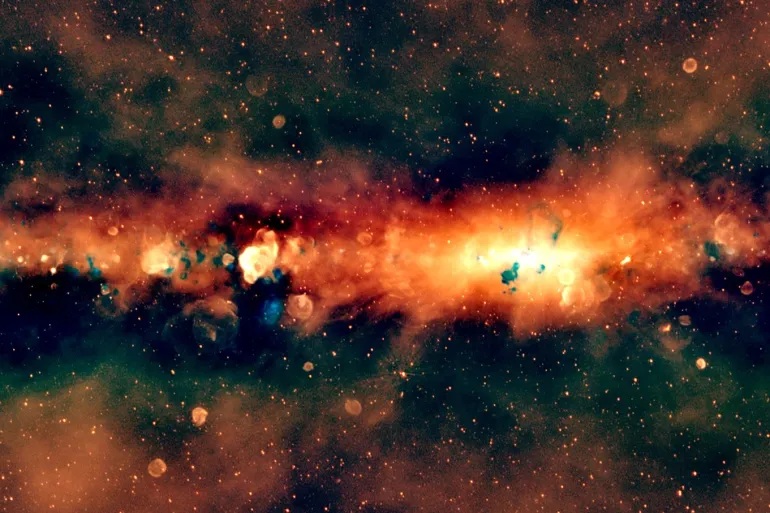
The new image reveals hidden details within the galactic plane features invisible to the naked eye.
Credit: The International Centre for Radio Astronomy Research (ICRAR).
Captured using the Murchison Widefield Array telescope, the image unveils breathtaking details from the core of our galaxy features that ordinary light could never reveal.
The research team has made this image freely available to the public as an interactive, zoomable map, featured in the official press release issued by the International Centre for Radio Astronomy Research (ICRAR).
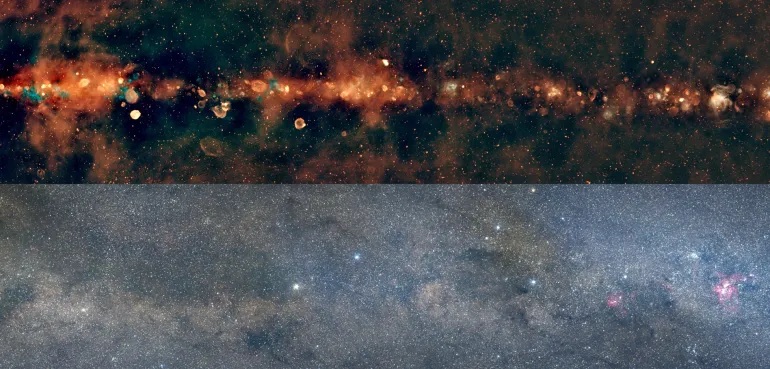
At the top, one can see a portion of the newly released, high-precision image, contrasted with a standard optical view of the Milky Way’s galactic plane shown below.
Credit: The International Centre for Radio Astronomy Research (ICRAR).
Unlike conventional telescopes that feature a single enormous dish, this telescope is composed of an array of over 400 small antenna clusters.
Each cluster contains 16 simple, spider-like antennas anchored to the ground, which collectively function as a single, giant virtual telescope.
Researchers employ supercomputers to meticulously merge the signals from all antennas, generating a high-resolution image of the sky at low radio frequencies between 80 and 300 megahertz.
Radio waves are a type of electromagnetic radiation, similar to light but with longer wavelengths and lower energy. Though invisible to the human eye, they travel through space, carrying both information and energy.
In astronomy, radio waves are invaluable because they can pass through cosmic dust that blocks visible light, enabling scientists to observe stars and galaxies as they emit their otherwise hidden signals. The same principle applies in everyday life, where radio waves power radio, communications, and Wi-Fi, serving as a language of both the cosmos and human technology.

Murchison Widefield Array (MWA).
Credit: International Centre for Radio Astronomy Research (ICRAR).
Over more than 100 nights of observations, researchers gathered an enormous dataset of the southern sky as part of two coordinated projects: GLEAM and GLEAM-X.
Earlier surveys had their limitations, but the latest release exceeds them with double the resolution and tenfold the sensitivity, revealing nearly 98,000 radio sources, including nebulae, supernova remnants, and pulsars.
This enabled researchers to create a vivid new portrait of the galaxy, almost like a living painting: small blue areas highlight stellar nurseries where new stars are forming, while large red circles trace the remnants of stellar explosions from thousands of years ago.
The Murchison Widefield Array uses low-frequency radio waves, enabling it to pick up extremely faint signals from cold gas and ancient stellar remnants. These signals reveal vast, extended structures that remain invisible in visible or infrared light.
Consequently, the image produced by the project presents the Milky Way not as the familiar bright band seen at night, but as a dynamic mosaic of radio energy and colors.
In the image, one can observe rivers of flowing gas, echoes of long-past stellar explosions, and new stars emerging from the remnants of old ones. It is a striking reminder that the universe communicates not only through visible light, but also through the hidden waves that fill space.
Source: https://www.icrar.org/gleam-x-galactic-plane/

One thought on “The announcement of the most detailed image of our galaxy revealing what the human eye cannot see.”