
Researchers have unveiled previously unknown configurations in which quarks can combine, shedding new light on the behavior of the tiniest constituents of matter known to humankind.
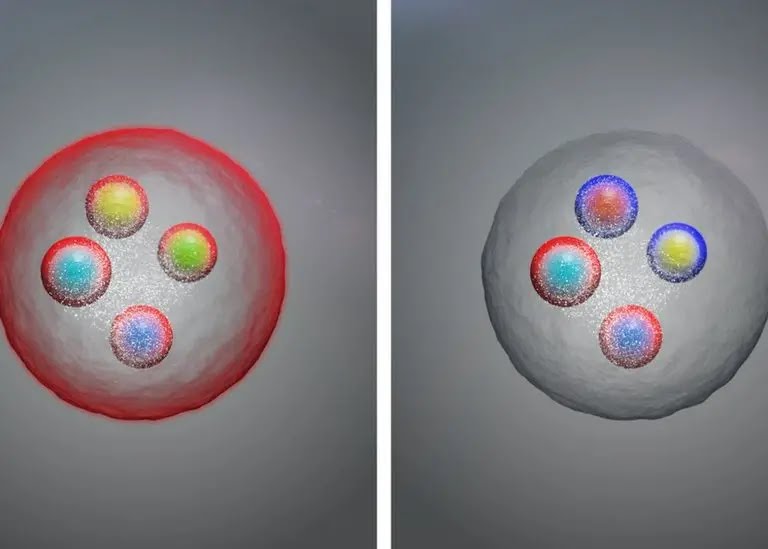
These exotic forms of matter persist only for a fleeting instant, far shorter than the blink of an eye.
Image credit: CERN.
Although these newly identified structures endure for only a fraction of a trillionth of a trillionth of a second, they could provide crucial insights into the mechanisms that shaped the early Universe.
Ordinary matter is built from atoms, whose nuclei contain protons and neutrons, each made up of three quarks.
The concept of fundamental building blocks of matter dates back to Democritus, a Greek philosopher of the fifth century BCE, who theorized that all things are composed of indivisible particles, later termed atoms.
Advances in experimental physics during the late 1800s and early 1900s demonstrated that atoms consist of smaller constituents : electrons, protons, and neutrons.
By the mid-20th century, research revealed that protons and neutrons are not elementary after all, but are formed from more fundamental particles called quarks. The interactions among quarks are mediated by the strong nuclear force, one of nature’s four fundamental interactions.
This force is not only responsible for binding atomic nuclei but also for governing the dynamics of countless subatomic processes, making it a cornerstone of the structure and stability of the Universe.
The exotic forms of matter revealed over the past few years consist of four- and five-quark combinations, referred to as tetraquarks and pentaquarks.
At the Large Hadron Collider in Switzerland, physicists have reported the discovery of a new pentaquark and two novel tetraquark states, raising the tally of known exotic hadrons to 21. Although each of these entities exhibits distinct characteristics, the team is particularly excited by the unusual properties of these latest findings.
The newly observed pentaquark undergoes a decay process that yields a unique set of particles, unseen in any previous cases, while the two tetraquarks appear to possess identical masses, a feature that may indicate they form the first recognized pair of related exotic configurations.
Perhaps most importantly, the growing number of known exotic particles now allows physicists to begin organizing them systematically, much like the elements in a periodic table of matter’s building blocks. This represents a crucial milestone toward constructing a unified framework capable of explaining and predicting the behavior of such unusual forms of matter.
To explore the implications of these new results, scientists convened a dedicated seminar at CERN, the European Organization for Nuclear Research, which operates the Large Hadron Collider.
While examining subtle differences among subatomic particles may appear highly specialized, it is through the interplay of quarks that the strong nuclear force emerges, the fundamental glue that binds atomic nuclei and, by extension, the entire cosmos.
“The strong force remains extraordinarily challenging to compute, and our theoretical understanding of how exotic pentaquarks and tetraquarks are assembled is still incomplete,” noted Professor Chris Parkes of the University of Manchester.
“We hope that ongoing discoveries will help us refine our models and ultimately achieve a clearer picture of these remarkable states of matter.”
Following a significant upgrade of the Large Hadron Collider, scientists anticipate the discovery of a wider range of exotic particles, potentially including those composed of six quarks bound in a single state.
Some of these configurations might exhibit greater stability, persisting for up to a few tens of billions of a second, an eternity in subatomic terms.
Despite their extremely short lifetimes, their near-light-speed motion would produce millimeter-scale tracks in the detectors, faint but crucial imprints that could help researchers reconstruct their properties and deepen our understanding of the strong force and the early Universe.
Source: CERN.
