
Explore the mind-bending world of neutron stars. From city-sized magnets to matter so dense a teaspoon weighs a mountain, discover the universe’s most extreme survivors.
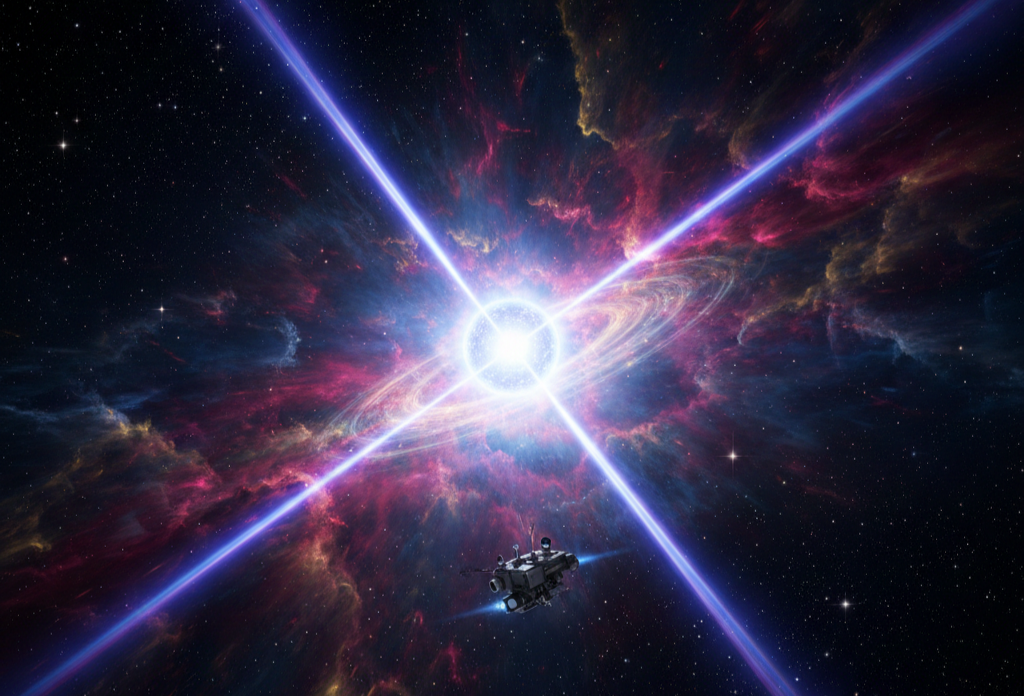
Imagine taking something twice as massive as our Sun, a star so large it could swallow a million Earths, and crushing it until it fits inside the city limits of San Francisco.
It sounds like a thought experiment gone wrong, or perhaps the opening scene of a big-budget sci-fi flick. But in the vast, silent stretches of our galaxy, these objects actually exist. They are called neutron stars, and they are the universe’s way of showing us exactly what happens when gravity wins the ultimate wrestling match against matter.
I’ve spent years writing about the cosmos, and if there is one thing I’ve learned, it’s that the universe loves to push the boundaries of “possible.” Neutron stars are the gold medalists of those extremes.
The Most Violent Birth Imagineable
To understand a neutron star, we first have to talk about how they’re born, and it isn’t exactly a peaceful process.
When a massive star, one much larger than our Sun, runs out of fuel, it stops producing the outward pressure that keeps it inflated. In a split second, gravity takes over and the star collapses inward. The outer layers are blown away in a supernova, an explosion so bright it can briefly outshine an entire galaxy.
But it’s what’s left behind that interests us. The core of the star is crushed so tightly that the very atoms it’s made of are forced to surrender. Electrons and protons are literally squeezed together until they merge into neutrons. What you’re left with is a ball of “neutron soup” roughly 12 miles across, spinning faster than a kitchen blender.
Density That Defies Logic
Let’s talk about density for a moment, because this is where neutron stars really start to break our brains.
If you were to take a standard teaspoon and scoop up a bit of neutron star material (assuming you didn’t instantly vaporize or get crushed), that single teaspoon would weigh about one billion tons. That is roughly the weight of every car currently on the planet combined, all packed into a space the size of your thumb.
Because they are so dense, their gravity is terrifying. If you stood on the surface of a neutron star, which you can’t, but let’s pretend, you would be crushed into a layer of atoms thinner than a sheet of paper instantly. The escape velocity is about half the speed of light. To put that in perspective, if you dropped a marshmallow onto the surface of a neutron star from a few miles up, it would hit the ground with the force of a nuclear bomb.
The Great Cosmic Lighthouses
One of the coolest things about these objects is how we find them. When they first form, they spin incredibly fast, sometimes hundreds of times per second.
As they spin, they blast out beams of radiation from their magnetic poles. If those beams happen to be pointed toward Earth, we see them as a “pulse” of light every time the star rotates. We call these Pulsars.
When Jocelyn Bell Burnell first discovered these pulses in 1967, the signals were so regular and precise that some scientists jokingly labeled the source “LGM-1” (Little Green Men). They honestly thought they might have found an alien radio station. Instead, they had found a dead star acting like a cosmic lighthouse.
Starquakes and Magnets
If a regular neutron star isn’t extreme enough for you, let me introduce you to the Magnetar.
Some neutron stars have magnetic fields that are a quadrillion times stronger than Earth’s. If a magnetar were to drift halfway to the Moon, it would instantly wipe the magnetic strips on every credit card on Earth and literally pull the iron atoms out of your bloodstream.
Every now and then, the “crust” of these stars, which is made of a crystal-like lattice of nuclei, cracks under the immense pressure. We call these starquakes. A shift of just a fraction of a millimeter on the surface of a magnetar can release more energy than the Sun produces in 100,000 years. It’s a scale of power that is almost impossible for our human minds to grasp.
Why Should We Care?
You might be wondering why we spend so much time staring at these distant, deadly marbles. It’s not just because they’re “cool” (though they definitely are).
Neutron stars are the only laboratories we have for studying matter in its most extreme state. We can’t recreate these conditions on Earth; no particle accelerator we build will ever be as powerful as a collapsing star. By observing them, we learn about the fundamental laws of physics, the rules that govern the very fabric of our reality.
Furthermore, we now believe that when two neutron stars collide, they create a “kilonova.” These cataclysmic events are responsible for forging many of the heavy elements in the universe, including the gold in your wedding ring and the platinum in your electronics. You are, quite literally, carrying around a piece of a cosmic collision.
Also read: The Great Cosmic Alchemy: How Giant Clouds of Dust Become Shining Suns.
A Humbled Perspective
When you look up at the night sky, it’s easy to feel like the universe is a static, quiet place. But objects like neutron stars remind us that we live in a dynamic, energetic, and incredibly complex creation.
There is a profound sense of wonder in knowing that the same laws of physics that allow us to brew a cup of coffee are the same laws that, under the right conditions, can create a city-sized diamond-hard sphere spinning at the speed of a jet engine.
It makes our little blue marble feel incredibly fragile, but also incredibly special. We are the observers, the ones lucky enough to peer through telescopes and catch a glimpse of these “impossible” stars, unraveling the mysteries of a universe that seems to have no end to its surprises.

One thought on “Nature’s Ultimate Crush: Why Neutron Stars Are the Weirdest Places in the Cosmos”