

We tend to think of Albert Einstein as the ultimate “ivory tower” genius, the guy with the wild hair scribbling impenetrable equations on a blackboard, far removed from our daily lives. But the truth is, every time you open Google Maps to find the nearest coffee shop, you are using his theories in real-time.
If the GPS (Global Positioning System) relied only on “classical” physics, the kind we learned in high school, it would start making errors within minutes. To guide you to within a few feet of your destination, your phone has to account for one of the weirdest ideas in history: the fact that time does not tick at the same speed for everyone.
A Matter of Extreme Timing
The way GPS works is deceptively simple. A constellation of satellites orbits the Earth, each carrying an atomic clock of terrifying precision. These satellites are constantly screaming out a signal: “I am Satellite No. 15, and the time is exactly 12:00:00.000000000.”
Your phone picks up these signals. By calculating exactly how long it took for that signal to travel at the speed of light, your phone figures out how far away it is from the satellite. With four satellites, it can triangulate your exact position on Earth.
The catch? For this to work, the clocks on the ground and the clocks in space must be perfectly synchronized. And this is where Einstein crashes the party with his two theories of relativity.
Also read: When a Star Dies.
1. Special Relativity: Speed Slows Down Time
According to Einstein’s Special Relativity (1905), the faster you move, the slower time passes for you relative to someone standing still.
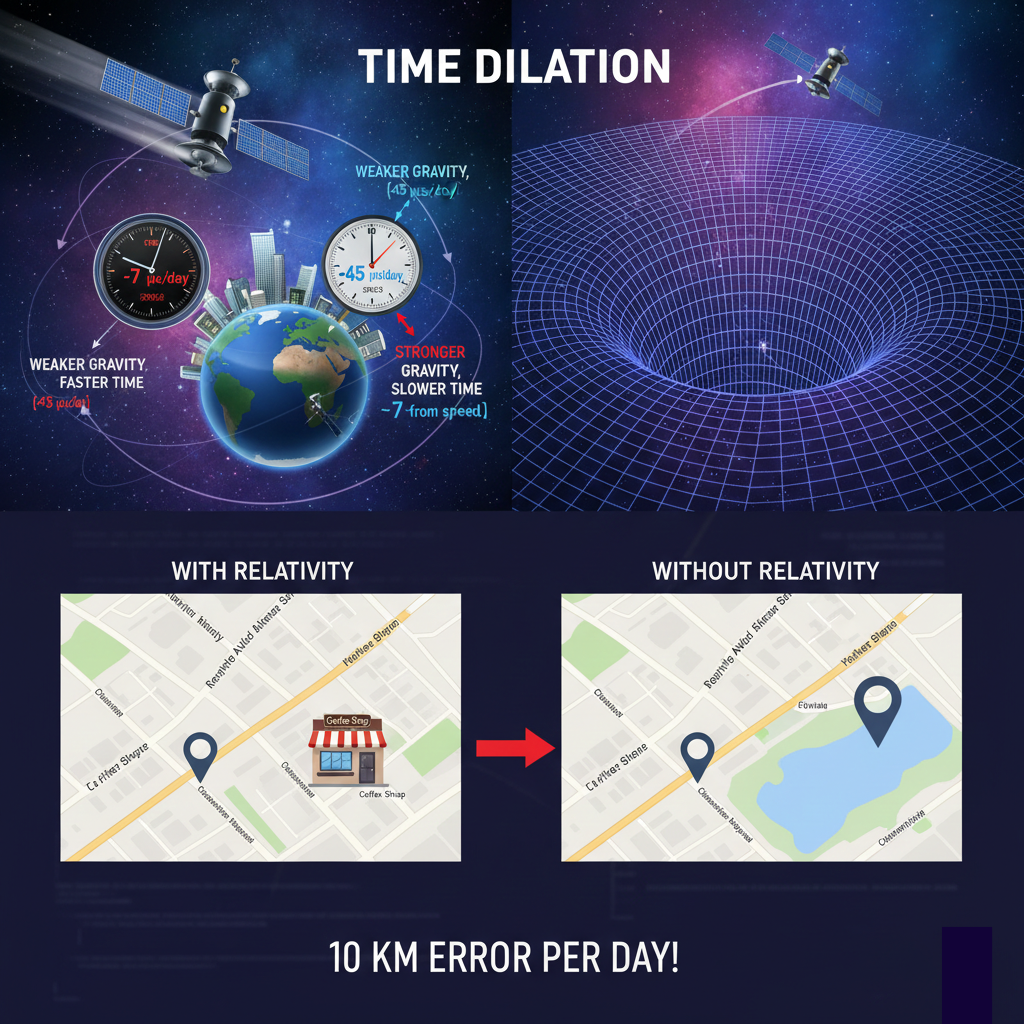
GPS satellites are whizzing around the Earth at about 14,000 km/h. Because they are moving so fast, their onboard atomic clocks actually fall behind clocks on the ground by about 7 microseconds every day. It sounds tiny, but for a signal traveling at the speed of light, a 7-microsecond error translates into a navigation mistake of over 2 kilometers.
2. General Relativity: Gravity Speeds Up Time
But wait, it gets weirder. Ten years later, Einstein published General Relativity, explaining that gravity warps space and time.
The further you get from a massive object (like the Earth), the weaker gravity is, and the faster time passes. The GPS satellites are perched 20,000 kilometers above us. Up there, gravity is much weaker than it is at sea level. Because of this, the satellite clocks actually tick faster than clocks on Earth by about 45 microseconds per day.
The Verdict: A Fatal Drift
If we do the math (45 – 7), the satellite clocks are gaining a net total of 38 microseconds every single day.
If engineers didn’t account for this, the location errors would accumulate at a rate of 10 kilometers (about 6 miles) per day. Within 24 hours, your GPS would tell you that you’re in the next town over when you haven’t even left your driveway.
The Solution is in the Chip
To fix this, engineers don’t just “reset” the clocks manually. They actually program the satellite’s atomic clocks to tick slightly slower before they are even launched. This way, once they are in orbit and the effects of speed and gravity kick in, they tick at the exact same frequency as the clocks in our phones.
It’s a stunning proof that even the most “abstract” science eventually becomes a tool for the masses. Einstein wasn’t trying to build a navigation tool; he was trying to understand the fabric of the universe. Yet, without his insights into the nature of time, we would all be literally lost.
Next time your GPS tells you to “turn left in 200 feet,” give a little mental nod to Albert. He did the heavy lifting over a century ago.
