
Does space go on forever, or does it eventually loop back on itself? We dive into the latest evidence from cosmology to see if the universe has an edge.
I was standing in a dark field last summer, looking up at the Milky Way, when that classic childhood question hit me again. It’s the one we all ask before we learn about taxes or mortgage rates: Does this thing ever end?
If you walk far enough in one direction on Earth, you eventually end up right back where you started because the planet is a sphere. But if you pointed a rocket ship toward the stars and just kept the engines running, would you eventually hit a wall? Would you loop back around like a character in a video game? Or would you just keep going into a cold, dark “forever”?
For centuries, this was a question for philosophers. But today, thanks to massive telescopes and the echoes of the Big Bang, cosmologists actually have some data to work with. Here is what we know (and what we’re still losing sleep over) regarding the size of the cosmos.
The “Observable” Trap
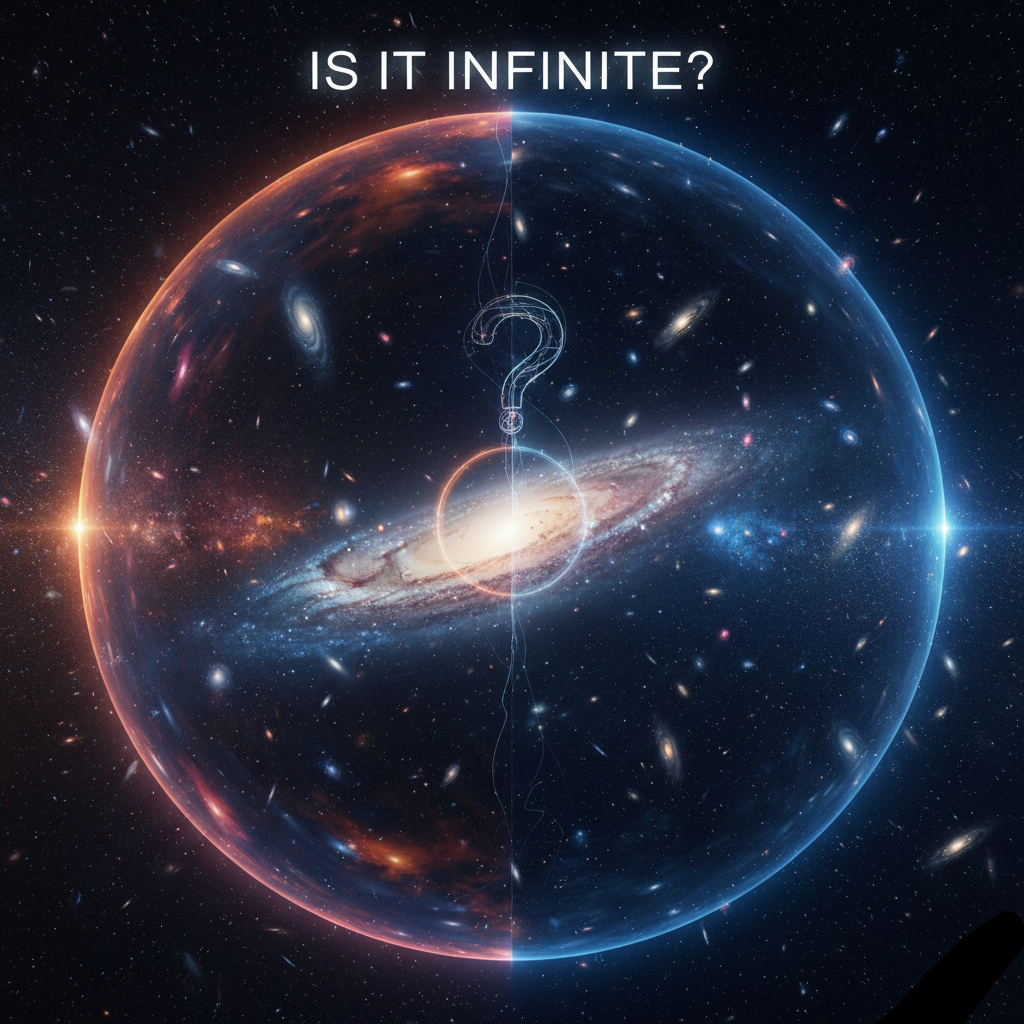
Before we can talk about whether the universe is infinite, we have to clear up a common misunderstanding. When you hear an astronomer say the universe is 93 billion light-years across, they aren’t talking about the whole thing. They are talking about the Observable Universe.
Think of yourself as standing in a fog. You can only see a certain distance in every direction before the light can’t reach your eyes. Because the universe has a starting point (the Big Bang) and light travels at a fixed speed, we can only see the parts of space whose light has had enough time to reach us in the last 13.8 billion years. Everything beyond that “horizon” is currently invisible to us. It’s not that there’s nothing there; it’s just that the news from those distant regions hasn’t arrived yet. So, the real question isn’t about the bubble we can see, it’s about what lies beyond the fog.
The Shape of Space: Flat, Round, or Pringled?
To figure out if the universe is infinite, scientists look at its geometry. In Einstein’s world, space isn’t just an empty stage; it’s a fabric that can be bent and warped by gravity. There are three main possibilities for the “shape” of the universe:
- Closed (The Sphere): If there is enough matter and energy, gravity would curve space back on itself. This universe is finite. If you flew long enough, you’d see the back of your own head.
- Open (The Saddle): If there’s too little matter, space curves outward. This universe would be infinite and shaped roughly like a Pringle potato chip.
- Flat (The Paper): This is the “Goldilocks” version. Space has just enough density to remain perfectly flat, extending forever in all directions.
How do we check this? We look at the Cosmic Microwave Background (CMB), the “afterglow” of the Big Bang. By measuring the size of the spots in this ancient light, we can determine if the light rays have traveled in straight lines (flat), converged (closed), or diverged (open).
Current data from the Planck satellite suggests the universe is flat with an incredibly small margin of error (about 0.4%). A flat universe is, mathematically speaking, usually an infinite one.
The “Pac-Man” Universe
Now, here is where it gets a little weird. Just because space is flat doesn’t strictly mean it’s infinite.
Imagine a sheet of paper. It’s flat. But if you roll it into a cylinder, it’s still “locally” flat, yet now it has a finite circumference. If you go a step further and connect the ends of the cylinder, you get a torus, a donut shape.
In a “donut” universe, the geometry looks flat to an observer, but the space is actually finite and connected. If we lived in a universe like this, we might be able to see multiple copies of the same galaxy in different parts of the sky. So far, we haven’t found any “ghost images” of our own Milky Way, which suggests that if the universe does loop back on itself, the “loop” is much larger than the 93 billion light-years we can see.
Why “Infinite” is Hard to Wrap Our Heads Around
If the universe is truly infinite, the implications are, frankly, exhausting.
In an infinite universe, every possible arrangement of matter must occur an infinite number of times. That means there would be another version of you out there reading this exact sentence, and another version of you who decided to skip this article and become a professional kite-surfer instead.
Most physicists lean toward the “infinite” side because it simplifies the math. As soon as you have a “finite” universe, you have to explain why it’s that specific size and not some other size. If it’s infinite, it just is.
The Expanding Mystery
There is one final twist: Dark Energy. We know the universe is expanding, and that expansion is accelerating.
If the universe is finite, it’s like a balloon being blown up. If it’s infinite, it’s like an infinite rubber sheet being stretched. In both scenarios, the galaxies are getting further apart. But because the expansion is happening so fast, light from distant regions will eventually never be able to reach us.
In the far future, our “Observable Universe” will actually shrink. The fog will move closer. We will be left in a lonely island of stars, unable to see any other galaxies, wondering, once again, if there is anything else out there.
Also read: The Ultimate Prequel: What Happened Before the Big Bang ?
Final Thoughts
Whether the universe ends at a trillion miles or goes on for eternity doesn’t change how we live our daily lives. But there is something deeply human about wanting to know the boundaries of our home.
Is the universe infinite? The honest, scientific answer is: We don’t know for sure, but it’s looking pretty likely. Most of our current models point toward a flat, never-ending expanse. However, we are limited by our “fog.” We are like ants on a carpet trying to figure out if the house ever ends, without being able to see past the sofa.
Perhaps the most beautiful thing about cosmology isn’t the answers it gives us, but the way it forces us to expand our own internal boundaries. We are a tiny species on a small rock, using math and glass to weigh the entire cosmos. Finite or infinite, that’s a pretty big achievement.

One thought on “Is the Universe Infinite? What Modern Cosmology Actually Tells Us”