

How do we measure the age of the universe? Explore the science of the Big Bang, the expansion of space, and the clues left behind in the stars.
The Greatest Clock Ever Made
Have you ever stood under a truly dark sky, the kind where the Milky Way looks like a spilled bucket of silver glitter, and felt that strange, humbling sense of scale? It’s natural to wonder how long all of this has been spinning.
For most of human history, the age of the universe was a matter of philosophy or intuition. But in the last century, we’ve transitioned from guessing to measuring. We’ve become cosmic detectives, piecing together a story that spans billions of years.
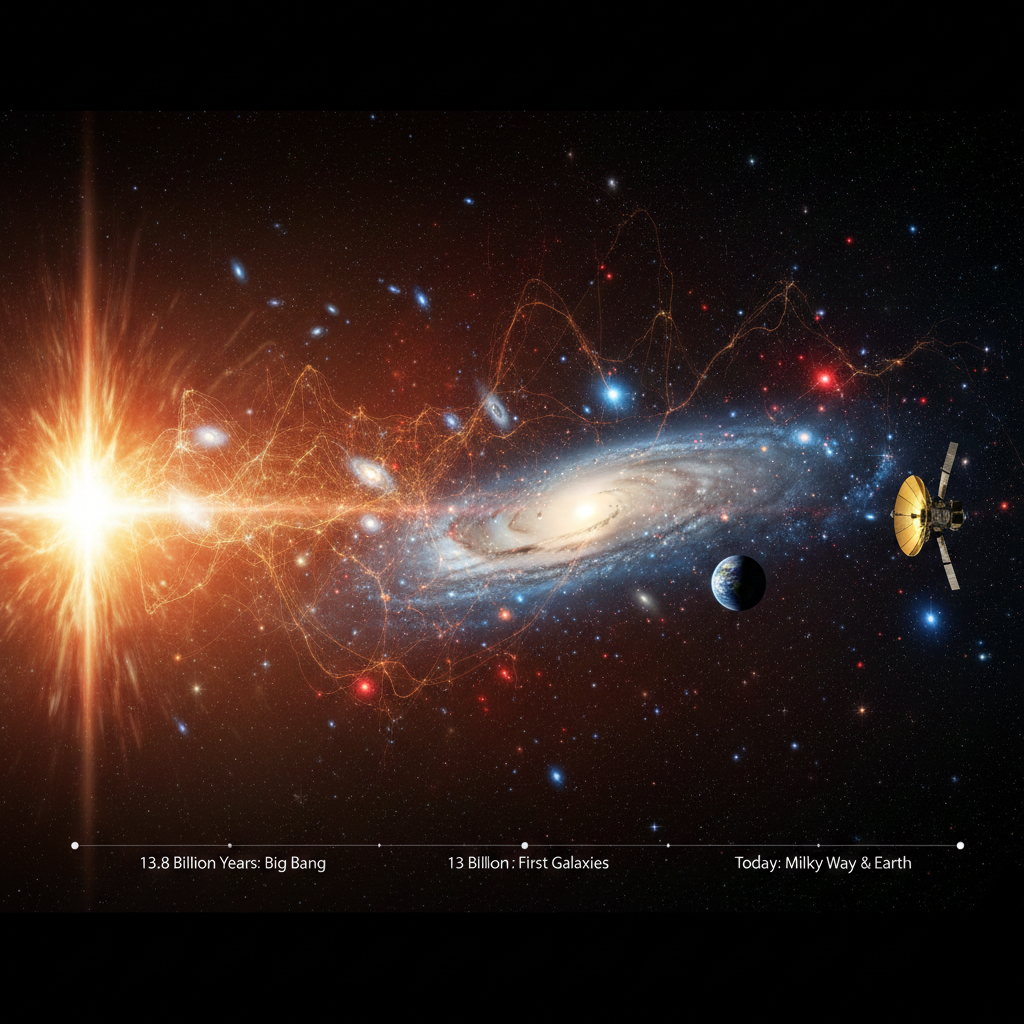
Today, the scientific consensus is that the universe is approximately 13.8 billion years old. But how on earth (or off it) did we arrive at that specific number? It wasn’t a single “Eureka!” moment. Instead, it was the result of two very different lines of evidence, like two witnesses at a trial, that ended up telling the exact same story.
The Expanding Balloon
The first major clue came in the 1920s, thanks to an astronomer named Edwin Hubble. Before Hubble, most people (including Albert Einstein, initially) thought the universe was static, unchanging and eternal.
Hubble noticed something strange: distant galaxies weren’t just sitting there. They were moving away from us. Even more fascinating, the farther away a galaxy was, the faster it seemed to be retreating.
Imagine a balloon with dots drawn on it. As you blow air into the balloon, every dot moves away from every other dot. The space between them is growing.
The Logic of Rewinding:
If the universe is expanding today, what happens if we play the movie in reverse? If you backtrack that expansion, everything, every star, every planet, every atom, eventually converges into a single point of infinite density. By calculating the rate of this expansion (now known as the Hubble Constant), scientists can calculate how long it has been since that initial “Beginning.”
It’s a bit like seeing a car driving away from a city at 60 miles per hour. if the car is currently 60 miles away, you can reasonably conclude it left the city exactly one hour ago.
The Oldest “People” in the Neighborhood
The second line of evidence is a bit more grounded: we look at the objects inside the universe.
Think of it like trying to guess the age of a house. You might not know when the foundation was poured, but if you find a newspaper in the attic from 1950, you know the house is at least that old. In the cosmos, our “old newspapers” are globular clusters, tightly packed groups of ancient stars.
Stars are predictable. They burn fuel based on their mass, and because we understand the physics of fusion, we can tell how old a star is by its color and brightness. When we look at the oldest globular clusters, they consistently clock in at around 13 billion years.
It’s a beautiful bit of harmony: the “house” (the universe) is calculated to be 13.8 billion years old, and the “furniture” (the stars) is about 13 billion years old. The stars are slightly younger than the space they inhabit, which is exactly what you’d expect in a designed, orderly system.
The Echo of the Beginning
The most “solid” evidence, however, came from something totally accidental. In the 1960s, two researchers were bothered by a persistent background hiss in their radio antenna. They tried everything to fix it, even cleaning out pigeon droppings, but the noise wouldn’t go away.
They eventually realized they weren’t hearing interference; they were hearing the Cosmic Microwave Background (CMB).
This is essentially the “afterglow” of the creation event. Shortly after the universe began, it was a hot, dense soup of particles. As it expanded and cooled, light was finally able to travel freely. That “first light” is still traveling through space today, stretched out into microwave frequencies.
By mapping this light with incredible precision using satellites like Planck, scientists can see a “baby picture” of the universe. The patterns in this light allow us to determine the universe’s composition and its age with a margin of error of less than 1%.
A Precision Beyond Chance
What strikes many scientists and observers alike is how “fine-tuned” these numbers are. If the expansion rate were just a fraction faster, galaxies would have never formed; the universe would be a thin, cold mist. If it were a fraction slower, the whole thing would have collapsed back in on itself long ago.
When we look at the age of 13.8 billion years, we aren’t just looking at a dry statistic. We are looking at the timeline of a masterpiece. To a person of faith, these measurements don’t replace the Creator; they reveal the scale of the “canvas” He used. Science describes the how and the when, while our hearts continue to ponder the why.
Also read: The Big Bang’s Big Secret: Why the Universe Pulled a Cosmic Sprint.
The Weight of Time
It is hard for the human mind to grasp what 13.8 billion years actually means. If the entire history of the universe were compressed into a single calendar year, the first modern humans wouldn’t show up until December 31st, at about 11:52 PM.
We are, in many ways, newcomers to a very old and very grand story. Knowing the age of the universe doesn’t make it feel smaller or less mysterious. If anything, knowing that we live in a universe with a definitive beginning makes our existence feel less like an accident and more like an invitation to explore.
We are living in a moment of history where we can finally look back at the dawn of time and say, with some measure of certainty, “This is how long the light has been traveling to reach us.”
