
Is the universe infinite or does it curve back on itself? Explore the mind-bending science behind the cosmic topology and what it means for our place in the stars.
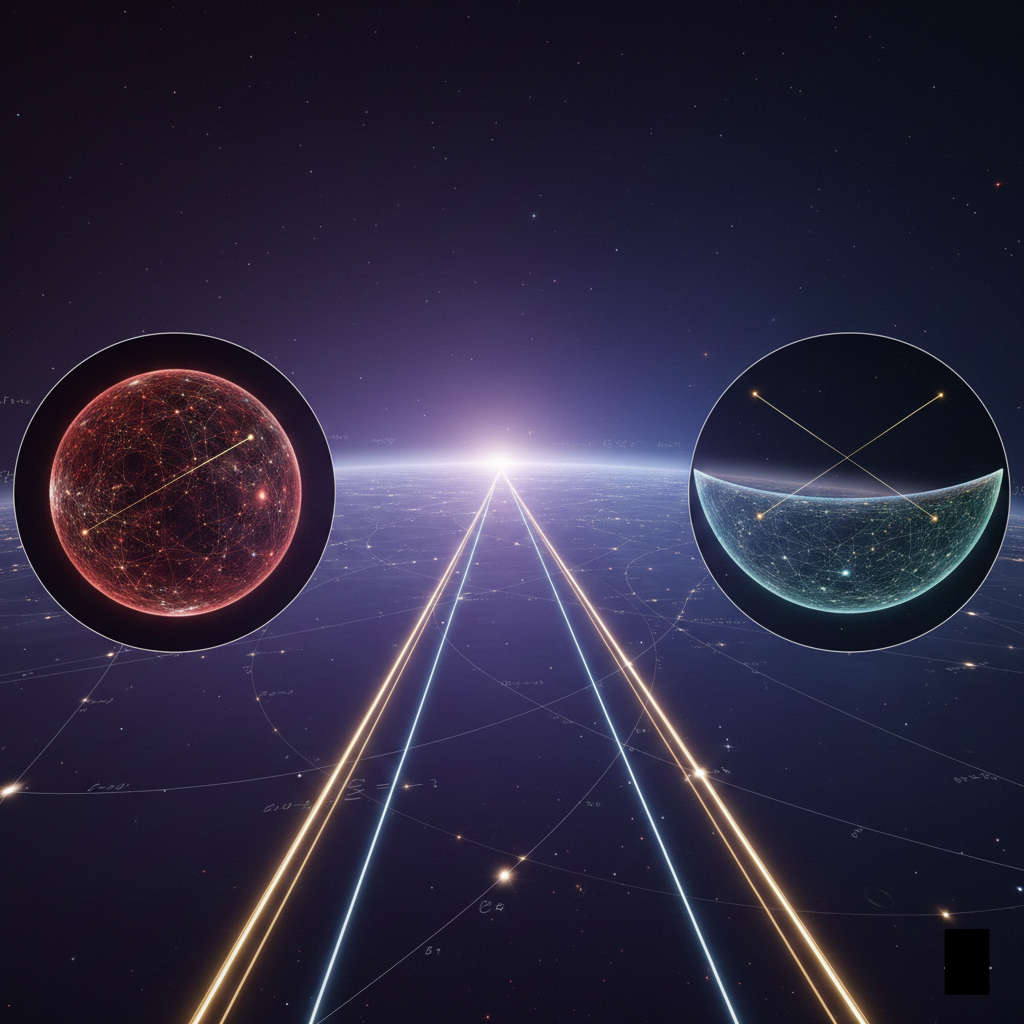
Close your eyes for a moment and try to imagine “everything.” Not just the Earth, or the solar system, but the entire physical reality, the vast, glittering tapestry of galaxies stretching out into the dark. Now, ask yourself a question that has kept astronomers up at night for centuries: Does that tapestry have an edge? Does it curve like a ball, or is it as flat as a tabletop?
When we talk about the “shape” of the universe, we aren’t just engaging in a fun mental exercise. We are asking about the very blueprint of existence. Understanding this shape tells us whether the universe will expand forever or eventually collapse, and whether it is finite or truly infinite.
The Three Great Possibilities
In the world of cosmology, the shape of the universe is tied to something called “curvature.” Einstein’s General Relativity tells us that mass and energy warp the fabric of space-time. Therefore, the total amount of “stuff” in the universe determines its ultimate geometry. Generally, scientists look at three main candidates:
- The Closed Universe (Sphere): Imagine an ant crawling on a basketball. If the ant travels in a straight line long enough, it eventually ends up right back where it started. In a closed universe, space curves back on itself. If you pointed a powerful enough laser into the distance, the light would eventually hit you in the back of the head.
- The Open Universe (Saddle): This one is harder to visualize. Picture a Pringle or a horse saddle. Here, space curves outward. In this scenario, parallel lines never meet; in fact, they fly away from each other. This universe would be infinite and would expand forever, getting colder and emptier as it goes.
- The Flat Universe (The Infinite Sheet): This is the “Goldilocks” version. Space has no major curvature. Parallel lines stay parallel forever, like tracks on an infinite railway. This doesn’t mean the universe is a 2D pancake; it means that Euclidean geometry, the kind you learned in high school, works perfectly even across billions of light-years.
How Do You Measure the Sky?
You might wonder how we could possibly know the shape of something we are stuck inside of. We can’t exactly step outside the universe and take a photo. Instead, cosmologists look at the “fossil light” left over from the Big Bang, known as the Cosmic Microwave Background (CMB).
Think of the CMB as a giant wallpaper covering the entire sky. It’s filled with tiny fluctuations in temperature, hot and cold spots. By measuring the size of these spots, scientists can perform a bit of cosmic trigonometry.
If the spots appeared larger than our models predicted, it would suggest a “closed” universe (the curvature acting like a magnifying lens). If they looked smaller, it would suggest an “open” universe. But when the Planck satellite and other missions mapped this light with incredible precision, they found something startling: the spots were exactly the right size.
The Verdict: Surprisingly Flat
According to our best current measurements, the universe is flat. And not just “sort of” flat, it’s flat with a margin of error of about 0.4%.
This is actually a bit of a head-scratcher for physicists. For the universe to be this flat, the density of matter and energy had to be at a very specific “critical density” at the moment of the Big Bang. If there had been just a tiny bit more matter, we’d be in a sphere; a tiny bit less, and we’d be on a saddle. This precision is what scientists call the “Flatness Problem,” and it’s one of the reasons many believe in a theory called Inflation, which suggests the universe expanded so rapidly in its first fraction of a second that any curves were stretched out flat, like the surface of a balloon being blown up to the size of a galaxy.
The “Donut” Twist: Topology vs. Geometry
Here is where it gets really interesting, and where your brain might start to itch. Just because space is geometrically flat doesn’t mean it’s an infinite sheet.Think of a piece of paper. It’s flat. But if you roll it into a cylinder, the paper is still “flat” in terms of its geometry (parallel lines still stay parallel), but its topology has changed. If you join the ends of that cylinder, you get a torus, a donut shape.
A “3-Torus” universe would be flat to our instruments, but finite in size. If you traveled far enough in one direction, you’d wrap around and come back to your starting point. While we haven’t found definitive proof of this “wrapping” yet, it remains a tantalizing possibility that the universe is a finite, interconnected loop.
Why Does It Matter?
Why do we spend billions of dollars and decades of research trying to figure out if we’re on a cosmic saddle or a cosmic donut? Because the shape of the universe is a map of its destiny.
A flat universe suggests a reality that is vast, perhaps infinite, and destined to expand forever. It speaks to a profound balance in the laws of nature, a “just right” quality that allowed galaxies and stars to form in the window between a rapid collapse and a chaotic scattering.
Also read : Beyond the Horizon: Why Science is Seriously Considering the Multiverse.
A Final Reflection
As we look up at the night sky, it’s easy to feel small. But there is something deeply moving about the fact that a collection of atoms like us, walking, talking pieces of the universe, can look back at the cosmos and begin to decipher its shape.
Whether the universe stretches out forever as an infinite flat plane or loops back in a magnificent, hidden curve, we are part of a structure of unimaginable scale and order. We may never see the “edge,” but the very fact that we can ask where it is, and find answers in the ancient glow of the stars, is perhaps the greatest mystery of all.

One thought on “Flat, Round, or a Giant Donut? Unlocking the Mystery of the Universe’s Shape”