

Is our universe just one of many? Explore the scientific theories behind the multiverse, from cosmic inflation to quantum mechanics, and what it means for our place in the grand design.
Close your eyes for a second and imagine the night sky. Even without a telescope, the sheer scale of what we can see is staggering. We’re looking at billions of stars in a single galaxy, which is just one of trillions in an observable universe spanning 93 billion light-years. For most of human history, that was “everything.” The universe was the sum total of existence.
But lately, a strange idea has moved from the pages of science fiction into the chalkboards of serious physics departments: the Multiverse.
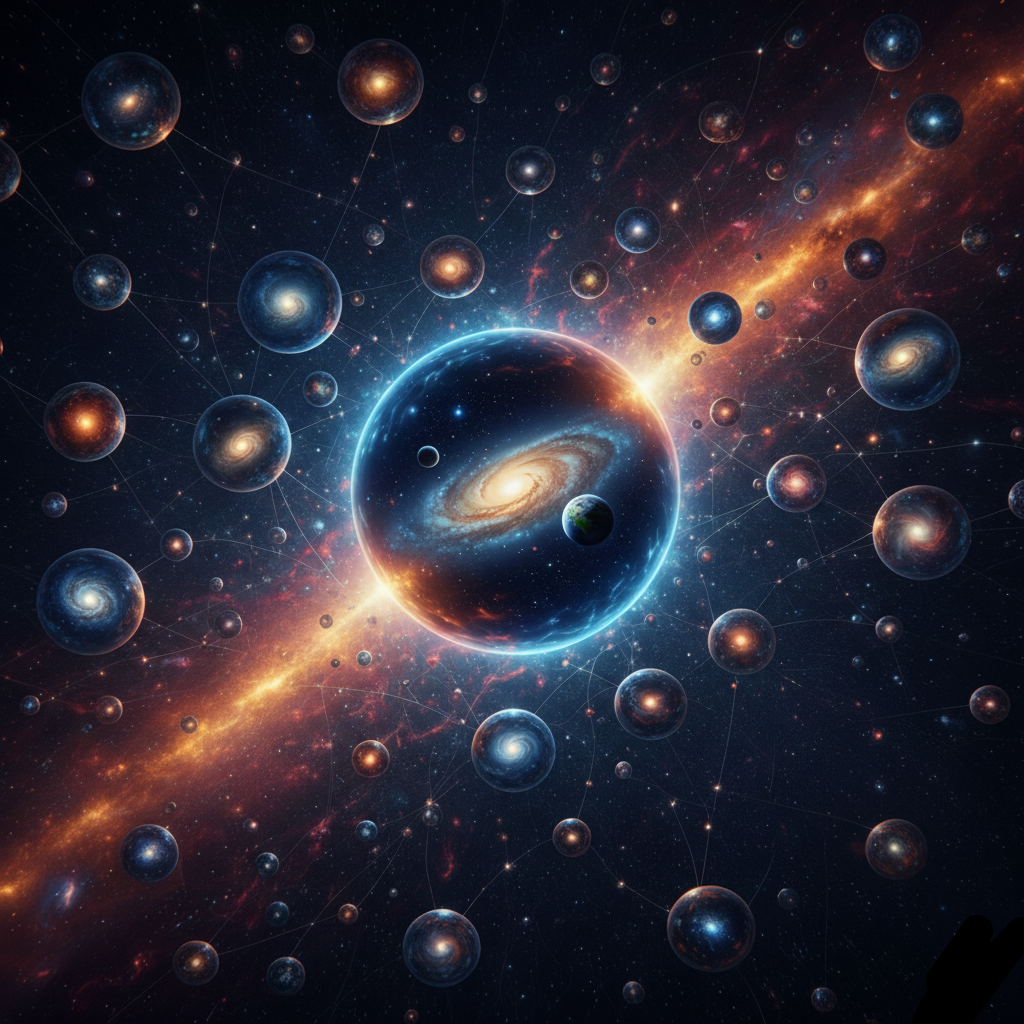
The suggestion isn’t just that the universe is big; it’s that our entire universe, everything we have ever seen or could ever see, might be just one small bubble in a vast, foaming ocean of other universes. To some, it sounds like a cosmic headache. To others, it feels like the next logical step in our journey to understand the grand architecture of creation.
The “Balloon” Problem: Eternal Inflation
To understand how we got here, we have to look at the beginning. Most of us are familiar with the Big Bang, but the Big Bang had a “prequel” called inflation.
In the earliest fractions of a second, the universe underwent a massive, faster-than-light growth spurt. Think of it like a piece of dough doubling in size every trillionth of a second. This explains why our universe looks so uniform today.
However, the math suggests that inflation might not be a one-time event. Instead of the whole “dough” stopping its expansion at once, different pockets might stop at different times. While our pocket slowed down and formed stars and galaxies, the space around us kept inflating, eventually spawning other “bubbles.”
In this scenario, we live in one bubble among an infinite sea of others, each potentially drifting away from us forever. It’s a bit humbling to think that our entire reality might just be a single steam vent in a much larger cosmic kitchen.
The Fine-Tuning Mystery
One of the most compelling reasons scientists take the multiverse seriously isn’t just about the math of the Big Bang, it’s about how “lucky” we seem to be.
Physics is governed by a set of fundamental constants. For example, there is a specific strength to gravity and a specific mass for an electron. If you changed these numbers by even a fraction of a percentage, the results would be catastrophic.
- If gravity were slightly stronger, the universe would have collapsed back on itself long ago.
- If it were slightly weaker, stars would never have ignited.
Everything is tuned to a “Goldilocks” level that allows for complexity and life. In the scientific community, the multiverse is often proposed as a physical explanation for this luck. If there are infinite universes with infinite variations of these constants, it becomes a mathematical certainty that at least one of them, ours, would have the right conditions for us to exist and marvel at it.
Read more about fine-tuning here.
The Quantum “Many Worlds”
If the “bubble” theory sounds too much like outer space, the quantum version of the multiverse happens right in your living room.
In the world of the very small (atoms and subatomic particles), things don’t like to sit still. A particle can technically exist in several places at once, a state called superposition, until it is observed or interacts with its environment.
The “Many Worlds Interpretation” suggests that the universe doesn’t actually “choose” one outcome. Instead, it branches. Every time a quantum event occurs, reality splits. It’s a dizzying thought: a version of reality where every possibility is accounted for. While this sounds like the plot of a superhero movie, it is a mathematically consistent way of reading the laws of quantum mechanics that govern our world.
Why We Can’t Just “Go There”
The biggest frustration with the multiverse theory is that it is, by definition, almost impossible to prove. These other universes are likely “causally disconnected” from us. Light from a neighboring bubble universe can’t reach us because the space between us is expanding too fast.
It’s like being in a house with no windows and trying to prove there’s a neighborhood outside. We can look at the “walls” of our universe, the Cosmic Microwave Background radiation, for bruises or cold spots that might indicate a collision with another universe in the distant past. So far, the evidence is tantalizing but inconclusive.
A Grand Design?
Whenever I talk about the multiverse, people often ask: “Doesn’t this make our world feel less special?”
I actually think it’s the opposite. Whether we live in a single universe or a sprawling multiverse, the fact that we are here, conscious, breathing, and capable of even asking these questions, is a miracle of the highest order.
If there is a Creator behind the scenes, a multiverse doesn’t diminish that power; it expands the canvas. It suggests a reality far more lush, complex, and teeming with possibility than we ever dared to dream. Just as we once learned that the Earth wasn’t the center of the solar system, and the Sun wasn’t the center of the galaxy, we may be learning that our universe is just one verse in a much larger, more magnificent song.
Also read: How Old is the Universe? The Incredible Detective Work Behind the Age of Creation.
Reflection
The multiverse remains a frontier. It sits right on the edge where physics meets philosophy. We may never be able to build a ship to visit another bubble, but the fact that our minds can conceive of them says something remarkable about the human spirit. We aren’t just observers of the universe; we are participants in a story that might be infinitely larger than we ever imagined.

One thought on “Beyond the Horizon: Why Science is Seriously Considering the Multiverse”